


“They received the word with all eagerness, examining the Scriptures daily to see if these things were so.” Acts 17:11
“Ezra had set his heart to study the Law of the LORD, and to do it and to teach his statutes and rules in Israel.” Ezra 7:10
Introduction: Every Christian Is an Interpreter
The moment you open a Bible and ask, “What does this mean?” you have become an interpreter. There is no way around it. The only question is whether you will interpret well or badly. Nobody reads the Bible without a method. Some people simply never notice theirs.
Most of us have seen what bad interpretation looks like. A verse is pulled out of a letter and stuck on a coffee mug, and it ends up promising something God never promised. A preacher builds a whole sermon on one word and gets the word wrong. A friend says, “Well, that’s just your interpretation,” as if every reading were as good as every other. Peter saw it happening in the first century. Of Paul’s letters he wrote, “There are some things in them that are hard to understand, which the ignorant and unstable twist to their own destruction, as they do the other Scriptures” (2 Pet. 3:16). The verb for “twist” is the word for wrenching a limb on a rack. You can make the Bible scream almost anything if you are willing to torture it.
The cure for bad interpretation is good interpretation, and God has not left us to guess what that looks like. The Bible itself shows us how it wants to be read. The prophets read earlier Scripture with care: Daniel, in exile, “perceived in the books” that Jeremiah had promised seventy years (Dan. 9:2), and it drove him to prayer. Jesus argued from the exact wording of a verse. Paul reasoned in the synagogues “from the Scriptures” (Acts 17:2). The Bereans checked even the apostle’s preaching against the text, and Luke calls them noble for it (Acts 17:11).
This study is built for new believers, and for anyone who has never been taught how to study. We will go in a deliberate order, because the order matters. First the posture: how to come to the Book. Then the foundation: why the Bible can be read logically at all. Then the tools: reasoning, the author’s meaning, context, and Scripture interpreting Scripture. Then the common errors to watch for. Then the method, step by step, with a flowchart and a checklist you can print and keep in your Bible. And finally the purpose, because the goal of Bible study was never information. It was always a Person.
Underneath all of it is one conviction the Reformers fought for and the Westminster Confession of Faith (a 1640s summary of what Scripture teaches, still used by Presbyterian churches; “WCF” from here on) put into words: “The infallible rule of interpretation of Scripture is the Scripture itself” (WCF 1.9). The Bible defines the Bible. Our job is to let it.
The Word: Cutting It Straight
Paul is writing his last letter. He is in a Roman prison, and he knows he is about to die (2 Tim. 4:6). Timothy is left in Ephesus to lead a church where false teachers are spreading. Paul names two of them a few verses later: Hymenaeus and Philetus, “who have swerved from the truth, saying that the resurrection has already happened. They are upsetting the faith of some” (2:17–18). Their error was a bad reading of a true doctrine. They took the resurrection, which the apostles taught, and bent it. And it wrecked people’s faith. So Paul tells Timothy to be a different kind of worker. Here is the word he uses:
Keep that straight line in mind for the rest of this study. Every tool we are about to pick up has one purpose: to help you follow the line the Author drew, instead of drawing your own.
Part One: The Posture Before the Method
Before you pick up a single tool, settle what kind of book you are holding. If the Bible were only a collection of ancient religious writings, the best you could do is study what some people once believed about God. But that is not what it claims to be.
“Breathed out by God.” Scripture is God speaking. Peter adds how it happened: “No prophecy was ever produced by the will of man, but men spoke from God as they were carried along by the Holy Spirit” (2 Pet. 1:21). Real men wrote, in their own languages and styles. God carried them along so that what they wrote is what he said. Two things follow for how we read.
First, we come to listen, not to sit in judgment. We do ask hard questions of the text, and we should. But the text has authority over us. We do not have authority over it. The Westminster Larger Catechism describes the right posture well. It says Scripture is to be read “with an high and reverent esteem of them; with a firm persuasion that they are the very Word of God, and that he only can enable us to understand them; with desire to know, believe, and obey the will of God revealed in them; with diligence, and attention to the matter and scope of them; with meditation, application, self-denial, and prayer” (WLC 157). Read that slowly. Notice “attention to the matter and scope of them.” The Westminster theologians meant the content and the purpose of a passage, and much of this study is about exactly that.
Second, we need help we cannot supply ourselves. “The natural person does not accept the things of the Spirit of God, for they are folly to him, and he is not able to understand them because they are spiritually discerned” (1 Cor. 2:14). The problem Paul names is not low intelligence. Brilliant people have read the Bible, followed every sentence, and still seen nothing worth having in it. Paul is not saying an unbeliever cannot follow the grammar. He is saying the natural person will not receive it as true and good, and so cannot understand it savingly. The problem is a heart that does not want what God says. So the first tool of interpretation is prayer. The Psalmist prayed, “Open my eyes, that I may behold wondrous things out of your law” (Ps. 119:18). On the road to Emmaus, Jesus walked two disciples through Moses and all the Prophets (Luke 24:27). That same night in Jerusalem, Luke says, “he opened their minds to understand the Scriptures” (Luke 24:45).
John Calvin has a picture for what Scripture does for us. He compared us to old people with failing eyes who can hardly make out two words on a page, until someone hands them glasses. Then they read clearly. Scripture, he said, “gathering together the impressions of Deity, which, till then, lay confused in our minds, dissipates the darkness, and shows us the true God clearly” (Institutes 1.6.1). The Bible is the lens. The Spirit is the one who puts it on your face.
One guardrail here, so prayer does not become a shortcut. The Spirit illumines the Word. He does not replace it. Praying over a verse and then deciding it means whatever came into your head is not illumination. The Confession is careful on this point. Nothing is “at any time to be added, whether by new revelations of the Spirit, or traditions of men,” and yet the Spirit’s inward illumination is “necessary for the saving understanding” of what is in the Word (WCF 1.6). The Spirit opens your eyes to what is on the page. He does not whisper a second meaning that is not there. So pray, and then do the work.
Also read: Psalm 19:7–11; 119:18, 105, 130; Luke 24:25–27, 44–45; John 16:13–14; 1 Corinthians 2:10–16; 2 Peter 1:19–21
Part Two: A God Who Reasons
Here is a question most Christians never think to ask: why should the Bible make sense at all? Why should we expect one part of it to agree with another, or a sentence to mean the same thing on Tuesday that it meant on Monday? The answer goes all the way down to who God is.
John is echoing the first page of the Bible: “In the beginning, God created… And God said” (Gen. 1:1, 3). The Word is the God who speaks. The Greek for “Word” is logos, which could also mean reason or account, and our word “logic” comes from it. We should not make a word mean everything it can mean (we will meet that mistake in Part Seven). But the God who speaks is a God who speaks sense, and the Christian philosopher Gordon H. Clark, whose textbook Logic stands behind this part of the study, pressed the point hard. He argued that logic is not a rule outside God that God must obey, and it is not a human invention either. It is the way God himself thinks. Speaking of the most basic rule of logic, that nothing can be true and false at the same time, he put it in five words: “The law is God thinking.” And he drew the conclusion that matters for Bible study: “if God has spoken, he has spoken logically.”
Clark was not the first to see this. Augustine, writing on how to interpret Scripture around AD 400, said that “the science of reasoning is of very great service in searching into and unravelling all sorts of questions that come up in Scripture.” Then he went further: “the validity of logical sequences is not a thing devised by men, but is observed and noted by them that they may be able to learn and teach it; for it exists eternally in the reason of things, and has its origin with God” (On Christian Doctrine 2.31–32).
Scripture shows this in how God speaks. “Come now, let us reason together, says the LORD” (Isa. 1:18). The Hebrew verb there (yākaḥ) is courtroom language, the word for arguing a case before a judge. God does not bully his people. He lays out the evidence and makes his case, and then offers astonishing grace: “though your sins are like scarlet, they shall be as white as snow.” God also never lies (Titus 1:2), and it is “impossible for God to lie” (Heb. 6:18). That is a logical claim as much as a moral one. A God who cannot lie cannot say both “yes” and “no” to the same thing. Paul makes exactly that argument about his own preaching: “As surely as God is faithful, our word to you has not been Yes and No” (2 Cor. 1:18). And Jesus, settling an argument with his opponents, said simply, “Scripture cannot be broken” (John 10:35).
Three laws you already use
Behind Clark’s Logic, as behind every traditional logic text, stand what are called the three laws of thought. They sound abstract. You use all three every day without thinking about it. Here they are, with what each one means when you open your Bible.
The second law, non-contradiction, is the one that will save you the most grief. It means two true statements can never truly contradict each other in the same sense at the same time. So when two Bible passages seem to clash, logic tells you that at least one of your readings is wrong, and it sends you back to look harder. We will see exactly how that works in Part Six, including the “faith” example in the diagram.
Clark also warned that you cannot prove a rule for everyone from a handful of examples (logicians call that kind of reasoning induction). So one story in Scripture is not automatically a rule for every believer, and we will come back to that in Part Six.
A fair word on a family disagreement
You should know that Reformed Christians have argued about this. In the 1940s Gordon Clark and Cornelius Van Til, both conservative Presbyterians, clashed over how God’s knowledge relates to ours. Both believed logic is grounded in God. Van Til stressed that God is the Creator and we are creatures, so our knowledge is always a copy of his, never the original. On that view some teachings can look contradictory to us, and we believe them anyway, because the contradiction is only apparent: God sees how they fit even when we cannot. Clark answered that unless some truth we know is the same truth God knows, we do not really know anything, and an apparent contradiction is a call to compare Scripture with Scripture until we see how it fits. Each man was guarding something precious. Van Til guarded the majesty of a God whose thoughts are higher than ours (Isa. 55:8–9). Clark guarded the fact that God has truly spoken and we can truly understand him (Deut. 30:11–14). This study follows Clark on logic. It also confesses with both men that God is beyond our full understanding: “The secret things belong to the LORD our God, but the things that are revealed belong to us and to our children forever” (Deut. 29:29). Logic is the servant of revelation, never its master. It helps us read what God has said. It does not entitle us to demand what he has not.
Also read: Numbers 23:19; Isaiah 1:18; 55:8–11; John 1:1–14; 10:35; 17:17; 2 Corinthians 1:17–20; Titus 1:2; Hebrews 6:17–18
Part Three: Reasoning the Way Jesus and Paul Reasoned
If the Bible is logical, then reading it well means following its arguments the way its authors built them. The best teachers of this are Jesus and Paul themselves. Watch how they handle Scripture and you will see sound reasoning at work on almost every page.
Jesus argues from a verb tense. The Sadducees did not believe in the resurrection. They tried to trap Jesus with a riddle about a woman married seven times. He answered from the book of Exodus, which they accepted:
Lay the argument out and it is a clean syllogism (two statements that, put together, force a third). God is not the God of the dead, but of the living. God says, centuries after the patriarchs died, “I am the God of Abraham.” Therefore Abraham, Isaac, and Jacob are living. The whole argument rests on that present claim (Ex. 3:6). A covenant God is not the God of corpses. Jesus treated the precise wording of Scripture as reliable enough to carry the weight of a doctrine, and when the crowd heard it, “they were astonished at his teaching” (22:33). This is what the Westminster Confession means when it says the whole counsel of God is “either expressly set down in Scripture, or by good and necessary consequence may be deduced from Scripture” (WCF 1.6). Some truths are stated outright. Others follow necessarily from what is stated. The doctrine of the Trinity is the classic example. No single verse says “God is three persons in one essence,” but it follows necessarily from what many verses say.
Jesus argues from absurdity. When the Pharisees claimed he cast out demons by the power of Satan, Jesus showed that their position destroyed itself: “Every kingdom divided against itself is laid waste… And if Satan casts out Satan, he is divided against himself. How then will his kingdom stand?” (Matt. 12:25–26). Take their claim seriously, follow it out, and it collapses. Logicians call that a reductio ad absurdum, Latin for “reducing to absurdity.” Jesus never needed the Latin.
Paul argues in a chain. Some in Corinth were saying there is no resurrection of the dead. Paul does not simply contradict them. He follows their claim to where it leads. In the diagram below, P stands for the “if” part of a sentence and Q for the “then” part.
This is the logic Paul uses throughout his letters, and it is why words like “if,” “then,” “therefore,” and “for” matter so much. They are the joints of the argument. One of the best habits a new believer can build is this: every time you see a “therefore,” stop and ask what it is there for. It is pointing back at what came before. Romans 12:1 begins, “I appeal to you therefore, brothers, by the mercies of God.” The “therefore” rests on eleven chapters of grace. Skip it and you turn the gospel upside down, making obedience the way to earn mercy when Paul made it the response to mercy.
Paul did this in his preaching too. In Thessalonica, “Paul went in, as was his custom, and on three Sabbath days he reasoned with them from the Scriptures” (Acts 17:2). The verb (dialegomai) gives us “dialogue.” It means to argue a point back and forth. Peter tells every believer to be ready to do the same: “always being prepared to make a defense to anyone who asks you for a reason for the hope that is in you” (1 Pet. 3:15). The word for “reason” there is logos. The hope is not irrational. It has a reason, and you can give it.
Valid and invalid: how arguments go wrong
Clark’s Logic spends a good deal of time on the difference between a valid argument and a sound one, and it is worth learning. An argument is valid when the conclusion really follows from the premises (the statements you start from). It is sound when it is valid and the premises are true. You can have a perfectly valid argument with a false premise, and it can march you confidently to a false conclusion. So in Bible study you have to check both things: Is the premise actually what the text says? And does my conclusion actually follow from it?
Most of the reasoning in Scripture runs on “if… then” statements, and there are two right ways and two wrong ways to reason with them. The wrong ways feel right, which is what makes them dangerous. The second valid form is the one Paul just used in 1 Corinthians 15. Look at the two invalid examples below closely. In the first one, Scripture itself warns you about the error.
Deuteronomy 13 is a remarkable passage for this reason. God tells Israel that a prophet might arise and give a sign, “and the sign or wonder that he tells you comes to pass,” and then say, “Let us go after other gods.” Do not listen, says the LORD, “for the LORD your God is testing you” (Deut. 13:1–3). A sign that comes true does not prove a prophet is from God. The Bible is teaching its readers not to make the third mistake in the diagram, affirming the “then” (logicians call it affirming the consequent), long before anyone gave the mistake a name. The Bereans had the same instinct: test what you hear against the written Word.
Also read: Matthew 12:1–8; 22:41–46; Acts 17:2–3; 18:4; Romans 6:1–4; 1 Corinthians 15:12–20; Galatians 3:15–18; Hebrews 7:11–17
Part Four: One Meaning: the Author’s
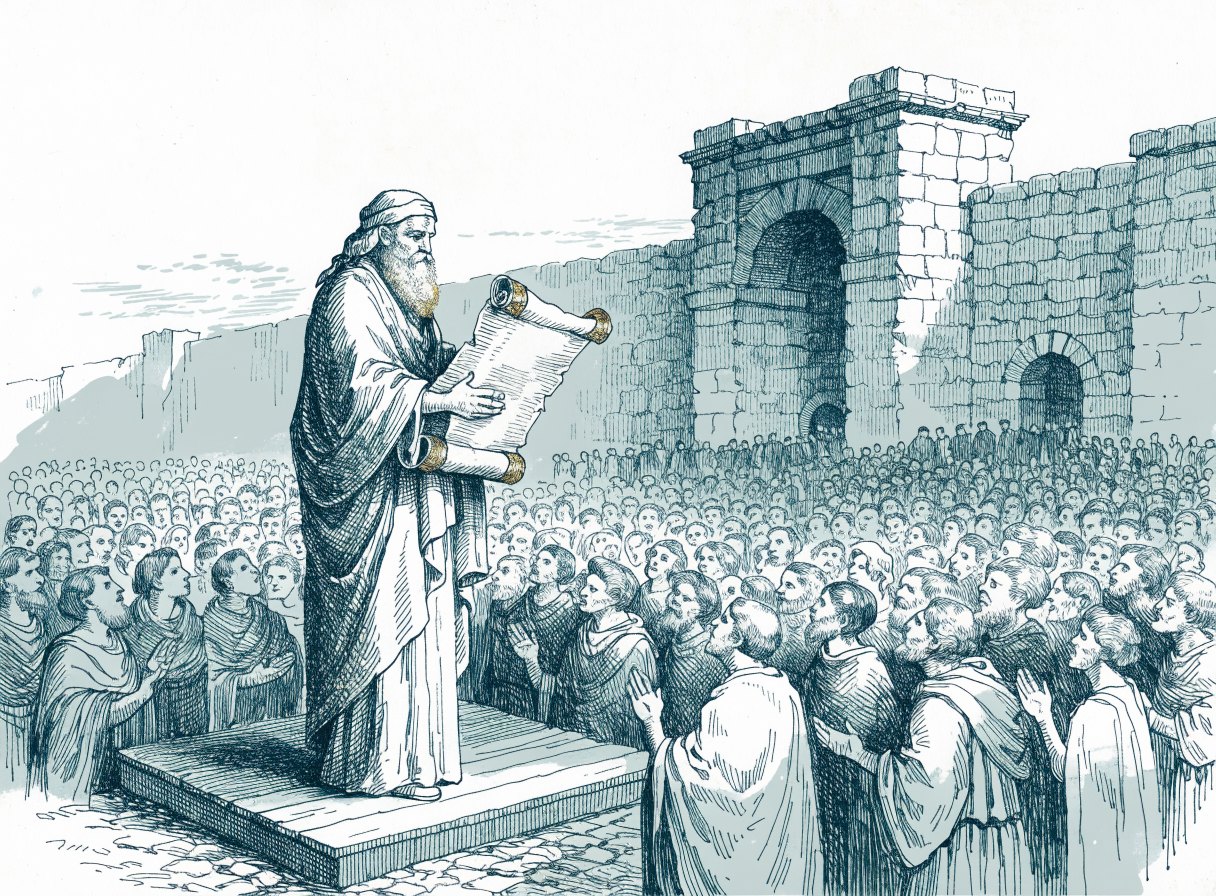
After the exile, the people of Jerusalem gathered in the square by the Water Gate and asked Ezra to bring out the Law. He stood on a wooden platform and read from early morning until midday, and the Levites moved among the people helping them understand. Nehemiah describes what they did: “They read from the book, from the Law of God, clearly, and they gave the sense, so that the people understood the reading” (Neh. 8:8). That one verse is a job description for every Bible teacher and every Bible student. Read it clearly. Give the sense. Make sure it is understood. And the result was weeping, then joy, then obedience (8:9–18).
“Gave the sense” assumes the text has a sense to give, one that was there before the reader arrived. This is the heart of what scholars call the grammatical-historical method: the meaning of a passage is what its author intended to communicate to his first readers, through the words and grammar he chose, in his historical setting. The Westminster Confession puts it in a short parenthesis that carries enormous weight. It speaks of “the true and full sense of any Scripture (which is not manifold, but one)” (WCF 1.9). One meaning. Not one for you and a different one for me.
That does not mean a passage has only one application. A single meaning can land in a thousand lives in a thousand ways. But the meaning itself is fixed, and every application has to grow out of it. Calvin said the interpreter’s first task is to stay with the author. In the dedication to his commentary on Romans he wrote that “it is almost his only work to lay open the mind of the writer whom he undertakes to explain.” The more a reader leads people away from the author’s meaning, Calvin went on, the further he wanders from his purpose.
Gordon Fee and Douglas Stuart, in their widely used How to Read the Bible for All Its Worth, give the principle a modern form that is easy to remember: a text cannot mean what it could never have meant to its original readers. If your reading would have made no sense to the Philippians or the exiles in Babylon, it is not the meaning of the text. This guards against a whole family of mistakes, including the very common one of reading the Bible as if it were written yesterday, to you, about your situation.
One caution keeps this rule in its place. God is the Author behind every human author, and the prophets themselves “searched and inquired carefully” about the Christ they were writing of (1 Pet. 1:10–12). So later Scripture can show the full depth of an earlier text. That is not a second meaning bolted on. It is the one meaning, seen in full, which is why the Confession speaks of the “true and full sense.” What no reader may do is invent a sense the rest of Scripture does not give.
This principle also corrects a famous misreading. People often quote 2 Peter 1:20, “no prophecy of Scripture comes from someone’s own interpretation,” to mean that ordinary believers are not allowed to interpret the Bible for themselves. But read the next verse: “For no prophecy was ever produced by the will of man, but men spoke from God” (1:21). Most commentators read Peter as talking about where prophecy came from, not about who may read it. The prophets did not make it up. R.C. Sproul, who taught a generation of Christians to study Scripture, gave the balance this way in Knowing Scripture: private interpretation gives you a license to interpret, not a license to distort.
Read it for what it is
One more piece belongs here. To find an author’s meaning, you have to know what kind of writing you are reading. Poetry, history, law, proverb, prophecy, parable, letter, and apocalyptic vision each communicate in their own way, and misreading the genre is one of the most common ways to miss the meaning. Sproul’s ten practical rules of interpretation include several that are about exactly this:
Also read: Nehemiah 8:1–12; Luke 1:1–4; John 20:30–31; 1 Corinthians 10:11; 2 Peter 1:19–21; Romans 15:4
Part Five: Context: the Circles Around Every Verse

If the author’s meaning is the target, context is the map that gets you there. Augustine’s advice for a difficult passage, sixteen hundred years ago, was simply this: “it remains to consult the context, both what goes before and what comes after” (On Christian Doctrine 3.2). It is still the best place to start.
J.I. Packer described three layers of context. Every text has an immediate context in its own passage, a broader context in its book, and, in his words, “its ultimate context in the Bible as a whole.” Add the history around the text and its place in the unfolding story of redemption, and you get a picture like this:
Work from the inside out. Read the verse carefully. Then read the paragraph it sits in, and ask what the author is arguing or narrating. Then step back to the book: who wrote it, to whom, and why? Then ask where it falls in the story of redemption. Is this before Christ or after? Is it law given to Israel in the land, or a letter to a Gentile church? Finally, ask what the whole Bible teaches on the subject. The testament-and-covenant circle matters more than new readers expect. Jesus himself said all of Scripture points to him: “beginning with Moses and all the Prophets, he interpreted to them in all the Scriptures the things concerning himself” (Luke 24:27). Every passage has a place on that road.
Here is what happens when you skip the circles. These four verses are among the most quoted in the Bible, and among the most often misread.
1Jeremiah 29:11
“For I know the plans I have for you, declares the LORD, plans for welfare and not for evil, to give you a future and a hope.” (Jeremiah 29:11)
The verse just before it says, “When seventy years are completed for Babylon, I will visit you” (29:10). Jeremiah is writing to people who have just been dragged into exile, and he is telling them to settle in, build houses, plant gardens, and pray for the city, because they are not going home soon (29:4–7). Many of the adults reading that letter would die in Babylon. The promise is real, and it does reach us, because God’s faithfulness to his covenant people runs all the way to Christ. But it is a promise of faithfulness through a long hardship, not a promise that the hardship will skip you.
2Philippians 4:13
“I can do all things through him who strengthens me.” (Philippians 4:13)
Read the two verses before it: “I have learned, in whatever situation I am, to be content. I know how to be brought low, and I know how to abound… facing plenty and hunger, abundance and need” (4:11–12). Paul is writing from prison. The “all things” he can do through Christ includes going hungry. The verse is the secret of contentment, and that is a far better gift than success.
3Matthew 18:20
“For where two or three are gathered in my name, there am I among them.” (Matthew 18:20)
The paragraph is about church discipline: going to a brother privately, then with “one or two others” as witnesses, then telling it to the church (18:15–17). The “two or three” echoes the witnesses required by the law (Deut. 19:15). Verse 19 does mention prayer, but it is prayer about this very case of discipline. Jesus is promising his authority and presence to the church as it does this hard work. He is present with his people in many ways. This verse is about one specific way.
4Isaiah 28:10
“For it is precept upon precept, precept upon precept, line upon line, line upon line, here a little, there a little.” (Isaiah 28:10)
This one surprises people. Read verses 7–13. The priests and prophets of Jerusalem “reel with wine” (28:7), and they sneer at Isaiah: “To whom will he teach knowledge?… those who are weaned from the milk?” (28:9). In Hebrew, verse 10 is a string of short, sing-song syllables (ṣaw lāṣāw, ṣaw lāṣāw, qaw lāqāw, qaw lāqāw). Most commentators hear them mimicking him, the way a child mocks a parent. God’s reply is that because they would not listen to plain words, he will speak to them through foreigners with “strange lips” (28:11), the Assyrian army. And the phrase comes back in verse 13 as a sentence of judgment: they will “go, and fall backward, and be broken.” A phrase many of us learned as a motto for Bible study is actually the sound of people refusing to listen. That is about as clear a lesson in context as Scripture offers.
In each case, the true meaning is better than the misreading, even when it is harder.
Also read: Jeremiah 29:1–14; Philippians 4:10–20; Matthew 18:15–20; Isaiah 28:7–16; Luke 24:25–27; John 5:39
Part Six: Scripture Interprets Scripture
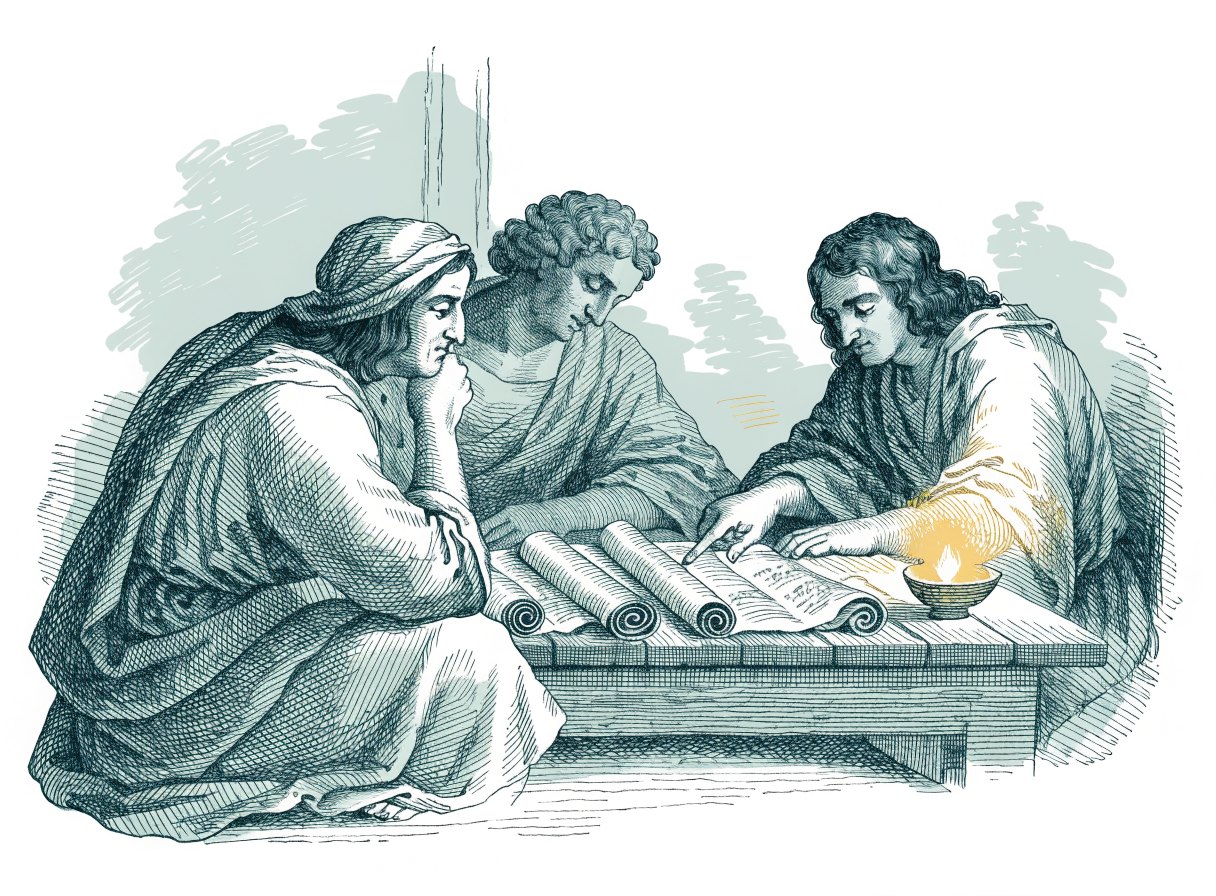
Now we come to the principle that holds all the others together. Because God is the ultimate Author of the whole Bible, and because he does not contradict himself, the Bible is its own best interpreter. This is not a Reformation novelty. Augustine taught it around AD 400: “draw examples from the plainer expressions to throw light upon the more obscure, and use the evidence of passages about which there is no doubt to remove all hesitation in regard to the doubtful passages” (On Christian Doctrine 2.9). Martin Luther, arguing in 1520 that Scripture must judge even the church fathers, called Scripture “its own interpreter” (sui ipsius interpres). And the Westminster Confession made it the rule:
Sproul called this the analogy of faith: reading each part of the Bible in agreement with the whole. He insisted that if the Bible is truly God’s Word, the analogy of faith is “not an option but a requirement.” The Bereans practiced it. When Paul preached in their synagogue, they did not simply accept him because he was an apostle, and they did not reject him because he was new. They went home and opened the Scriptures, every day, “to see if these things were so.” The verb Luke uses (anakrinō) is one he also uses for a judge examining a case (Luke 23:14). And Luke calls them “more noble” for it (Acts 17:11).
In practice, the principle works out in a few simple rules about which passages explain which. Learn these five and you will avoid many of the errors that divide churches.
Two of those rules come straight from Sproul’s list. “The implicit is to be interpreted by the explicit” means that when a verse only hints at something, you do not build a doctrine on the hint against a verse that says the opposite plainly. Sproul believed that this one rule, consistently followed, would settle the large majority of doctrinal disputes among Christians. “Historical narratives are to be interpreted by the didactic” means that a story tells you what happened, while teaching passages tell you what it means and what God requires. This is where Clark’s caution about induction pays off. In Acts 5, Ananias and Sapphira fall dead for lying. That does not mean God will strike every liar dead on the spot.
The last rule, later revelation explaining earlier shadows, is how the Reformed tradition reads the Bible as one unfolding story. “Long ago, at many times and in many ways, God spoke to our fathers by the prophets, but in these last days he has spoken to us by his Son” (Heb. 1:1–2). The sacrifices, the temple, the priesthood, and the kings were real, and they were also shadows of the substance, which is Christ (Col. 2:16–17; Heb. 8:5; 10:1). The New Testament is God’s own commentary on the Old.
When two texts seem to clash
Sooner or later every Bible reader finds two passages that seem to say opposite things. This is where logic and the analogy of faith work together. The law of non-contradiction tells you two true statements cannot truly contradict each other, and God never lies. So if both texts are his, the clash must be in my reading. You do not throw up your hands. You ask a few careful questions, in order:
The first question asks whether the same word is being used in the same sense in both places. The most famous case of all turns on exactly that. It troubled Luther, and it still troubles new believers.
Paul says we are justified by faith apart from works of the law (Rom. 3:28). James says we are justified by works and not by faith alone (James 2:24). If both writers meant exactly the same thing by “justified,” “faith,” and “works,” we would have a real contradiction. But they do not. Paul is answering the question of how a guilty sinner is declared righteous by God, and his answer is: through trusting Christ, not by earning it (Rom. 4:5). James is answering a different question: what kind of faith is real? He is dealing with someone who “says he has faith but does not have works” (James 2:14). That is a claim with no life in it, and James calls it dead (2:17).
His proof is Abraham, who was declared righteous by faith in Genesis 15 and then, decades later, showed that faith was real by offering Isaac in Genesis 22 (James 2:21–23). Faith is the root. Works are the fruit. The Westminster Confession holds both together in one sentence: faith is “the alone instrument of justification: yet is it not alone in the person justified, but is ever accompanied with all other saving graces, and is no dead faith, but worketh by love” (WCF 11.2).
The second question asks whether the two texts are even talking about the same thing in the same way. Proverbs 26:4 says, “Answer not a fool according to his folly, lest you be like him yourself.” The very next verse says, “Answer a fool according to his folly, lest he be wise in his own eyes.” A contradiction? The editor who put them side by side obviously did not think so. They are about different situations: there is a way of answering a fool that drags you down to his level, and a way of answering that exposes his folly. Wisdom is knowing which moment calls for which. The apparent clash is the lesson.
Also read: Acts 15:13–18; Romans 3:21–4:8; Galatians 3:6–14; James 2:14–26; Hebrews 1:1–4; Colossians 2:16–17; Proverbs 26:4–5
Part Seven: Errors That Bend the Text
It helps to know the common ways readers go wrong, the same way it helps a driver to know where the ice usually forms. D.A. Carson wrote a whole book on the subject, Exegetical Fallacies, and Clark’s Logic covers common reasoning mistakes as well. Here are eight that every new Bible reader will run into sooner or later.
| The error | What it looks like | The fix |
|---|---|---|
| Proof-texting | Pulling a verse out of its passage to support a point it was never making. | Read the circles. A verse means what it means in its paragraph. |
| Equivocation | Letting one word slide between two meanings mid-argument, like reading Paul’s sense of “justify” into James. | Define the word the way this author uses it here. |
| The root fallacy | Assuming a word’s “real” meaning is hidden in its parts or its origin. | Meaning comes from how a word is used in its own day (Carson). |
| Reading back | Pouring a later meaning into an older word: “power” (dynamis) means “dynamite.” | Dynamite came 1,800 years later. Ask what Paul’s readers heard. |
| Loading every meaning | Packing all a word’s possible senses into one verse at once. | A word in a sentence carries the one sense its context gives it. |
| False either/or | “Is this about God’s sovereignty or our responsibility?” when the text affirms both. | Ask whether the text forces a choice before you make one. |
| Story as rule | Turning one event in a narrative into a promise or command for everyone. | Let the teaching passages tell you what the story means. |
| The free association | A word sets off a personal memory or idea that has nothing to do with the text. | Ask, “Would the first readers have thought this?” |
Most of these are word mistakes. That is because words are the joints of meaning, and the joints are where things break. When you study a word, look at how the same author uses it elsewhere, then how the rest of Scripture uses it. A good concordance or a site like Blue Letter Bible will show you every place a Greek or Hebrew word appears. Let usage define the word. That is Scripture interpreting Scripture at the smallest scale.
And one warning about the spirit of all this. Augustine, right after praising logic, added that “in the use of it we must guard against the love of wrangling, and the childish vanity of entrapping an adversary” (On Christian Doctrine 2.31). Paul told Timothy the same thing in our key passage: “not to quarrel about words, which does no good, but only ruins the hearers” (2 Tim. 2:14). Learn these tools to read your Bible better, not to win arguments at small group. Augustine gave one more rule that sits over every other: whoever thinks he understands Scripture, “but puts such an interpretation upon them as does not tend to build up this twofold love of God and our neighbor, does not yet understand them as he ought” (On Christian Doctrine 1.36). Sound interpretation always ends in love.
Part Eight: The Method, Step by Step
Now we put it all together. On our How to Study the Bible page we teach five steps, each with one question: Read, Interpret, Evaluate, Apply, and Correlate. Other good teachers compress the same path into three steps: observe, interpret, apply. The names matter less than the order. You see what it says before you decide what it means, and you know what it means before you decide what to do with it. Here is the whole path, with the tools from this study attached to the step where you use them.
Notice the gold diamond after Evaluate. That is the contradiction check from Part Six, built into the path. If your reading of a passage sets it against a clearer passage, you do not move on to application. You go back and interpret again.
You may wonder why Correlate comes last, when Part Six said Scripture interprets Scripture. You already compared Scripture with Scripture at Evaluate, checking your reading against clearer texts. Correlate is the wider sweep. Once one passage has done its work on you, you trace the same truth through the whole Bible and into Christ. And the whole Bible always sends you back to read the passage again, which is why the path loops.

Before the checklist, a word about help. You were never meant to do this alone. An Ethiopian official was riding home from Jerusalem, reading Isaiah 53 aloud, and Philip ran up beside the chariot and asked if he understood it. His answer is one of the most honest lines in the Bible: “How can I, unless someone guides me?” (Acts 8:31). Philip “opened his mouth, and beginning with this Scripture he told him the good news about Jesus” (8:35). Christ gave his church teachers for exactly this reason, “to equip the saints… so that we may no longer be children, tossed to and fro by the waves and carried about by every wind of doctrine” (Eph. 4:11–14). Use them. Use a good study Bible, a solid commentary, your pastor, the men or women in your small group, and the historic confessions, which are the church’s summaries of what the whole Bible teaches.
But keep them in their place. Teachers and confessions are helps. Scripture is the judge. The Westminster Confession is careful to put every church gathering, its own authors included, under the Bible. Councils “may err; and many have erred” (WCF 31). And “The supreme judge by which all controversies of religion are to be determined, and all decrees of councils, opinions of ancient writers, doctrines of men, and private spirits, are to be examined, and in whose sentence we are to rest, can be no other but the Holy Spirit speaking in the Scripture” (WCF 1.10). The Bereans checked Paul. You may check your pastor, and a good pastor will thank you for it.
The study checklist
Print this and keep it in your Bible. You will not need every question every time. Over a few months, you will find you are asking them without the list.
| Step | Ask these questions |
|---|---|
| Pray | Have I asked God to open my eyes (Ps. 119:18)? Am I ready to obey what I find? |
| 1. Read | Who is speaking, and to whom? What happens, where, and when? What words repeat? What is the main verb? What surprises me? What don’t I understand yet? |
| 2. Interpret | What kind of writing is this? What comes right before and after? What is the author arguing or showing? What does each key word mean as this author uses it? Where are the “if,” “then,” “therefore,” and “for”? What would the first readers have understood? |
| 3. Evaluate | Does my reading fit clearer passages on the same subject? Is my conclusion valid, or did I affirm the “then” (treat a result as proof) or turn a story into a rule? What do faithful teachers and the confessions say? |
| 4. Apply | What does this show me about God? About Christ and his work? About me? Is there a promise to believe, a command to obey, a sin to confess, an example to follow or avoid? What one thing will I do this week? |
| 5. Correlate | Where else does Scripture teach this? How does it unfold through the covenants and land in Christ? Have I gathered the whole witness before I settle a doctrine? |
Also read: Acts 8:26–40; 17:10–12; Ephesians 4:11–16; Hebrews 5:11–14; 2 Timothy 2:1–2; Psalm 1:1–3
The Turn: The Word Behind the Words
Remember the brilliant readers from Part One, who could follow every sentence and still see nothing worth having. Every technique in this study could be learned by someone like that. That is the sobering part. You can master context and grammar and logic, read the Bible with perfect technique, and still miss the point of the whole thing. Jesus said it to the most careful Bible students of his day:
They searched diligently and knew the text better than most of us ever will. And they walked right past the Person the text was about. Bible study that does not end at Jesus has not finished.
Go back to where Part Two began. “In the beginning was the Logos.” The God who speaks, the mind behind every true sentence, is not an abstract principle. John goes on: “And the Word became flesh and dwelt among us, and we have seen his glory, glory as of the only Son from the Father, full of grace and truth” (John 1:14). The Logos has a face. The same God who will not contradict himself has kept every promise he ever made, and he kept them in his Son. “For all the promises of God find their Yes in him” (2 Cor. 1:20). That is the logic of the whole Bible. Every “if” in the law that condemned us, Christ answered with his obedience. Every “then” of judgment, Christ took on himself at the cross. And the “therefore” of the gospel is ours: “There is therefore now no condemnation for those who are in Christ Jesus” (Rom. 8:1).
So come to the Bible the way the Bereans did, eager and careful. Cut it straight. Read the circles. Let the clear explain the hard. Follow the “therefore.” But read it the way the two disciples on the Emmaus road finally learned to read it, with burning hearts, because the Stranger walking beside them was opening the Scriptures and showing them himself (Luke 24:32).
Ezra gives us the right order to close on: he “set his heart to study the Law of the LORD, and to do it and to teach his statutes and rules in Israel” (Ezra 7:10). Study. Do. Teach. In that order. And do not be afraid that you are too new or too untrained to begin. You will give reasons for your hope (1 Pet. 3:15), but the Word does not hang on your skill. Charles Spurgeon, preaching in 1886, pictured the gospel as a lion that some were anxious to protect. His advice was to open the door and let the lion out, because he would take care of himself: “the best ‘apology’ for the gospel is to let the gospel out.” Open the Book. It will take care of itself, and the God who speaks in it will take care of you.
Living It: Seven Practices
For Discussion
- Before this study, how would you have described your “method” for reading the Bible? What has changed?
- Paul says Hymenaeus and Philetus “swerved from the truth” by misreading a true doctrine (2 Tim. 2:18). Why can a bad interpretation of a true teaching be more dangerous than an obviously false teaching?
- Why does it matter that logic comes from God rather than being a human invention? What would change about Bible study if it did not?
- Which of the four misread verses in Part Five have you heard used the “often read as” way? How does the real meaning compare?
- Walk through Romans 3:28 and James 2:24 together using the contradiction check. Which question settles it, and why?
- The Bereans checked the apostle Paul against Scripture. What would it look like for you to be a Berean this week, kindly and humbly?
- Jesus told careful Bible students that they searched the Scriptures but refused to come to him (John 5:39–40). How can you guard against studying the Bible without meeting Christ in it?
Sources & For Further Study
- Text: Deuteronomy 13:1–3; 18:22; 19:15; 29:29; 30:11–14; Ezra 7:10; Nehemiah 8:8–18; Psalm 19:1; 119:18, 105; Proverbs 3:6; 11:5; 22:6; 26:4–5; Isaiah 1:18; 28:7–13; 55:8–9; Jeremiah 29:4–11; Amos 7:7–8; Matthew 12:25–26; 18:15–20; 22:31–33; Luke 24:27, 32, 45; John 1:1, 14; 5:39–40; 10:35; Acts 2:16–21; 5:1–11; 8:26–35; 17:2, 11; Romans 3:28; 4:5; 8:1; 10:9; 12:1; 1 Corinthians 2:14; 15:12–20; 2 Corinthians 1:18–20; Ephesians 4:11–14; Philippians 4:11–13; Colossians 2:17; 1 Timothy 5:8; 2 Timothy 2:14–18; 3:16–17; 4:6; Titus 1:2; Hebrews 1:1–2; 6:18; James 1:22; 2:14–24; 1 Peter 3:15; 2 Peter 1:20–21; 3:16. English quotations follow the ESV.
- Greek and Hebrew: BDAG on ὀρθοτομέω (NT hapax; LXX Prov. 3:6; 11:5), στρεβλόω, διαλέγομαι, ἀνακρίνω, λόγος, δύναμις; LSJ on ὀρθός and τέμνω. HALOT on יָכַח (yākaḥ), and the syllables צַו לָצָו קַו לָקָו in Isa. 28:10. Strong’s: orthotomeō G3718; streblóō G4761; dialegomai G1256; anakrinō G350; logos G3056.
- Confessions: Westminster Confession of Faith 1.6, 1.7, 1.9, 1.10, 11.2; Westminster Larger Catechism Q. 157; Second Helvetic Confession, ch. 2 (true interpretation is “gleaned from the Scriptures themselves”).
- Older voices: Augustine, On Christian Doctrine 1.36; 2.9; 2.31–32; 3.2; 3.26 (tr. J.F. Shaw, NPNF 1.2); Martin Luther, Assertio omnium articulorum (1520), WA 7:97; John Calvin, Institutes 1.6.1 (tr. Beveridge) and the dedication to the Commentary on Romans (tr. Owen); John Owen, The Causes, Ways, and Means of Understanding the Mind of God, Works 4; Thomas Watson, How We May Read the Scriptures with Most Spiritual Profit; Charles Spurgeon, “Christ and His Co-Workers” (sermon on Mark 16:20, 1886).
- Logic: Gordon H. Clark, Logic (Trinity Foundation) and the essay “God and Logic” (The Trinity Review, 1980). On the Clark–Van Til controversy, John Frame’s fair-minded treatment in Cornelius Van Til: An Analysis of His Thought, and Douglas Douma, The Presbyterian Philosopher.
- Practical: R.C. Sproul, Knowing Scripture (the best single book to read next); J.I. Packer, “Fundamentalism” and the Word of God, ch. 4; Gordon Fee and Douglas Stuart, How to Read the Bible for All Its Worth; Howard and William Hendricks, Living by the Book; Jen Wilkin, Women of the Word; D.A. Carson, Exegetical Fallacies (for leaders); Walter Kaiser, Toward an Exegetical Theology (for leaders).
Want this whole study as a beautifully formatted, printable PDF, ready for your small group? It’s free when you join the weekly list.