

“If any of you lacks wisdom, let him ask God, who gives generously to all without reproach, and it will be given him.” James 1:5
Introduction: The Golden Age
In Week 28 God made a promise to David: “I will raise up your offspring after you.… He shall build a house for my name” (2 Sam. 7:12–13). These two weeks are about that son. His name was Solomon, the son born to David and Bathsheba after their first child died, and the Bible adds a tender note at his birth: “the LORD loved him” (2 Sam. 12:24).
Under Solomon, Israel reached its golden age. The kingdom was at peace. Gold poured in. Rulers came from distant lands to hear his wisdom. And Solomon built the most famous building in Israel’s history, the temple in Jerusalem, where the glory of God came down as it had on the tabernacle.
But Solomon’s story is also a warning. The wisest king Israel ever had let his heart drift from God, and after his death the kingdom split in two. On our timeline, Solomon reigns from about 970 to 931 BC. He begins the temple in 966 BC, one of the most important dates for the Old Testament timeline, because Scripture ties it directly to the exodus.
The Word: Wisdom
Part One: A King Asks for Wisdom
Early in his reign, God appeared to Solomon in a dream and made an astonishing offer: “Ask what I shall give you” (1 Kings 3:5). Solomon could have asked for anything. He knew he was in over his head: “I am but a little child. I do not know how to go out or come in.” So he asked, “Give your servant therefore an understanding mind to govern your people, that I may discern between good and evil” (3:7, 9).
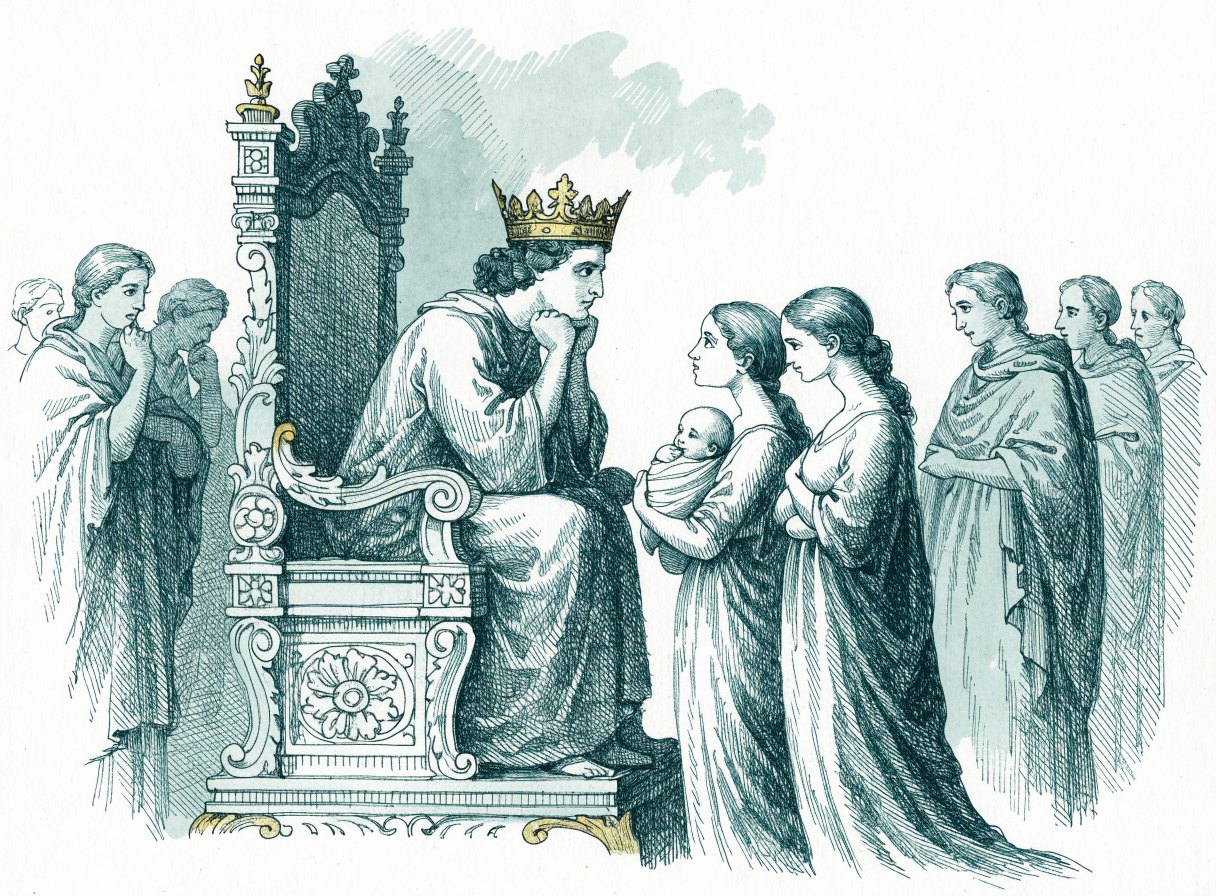
God was pleased. Because Solomon had not asked for long life or riches or the death of his enemies, God gave him wisdom, and riches and honor besides (3:11–13). Soon a hard case came before the new king. Two women lived in one house, and each had a baby. One baby died in the night, and now both women claimed the living child. There were no witnesses. Solomon called for a sword and ordered the living baby cut in two, half for each woman. One woman said, go ahead. The other cried out, give her the child, only do not kill him. Solomon knew at once that the woman willing to lose her son to save his life was the real mother (3:16–27). “And all Israel heard of the judgment that the king had rendered,” and they saw “that the wisdom of God was in him to do justice” (3:28).
Solomon’s wisdom became world famous. He spoke three thousand proverbs and over a thousand songs, and “people of all nations came to hear the wisdom of Solomon” (4:32, 34). Much of the book of Proverbs comes from him. The same God offers wisdom to you: “If any of you lacks wisdom, let him ask God, who gives generously to all without reproach, and it will be given him” (James 1:5).
Part Two: Building God’s House
Then Solomon built the temple. The Bible dates it with unusual precision: “In the four hundred and eightieth year after the people of Israel came out of the land of Egypt, in the fourth year of Solomon’s reign over Israel… he began to build the house of the LORD” (1 Kings 6:1). That verse is one of the main anchors for the dates in this series. Count back 480 years from 966 BC and you reach the exodus in about 1446 BC.
Where did he build it? “On Mount Moriah” (2 Chr. 3:1). That name should ring a bell. Abraham took Isaac to “the land of Moriah” to sacrifice him, and there God provided a ram in his place (Gen. 22:2, 13; Week 12). Chronicles uses the same name on purpose: more than a thousand years later, on Mount Moriah, Israel’s altar would burn day after day.
The temple followed the plan of the tabernacle, but larger and permanent: a courtyard with a great bronze altar and a huge bronze basin called “the sea,” resting on twelve bronze oxen (7:23–25), a Holy Place, and an inner room, the Most Holy Place, a perfect cube “twenty cubits long, twenty cubits wide, and twenty cubits high” (about 30 feet each way), overlaid with pure gold (6:20). It took seven years to build (6:38).
While Solomon was building, God reminded him that a beautiful building could never take the place of a faithful heart: “if you will walk in my statutes and obey my rules and keep all my commandments… I will dwell among the children of Israel and will not forsake my people Israel” (6:12–13). God’s presence was always a gift of grace, and grace calls for a faithful response.
The Turn: Wisdom from Above
Solomon’s best moment was a prayer that admitted weakness. Wisdom, in the Bible, starts there: with a person who knows how small he is and how great God is.
The wisdom God gives does not stay in the head. James describes it: “the wisdom from above is first pure, then peaceable, gentle, open to reason, full of mercy and good fruits, impartial and sincere” (James 3:17). That is a portrait of Jesus, and it is what he grows in everyone who comes to him and learns from him. If you lack wisdom, start where Solomon started. Come to Christ and ask. Next week the glory of God fills Solomon’s temple, and then we watch the wisest king in Israel let his heart drift.
Living It: Three Practices for This Week
Before Week 30: Read 1 Kings 8 and 11. Week 30 watches the glory fill the temple, and Solomon’s heart turn away.
For Discussion
- If God said to you, “Ask what I shall give you,” what would you honestly ask for? What does Solomon’s request teach you?
- Proverbs says the fear of the LORD is the beginning of wisdom. How is that different from simply being smart?
- The temple stood on Mount Moriah. Why does that connection to Abraham and Isaac matter?
- While Solomon was building, God told him a beautiful building could never replace a faithful heart (1 Kings 6:12–13). Where are you tempted to let outward things stand in for faithfulness?
Sources & For Further Study
- On חָכְמָה: Brown, Driver, and Briggs, Hebrew and English Lexicon, s.v.; Bruce K. Waltke, The Book of Proverbs (NICOT), introduction.
- On 1 Kings 6:1 and biblical chronology: Eugene H. Merrill, Kingdom of Priests. On the temple: G. K. Beale, The Temple and the Church’s Mission.
- For further reading: Dale Ralph Davis, 1 Kings: The Wisdom and the Folly; Philip Graham Ryken, 1 Kings (Reformed Expository Commentary).
Leading a small group? This week comes as a beautifully formatted, printable PDF, along with a 2-page Small Group Guide: a discussion page for your group and leader notes with a session plan and answer key. Both are free when you join the weekly list.