

“Something greater than Solomon is here.” Matthew 12:42
Introduction: A House Full of Glory
Last week young King Solomon asked God for wisdom, and God gave it, with riches and honor besides. Then Solomon built the temple on Mount Moriah, following the pattern of the tabernacle, and spent seven years on it.
This week the ark goes into the Most Holy Place and the glory of God comes down. Then we watch the wisest king who ever lived let his heart drift, one compromise at a time.
Part Three: The Glory Fills the House
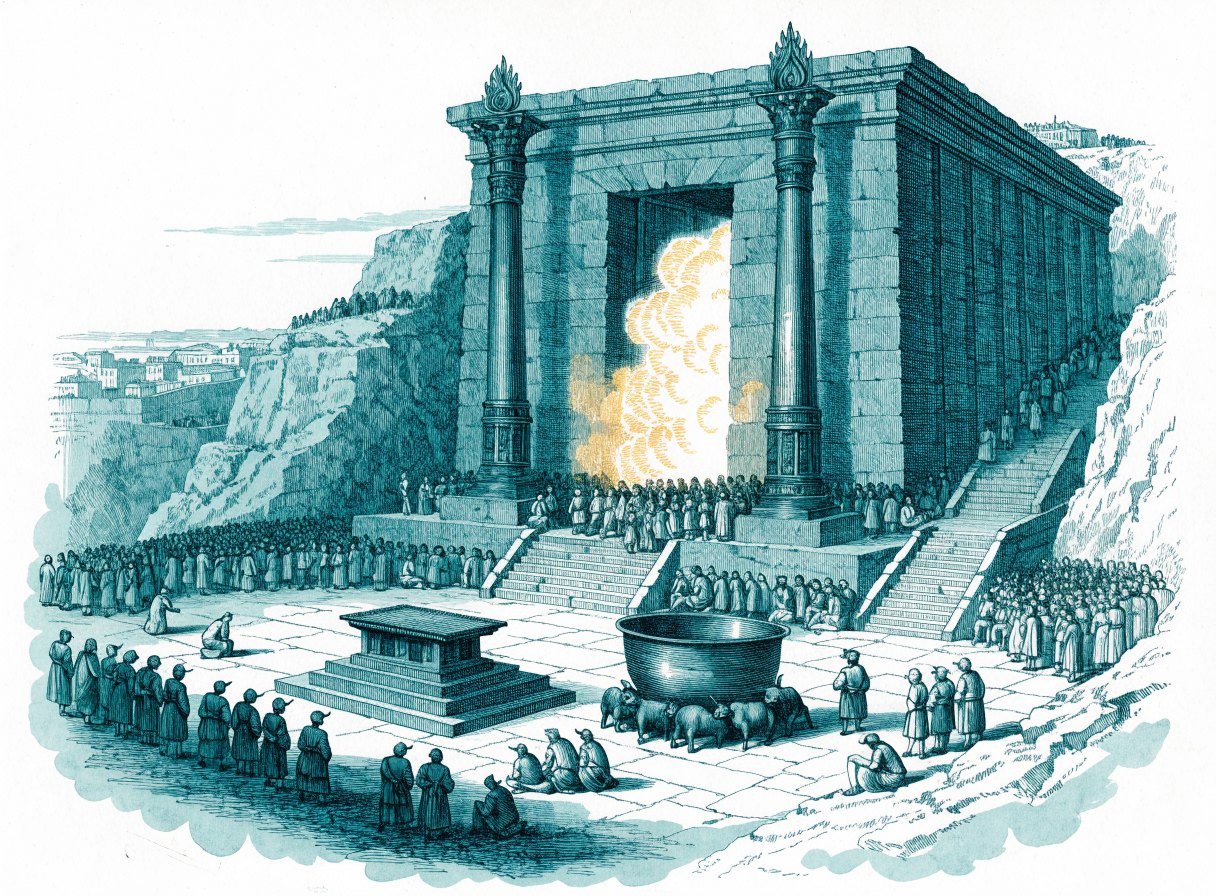
When the temple was finished, the priests carried the ark of the covenant into the Most Holy Place, “underneath the wings of the cherubim” (8:6). And then it happened again, just as it had at the tabernacle (Week 20):
Then Solomon stood before the altar, “spread out his hands toward heaven” (8:22), and prayed one of the great prayers of the Bible. In the middle of the most magnificent building Israel ever built, he said something remarkably humble:
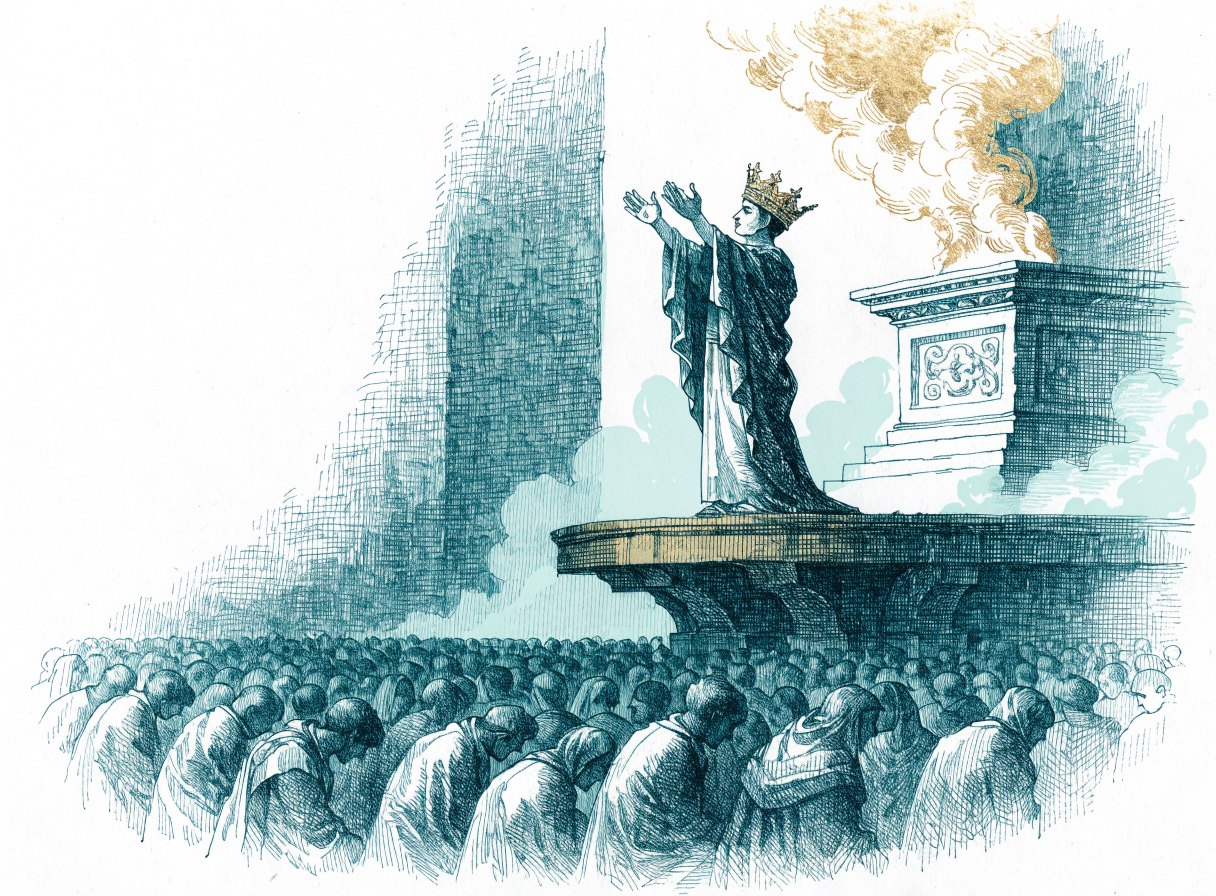
Solomon knew that no building could hold God. The temple was a meeting place, the place where God had promised, “My name shall be there” (8:29). So Solomon asked God to hear every prayer prayed toward it. He prayed for Israel when they sinned and were defeated, when drought came, when sickness struck. He even prayed for foreigners: “when a foreigner, who is not of your people Israel, comes from a far country for your name’s sake… hear in heaven… in order that all the peoples of the earth may know your name” (8:41–43). And looking far ahead, he prayed for a day when Israel might be carried off into exile for their sins: if they repented there, would God hear and forgive (8:46–50)? That day would come, as we will see in Week 33.
When he finished, “fire came down from heaven and consumed the burnt offering and the sacrifices, and the glory of the LORD filled the temple,” and the people fell on their faces and worshiped: “For he is good, for his steadfast love endures forever” (2 Chr. 7:1, 3). Solomon blessed the people with words that echo Joshua 21:45: “Not one word has failed of all his good promise” (1 Kings 8:56).
We were made to glorify God and enjoy him. Worship is giving God the honor he deserves, in all of life and together with his people. Prayer is bringing our requests to God, confessing our sins and thanking him for his mercies, as Solomon did at the temple. Christians now pray in Jesus’ name, because he is the way to the Father.
“Prayer is an offering up of our desires unto God, for things agreeable to his will, in the name of Christ, with confession of our sins, and thankful acknowledgment of his mercies.” (Westminster Shorter Catechism 98)
Part Four: The Wise King’s Foolish Heart
If you only read the first half of Solomon’s story, you would think he was the promised King. Read on, and you find out he was not.
Hundreds of years earlier, God had set three limits on Israel’s future kings. A king must not multiply horses, especially from Egypt. He must not multiply wives, “lest his heart turn away.” And he must not pile up silver and gold for himself (Deut. 17:16–17). Solomon broke all three. He imported horses and chariots from Egypt (1 Kings 10:26–29). Gold flowed in by the ton (10:14). And “he had 700 wives, who were princesses, and 300 concubines. And his wives turned away his heart” (11:3).
The drift was slow. “When Solomon was old his wives turned away his heart after other gods, and his heart was not wholly true to the LORD his God” (11:4). The man who built God’s temple built shrines for the gods of his wives on the hill east of Jerusalem, even for Molech, the god whose worshipers burned their children in the fire (11:7; see Lev. 18:21; 2 Kings 23:10). “And the LORD was angry with Solomon, because his heart had turned away from the LORD, the God of Israel, who had appeared to him twice” (11:9).
God told Solomon the kingdom would be torn from his son. Yet even in judgment he kept his promise to David: one tribe would remain for David’s sake (11:11–13). After Solomon died in 931 BC, the ten northern tribes broke away, crying, “What portion do we have in David?… To your tents, O Israel!” (12:16). The golden age lasted one generation. Wisdom, wealth, and even a temple could not keep a heart faithful.
The Turn: Something Greater Than Solomon
The Queen of Sheba traveled from the far south of Arabia, well over a thousand miles, to hear Solomon’s wisdom (1 Kings 10:1–9). Jesus pointed to her and said, “behold, something greater than Solomon is here” (Matt. 12:42). Solomon asked God for wisdom. Jesus is the answer to that prayer in person. “Because of him you are in Christ Jesus, who became to us wisdom from God, righteousness and sanctification and redemption” (1 Cor. 1:30).
Solomon built a temple of stone. Jesus said, “Destroy this temple, and in three days I will raise it up,” and John explains, “he was speaking about the temple of his body” (John 2:19, 21). Solomon’s temple was burned to the ground, and even the temple rebuilt after it was destroyed in its turn. The temple of Jesus’ body was destroyed on the cross and rose on the third day, never to die again. He is where God now meets his people. That is why Jesus told a Samaritan woman, “the hour is coming, and is now here, when the true worshipers will worship the Father in spirit and truth” (John 4:23). You do not have to travel to Jerusalem. You come to Jesus. And all who come to him become “living stones… being built up as a spiritual house” (1 Pet. 2:5).
Solomon’s heart turned away when he was old. Jesus’ heart never turned. He is the Son of David whom God promised, the one who builds God’s house and whose throne lasts forever. Solomon prayed that foreigners from far countries would come and pray toward God’s house. Through Jesus, they have, from every nation on earth.
Solomon’s story asks you an honest question: what is slowly turning your heart? It rarely happens all at once. Ask God for wisdom, and he will give it. But the wisdom you need most is a Person. Jesus forgives drifting hearts and holds on to the people he saves. Come to the One who is greater than Solomon, and let him turn your heart back.
Living It: Three Practices for This Week
Before Week 31: Read 1 Kings 12 and 17–18. Week 31 follows the divided kingdom to a showdown on Mount Carmel.
For Discussion
- Solomon said heaven cannot contain God, yet God promised to put his name in the temple. How can both be true?
- Solomon broke all three of the king’s limits in Deuteronomy 17: horses (military power), wives (sex and romance), and gold (money). Which of these pulls hardest on hearts today?
- Solomon’s heart turned away slowly, “when Solomon was old.” What helps a heart stay faithful over a lifetime?
- Jesus said “something greater than Solomon is here.” In what ways is Jesus greater?
Sources & For Further Study
- For further reading: Dale Ralph Davis, 1 Kings: The Wisdom and the Folly; Philip Graham Ryken, 1 Kings (Reformed Expository Commentary).
Leading a small group? This week comes as a beautifully formatted, printable PDF, along with a 2-page Small Group Guide: a discussion page for your group and leader notes with a session plan and answer key. Both are free when you join the weekly list.