

“But in fact Christ has been raised from the dead, the firstfruits of those who have fallen asleep.” 1 Corinthians 15:20
Introduction: He Is Risen. So What?
Last week the tomb was empty. Jesus met Mary Magdalene in the garden, stood among his frightened disciples behind a locked door, showed Thomas his hands, and restored Peter by the sea. Over forty days he appeared to many witnesses, more than five hundred of them at one time.
This week we ask what the resurrection means, for Jesus, for his people, and for death itself. Then we stand on the Mount of Olives as he is taken up into heaven.
Part Three: Why It Matters
Paul is blunt: “if Christ has not been raised, your faith is futile and you are still in your sins” (1 Cor. 15:17). The resurrection is God’s verdict on the cross. Jesus “was delivered up for our trespasses and raised for our justification” (Rom. 4:25). His death paid the debt in full. His resurrection is God’s public verdict that the payment was enough. The Father raised him and declared him righteous, and everyone joined to him by faith alone shares that verdict. That is what Paul means by “raised for our justification.” The resurrection also proves he is who he said he is, “declared to be the Son of God in power… by his resurrection from the dead” (Rom. 1:4).
It also means death has been defeated. Jesus came “that through death he might destroy the one who has the power of death, that is, the devil, and deliver all those who through fear of death were subject to lifelong slavery” (Heb. 2:14–15). The risen Jesus says, “I died, and behold I am alive forevermore, and I have the keys of Death and Hades” (Rev. 1:18).
And his resurrection is the first of many. “But in fact Christ has been raised from the dead, the firstfruits of those who have fallen asleep” (1 Cor. 15:20). The firstfruits were the first sheaf of the harvest, the promise that the rest was coming. One day every believer’s body will be raised like his: “What is sown is perishable; what is raised is imperishable. It is sown in dishonor; it is raised in glory” (15:42–43). Christians can say at a graveside what no one else can: “O death, where is your victory? O death, where is your sting?” (15:55).
Part Four: The Ascension
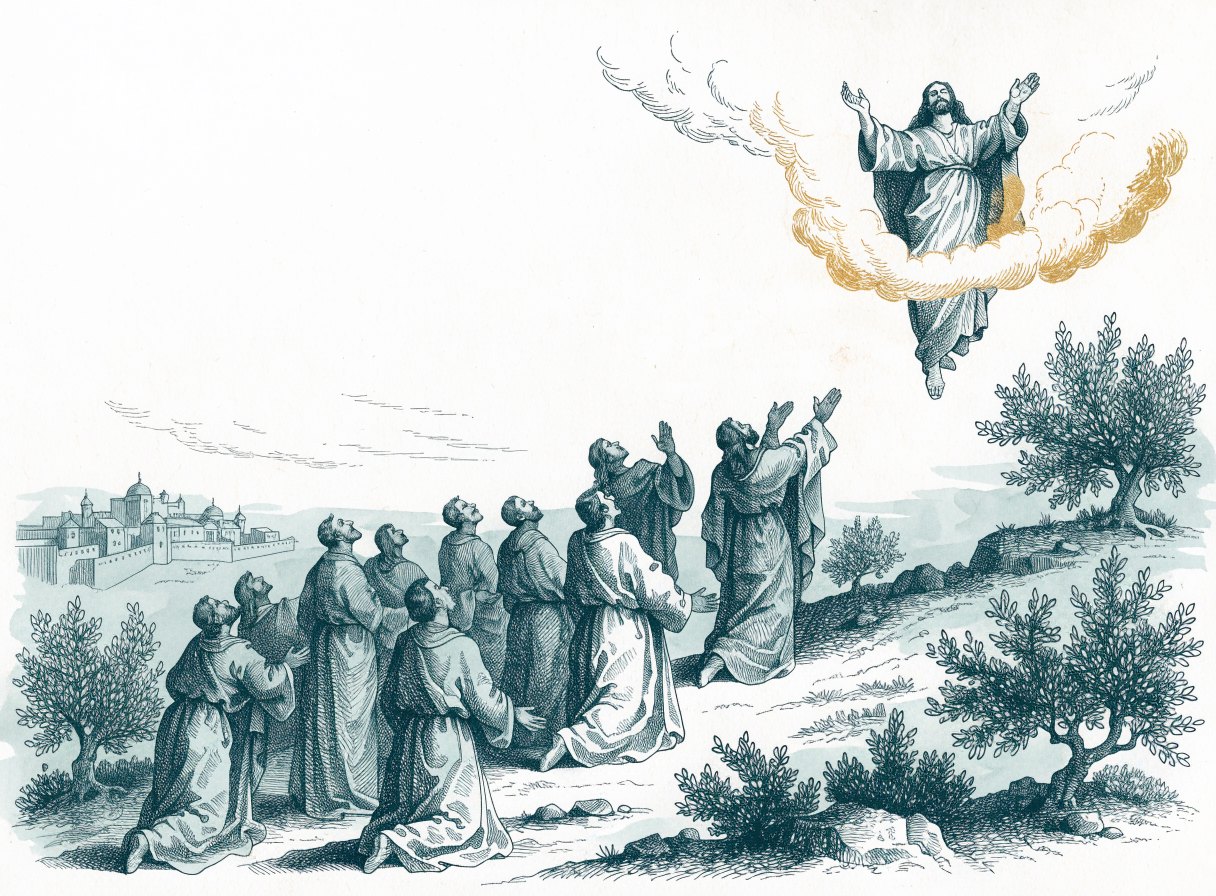
Forty days after Easter, Jesus led his disciples out to the Mount of Olives, near Bethany. He told them to wait in Jerusalem for the Holy Spirit, “and you will be my witnesses in Jerusalem and in all Judea and Samaria, and to the end of the earth” (Acts 1:8). He “led them out as far as Bethany, and lifting up his hands he blessed them. While he blessed them, he parted from them and was carried up into heaven” (Luke 24:50–51). A cloud took him out of their sight, and two angels said, “This Jesus, who was taken up from you into heaven, will come in the same way as you saw him go into heaven” (Acts 1:11).
Surprisingly, the disciples did not go home sad. “They worshiped him and returned to Jerusalem with great joy” (Luke 24:52). Why joy? Jesus had told them, “it is to your advantage that I go away” (John 16:7). He went up in the same body they had touched, and he reigns now as a real man at God’s right hand. God “raised him from the dead and seated him at his right hand in the heavenly places, far above all rule and authority” (Eph. 1:20–21), just as David foretold: “Sit at my right hand, until I make your enemies your footstool” (Ps. 110:1). And from there he works for his people now.
Before he left, Jesus gave his followers their mission: “All authority in heaven and on earth has been given to me. Go therefore and make disciples of all nations, baptizing them in the name of the Father and of the Son and of the Holy Spirit, teaching them to observe all that I have commanded you. And behold, I am with you always, to the end of the age” (Matt. 28:18–20). Week 45 will show what happened when the Spirit came and they obeyed.
Jesus rose bodily from the dead on the third day. He ascended into heaven in that same body and now reigns at the Father’s right hand. His resurrection is God’s seal on his finished work and the promise that all who belong to him will rise too.
The Turn: Do You Believe This?
When Jesus told Martha, “I am the resurrection and the life,” he did not stop with a statement. He asked her a question: “Do you believe this?” (John 11:26). He asks you the same thing.
If Jesus is still in the tomb, then his promises died with him, and we are still in our sins. But if he rose, then everything he said is true. His death really paid for sin. Death is really defeated. And your future, if you belong to him, is not a grave but a resurrection body and a world made new.
Everyone will be raised one day, “some to everlasting life, and some to shame and everlasting contempt” (Dan. 12:2). God “has fixed a day on which he will judge the world,” and he has given proof of it “by raising him from the dead” (Acts 17:31).
Christians grieve when people they love die, but not “as others do who have no hope. For since we believe that Jesus died and rose again, even so, through Jesus, God will bring with him those who have fallen asleep” (1 Thess. 4:13–14). Here is the promise: “if you confess with your mouth that Jesus is Lord and believe in your heart that God raised him from the dead, you will be saved” (Rom. 10:9). Thomas would not believe without seeing. Jesus calls you blessed if you believe without seeing. Turn from your sin, and trust the living Lord.
Living It: Three Practices for This Week
Before Week 45: Read Acts 1–2. Week 45 opens Unit 6: the Spirit comes and the church is born.
For Discussion
- Paul says if Christ has not been raised, our faith is futile. Why is the resurrection so central?
- Paul says Jesus was “raised for our justification.” What does his resurrection tell you about whether God accepted his payment for sin?
- The disciples returned from the ascension “with great joy.” Why would Jesus leaving make them joyful?
- Jesus asked Martha, “Do you believe this?” How would you answer him today?
Sources & For Further Study
- On the ascension and Christ’s present work: Westminster Shorter Catechism 28; Gerrit Scott Dawson, Jesus Ascended.
- For further reading: Richard B. Gaffin Jr., Resurrection and Redemption; Timothy Keller, Hope in Times of Fear.
Leading a small group? This week comes as a beautifully formatted, printable PDF, along with a 2-page Small Group Guide: a discussion page for your group and leader notes with a session plan and answer key. Both are free when you join the weekly list.