

“For we do not have a high priest who is unable to sympathize with our weaknesses, but one who in every respect has been tempted as we are, yet without sin.” Hebrews 4:15
Introduction: Truly Man
Last week we watched the Word become flesh. The Son of God was born in Bethlehem and laid in a manger, and then, once grown, he forgave sins, calmed a storm, took God’s own name, and accepted worship. He is truly God.
This week we look at the other side: he is just as truly man. Then Jesus asks his friends the question at the center of the Bible, and a voice from a bright cloud answers it.
Part Three: Truly Man
But the same Gospels that show Jesus’ divine glory show his full humanity just as clearly. He was a baby who needed his mother. He “increased in wisdom and in stature and in favor with God and man” (Luke 2:52). He got tired: “Jesus, wearied as he was from his journey, was sitting beside the well” (John 4:6). He got hungry (Matt. 4:2). He fell asleep in a boat (Mark 4:38). At the grave of his friend Lazarus, Jesus wept. In most English Bibles it is the shortest verse of all: “Jesus wept” (John 11:35). He was tempted in every way we are, “yet without sin” (Heb. 4:15).
Christians have always confessed both truths together. Jesus is one Person with two natures, fully God and fully man. The Westminster Confession puts it carefully: the two natures were joined together in one person, “without conversion, composition, or confusion” (WCF 8.2). He did not stop being God when he became man. He did not become a mix of the two. He is truly God and truly man, forever.
Why does it matter? Because only someone who is both could save us. He had to be truly man to stand in our place, obey where we disobeyed, and die our death. “Therefore he had to be made like his brothers in every respect, so that he might become a merciful and faithful high priest in the service of God, to make propitiation for the sins of the people” (Heb. 2:17). “For there is one God, and there is one mediator between God and men, the man Christ Jesus” (1 Tim. 2:5). And he had to be truly God for his obedience and death to have infinite worth and to conquer death. Paul describes how far he came down: though he was “in the form of God,” he “emptied himself, by taking the form of a servant… he humbled himself by becoming obedient to the point of death, even death on a cross” (Phil. 2:6–8). He did not empty himself of being God. He emptied himself by taking: he added a servant’s nature to the divine nature he always had, and he set aside the glory and honor that were his right.
Jesus Christ is one person with two natures. He is fully God, the eternal Son, and fully man, with a real body and soul. The two natures are not mixed or divided. He became one of us without ceasing to be God, so that he could stand in our place.
Part Four: Who Do You Say I Am?
At a turning point in his ministry, Jesus took his disciples north to Caesarea Philippi and asked them what people were saying about him. Some said John the Baptist, others Elijah, Jeremiah, or one of the prophets. Then he made it personal: “But who do you say that I am?” Simon Peter answered, “You are the Christ, the Son of the living God.” And Jesus said, “Blessed are you, Simon Bar-Jonah! For flesh and blood has not revealed this to you, but my Father who is in heaven” (Matt. 16:15–17). To see who Jesus really is takes a gift from God.
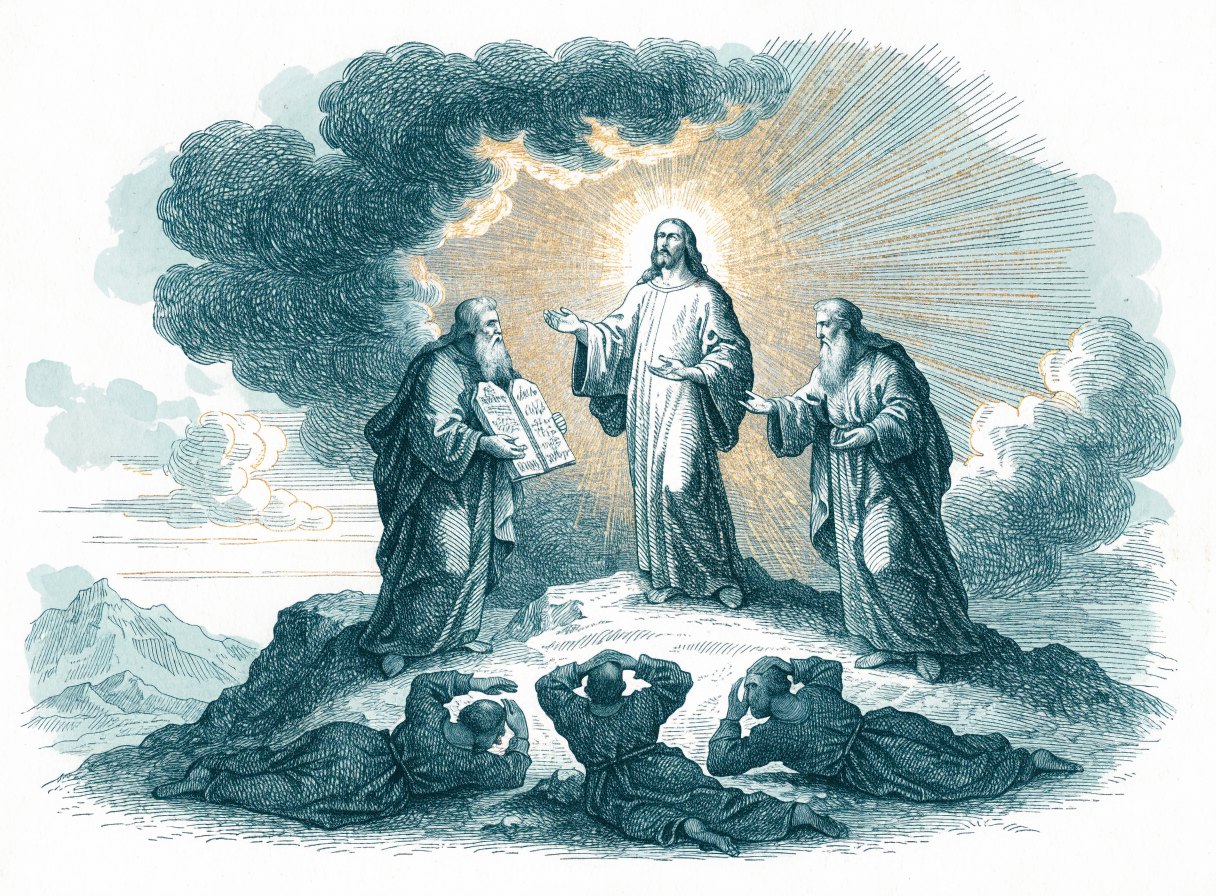
Six days later, Jesus took Peter, James, and John up a high mountain. There “he was transfigured before them, and his face shone like the sun, and his clothes became white as light. And behold, there appeared to them Moses and Elijah, talking with him” (17:2–3). The Law and the Prophets stood beside the One they had pointed to. Then a bright cloud overshadowed them, the same word the angel used to Mary, and a voice from the cloud said, “This is my beloved Son, with whom I am well pleased; listen to him” (17:5). The disciples fell on their faces. And Jesus touched them and said, “Rise, and have no fear” (17:7).
Jesus also said plainly why he came: “For the Son of Man came to seek and to save the lost” (Luke 19:10). “For even the Son of Man came not to be served but to serve, and to give his life as a ransom for many” (Mark 10:45). Weeks 39 and 40 will listen to what he taught about his kingdom. Weeks 41 through 44 will follow him to the cross and out of the tomb. But first, the question must be answered.
The Turn: The Question That Will Not Go Away
The whole Old Testament was waiting for three kinds of leader. It needed a Prophet who would speak God’s final word, a Priest who would offer a sacrifice that really takes sin away, and a King from David’s line who would reign forever. Jesus is all three in one Person (Westminster Shorter Catechism 23). As Paul says, “all the promises of God find their Yes in him” (2 Cor. 1:20).
Many people today say Jesus was a good teacher and nothing more. But a merely good teacher does not forgive other people’s sins, claim God’s name, accept worship, and say that seeing him is seeing God. Either those claims are false, or he is exactly who he said he is. Peter and Thomas reached their conclusion. John wrote his whole Gospel so that you could reach it too: “these are written so that you may believe that Jesus is the Christ, the Son of God, and that by believing you may have life in his name” (John 20:31).
So the question comes to you: who do you say that he is? If you are not sure yet, keep reading the Gospels, and ask God to open your eyes as he opened Peter’s. And if you are ready to bow with Thomas, then come to him as he invited everyone to come: “Come to me, all who labor and are heavy laden, and I will give you rest… for I am gentle and lowly in heart” (Matt. 11:28–29). Turn from your sin, and trust him as your Savior, Christ, and Lord.
Living It: Three Practices for This Week
Before Week 39: Read Mark 1–2 and Matthew 5. Week 39 hears the King announce his kingdom.
For Discussion
- Jesus got tired, hungry, and wept. How does his full humanity change the way you pray to him?
- Many people say Jesus was a good teacher and nothing more. How would you answer them from these two weeks?
- Jesus asked, “Who do you say that I am?” What is your answer today?
- Peter’s confession was a gift from the Father (Matt. 16:17). What does that mean for the people you are praying for?
Sources & For Further Study
- On the person of Christ: Westminster Confession of Faith 8.2; the Definition of Chalcedon (AD 451); Donald Macleod, The Person of Christ.
- For further reading: Sinclair B. Ferguson, In Christ Alone; Timothy Keller, Hidden Christmas; B. B. Warfield, The Person and Work of Christ.
Leading a small group? This week comes as a beautifully formatted, printable PDF, along with a 2-page Small Group Guide: a discussion page for your group and leader notes with a session plan and answer key. Both are free when you join the weekly list.