

“I will put my law within them, and I will write it on their hearts.” Jeremiah 31:33
Introduction: Rescued People, Holy Law
Last week we stood at the foot of Mount Sinai. God reminded Israel that he had carried them on eagles’ wings. Then he came down on the mountain in fire and spoke the Ten Words from the smoke: “I am the LORD your God, who brought you out of the land of Egypt.” The people trembled and asked Moses to stand between them and God.
This week we ask the question every new reader of the Bible asks: what is the law for? Then we watch the covenant sealed with blood, and broken within weeks by a golden calf.
Part Four: What Is the Law For?
If you are new to the Bible, you have probably wondered: do Christians still have to keep all of Moses’ laws? Do we avoid pork and wear clothes of one fabric? The Westminster Confession gives a clear and helpful answer by sorting the laws God gave at Sinai into three kinds.
The moral law, summed up in the Ten Commandments, shows God’s own holy character, and it “doth forever bind all,” believers and unbelievers alike (WCF 19.5). The ceremonial laws (sacrifices, priests, food laws, festivals) were pictures “prefiguring Christ, his graces, actions, sufferings, and benefits,” and they “are now abrogated,” set aside, because Christ has come (WCF 19.3). The judicial laws were the civil laws of the nation of Israel, and they “expired together with the State of that people,” though their “general equity,” their underlying justice, still teaches us (WCF 19.4).
And what does the moral law do in our lives? Since the Reformation, Christians have usually named three uses. First, it is a mirror. It shows us our sin and drives us to Christ. “Through the law comes knowledge of sin” (Rom. 3:20), and so “the law was our guardian until Christ came, in order that we might be justified by faith” (Gal. 3:24). Second, it is a restraint. Even in people who do not know God, the law’s warnings hold back evil and keep a society livable (1 Tim. 1:9–10). Third, for those who belong to Christ, it is a guide, “a rule of life informing them of the will of God, and their duty” (WCF 19.6). Believers are “not under the law, as a covenant of works, to be thereby justified, or condemned” (WCF 19.6). That is the covenant of works from Week 6, the one Adam broke in Week 7, and Christ kept it in our place. So the law can no longer condemn a believer. It still shows us how to love.
The mirror shows a hard truth: no one keeps the law. “No mere man since the fall is able in this life perfectly to keep the commandments of God, but doth daily break them in thought, word and deed” (WSC 82). James says, “whoever keeps the whole law but fails in one point has become guilty of all of it” (James 2:10). The law is holy, “and the commandment is holy and righteous and good” (Rom. 7:12). The fault lies with us.
God’s moral law, summed up in the Ten Commandments, shows us his holy character. It exposes our sin and drives us to Christ, who kept it perfectly for us. For those who belong to him, it becomes a guide for a grateful life, written on the heart by the Spirit.
Part Five: The Blood of the Covenant, and a Golden Calf
After the Ten Commandments, God gave Moses more detailed laws, recorded in Exodus 21–23. Moses wrote them down, and Exodus calls the scroll “the Book of the Covenant” (24:7). These chapters show the Ten Commandments at work in a farming people’s daily life: what happens when an ox gores a neighbor, what to do when a borrowed animal dies, why a judge must never take a bribe. Some of these laws sound harsh or strange to us, because they were written for Israel as a nation in a hard ancient world. They are the judicial laws we met in Part Four. But listen to their heart: “You shall not wrong a sojourner or oppress him, for you were sojourners in the land of Egypt” (22:21).
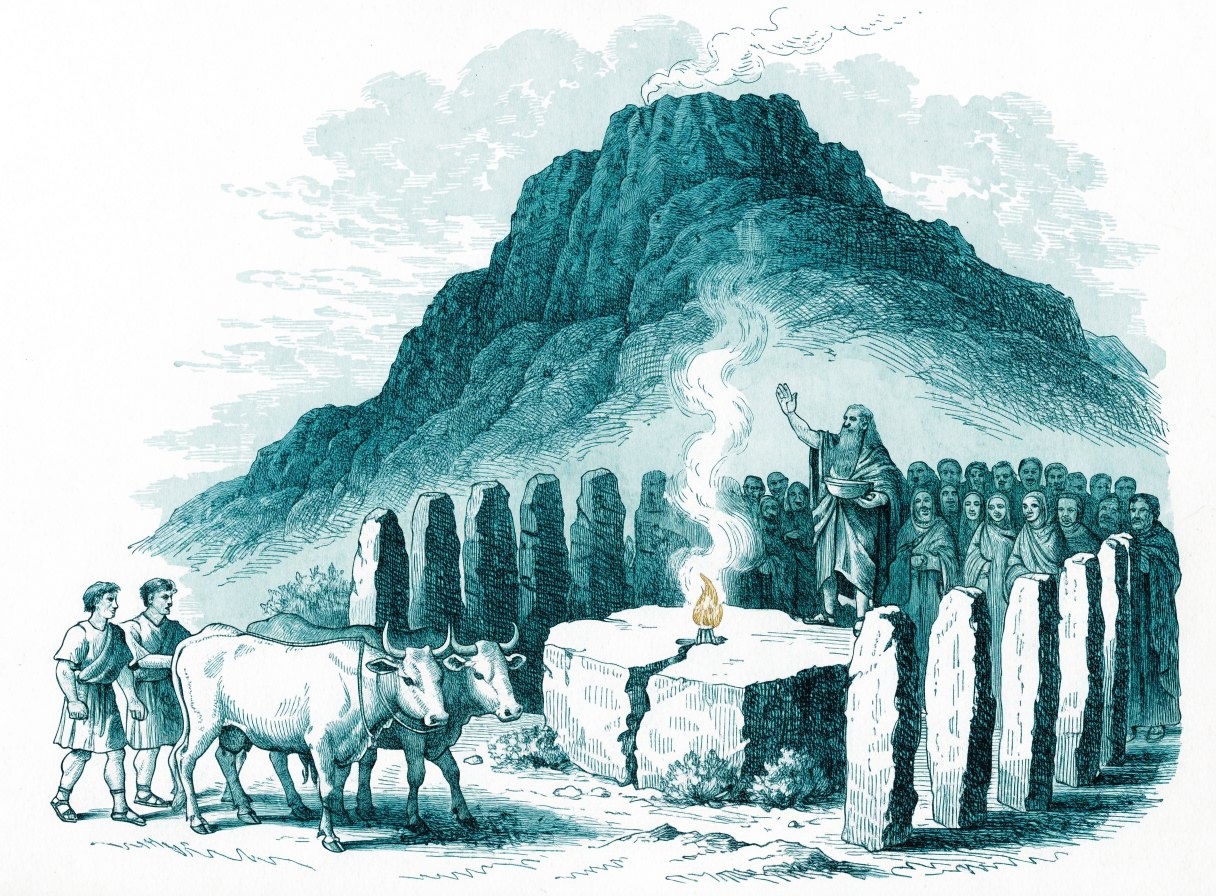
In Exodus 24 the covenant was sealed. Moses wrote down God’s words and built an altar at the foot of the mountain with twelve pillars for the twelve tribes. Young men offered sacrifices, and Moses threw half the blood against the altar. Then he read the Book of the Covenant to the people, and they answered, “All that the LORD has spoken we will do, and we will be obedient” (24:7). He threw the rest of the blood on the people, saying, “Behold the blood of the covenant that the LORD has made with you in accordance with all these words” (24:8). Then the leaders of Israel went up the mountain, and “they beheld God, and ate and drank” (24:11). A meal in God’s presence, sealed by blood.
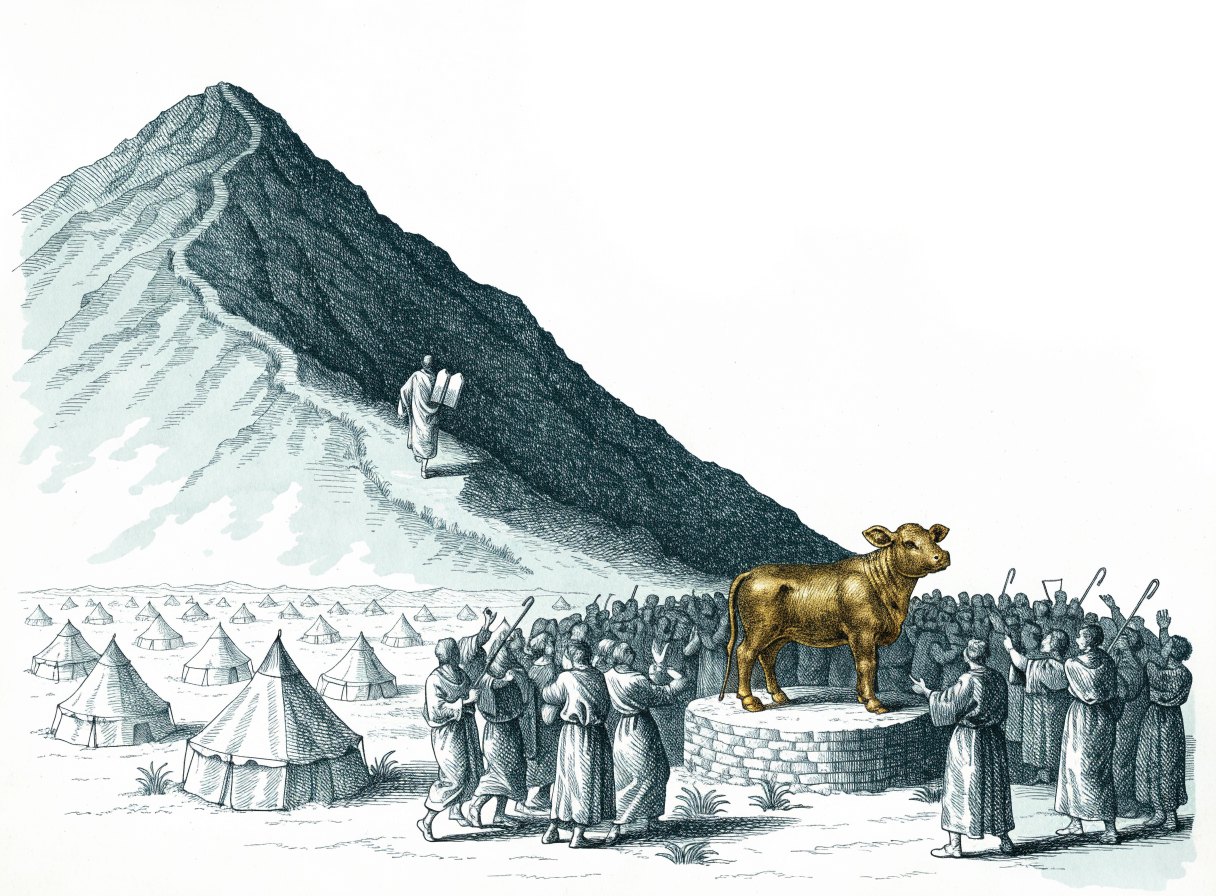
And then Moses went up the mountain for forty days to receive the stone tablets. Down in the camp, the people grew impatient. “Up, make us gods who shall go before us,” they told Aaron. He collected their gold earrings and made a golden calf, and they said, “These are your gods, O Israel, who brought you up out of the land of Egypt!” (32:1, 4). They feasted and danced around it.
Weeks after promising, “All that the LORD has spoken we will do,” they broke the first two commandments at once. When Moses came down and saw it, he smashed the tablets at the foot of the mountain (32:19).
Then Moses did something astonishing. He went back up to God and begged for the people: “Alas, this people has sinned a great sin.” He asked God to forgive them, and if not, “please blot me out of your book that you have written” (32:31–32). Moses would rather be lost with his people than saved without them. God refused: “Whoever has sinned against me, I will blot out of my book” (32:33). Moses was a sinner too, and no sinner can carry another’s guilt. Judgment did fall on the camp (32:28, 35). But God did forgive, renewed the covenant, and gave new tablets. And when he did, he proclaimed his name: “The LORD, the LORD, a God merciful and gracious, slow to anger, and abounding in steadfast love and faithfulness” (34:6).
When Moses came down the mountain with the new tablets, his face was shining from speaking with God, and the people were afraid to come near him. So Moses put a veil over his face (34:29–35). Paul picks up this scene in 2 Corinthians 3. The glory at Sinai was real, he says, but it was fading, and words on stone could not change a heart. “When one turns to the Lord, the veil is removed,” and “we all, with unveiled face, beholding the glory of the Lord, are being transformed into the same image from one degree of glory to another” (2 Cor. 3:16, 18). Moses reflected God’s glory for a little while. Everyone who turns to Christ beholds it and is slowly changed by it.
The Turn: A Better Covenant, a Better Mediator
Israel said, “All that the LORD has spoken we will do,” and could not do it. Neither can we. If all we took from Sinai were the law’s demands, the law would only be a mirror showing us how far we fall short, and a mountain of fire we could never climb.
But God did not leave it there. Centuries later, after Israel had broken the covenant again and again, God promised through Jeremiah a new covenant, “not like the covenant that I made with their fathers… my covenant that they broke.” This time, God said, “I will put my law within them, and I will write it on their hearts… For I will forgive their iniquity, and I will remember their sin no more” (Jer. 31:31–34). The trouble at Sinai was never a shortage of grace. Sinai had a mediator, a blood sacrifice, and a God who called himself merciful and gracious. Hebrews says God “finds fault with them” (Heb. 8:8), with hearts that would not keep what they promised. Believers in Israel were saved the same way we are, by grace through faith in the Messiah God had promised (Week 1; WCF 7.5). The new covenant brings that same salvation in its full light: the law written on the heart of every member, sin forgiven once for all, and the Mediator himself come in the flesh.
Jesus is the one who brings that new covenant. He said, “Do not think that I have come to abolish the Law or the Prophets; I have not come to abolish them but to fulfill them” (Matt. 5:17). He kept the law perfectly, every commandment, in thought, word, and deed, for us. Paul says, “by the one man’s obedience the many will be made righteous” (Rom. 5:19). When you trust Christ, God counts his perfect record as yours. Moses asked to be blotted out and could not be. Jesus went further. He was “cut off out of the land of the living, stricken for the transgression of my people” (Isa. 53:8), redeeming us “by becoming a curse for us” (Gal. 3:13). “God has done what the law, weakened by the flesh, could not do. By sending his own Son… he condemned sin in the flesh, in order that the righteous requirement of the law might be fulfilled in us” (Rom. 8:3–4).
Hebrews puts the two mountains side by side. You have not come to Sinai, “a blazing fire and darkness and gloom and a tempest,” where even Moses said, “I tremble with fear.” You have come to Mount Zion, the city of the living God, “and to Jesus, the mediator of a new covenant, and to the sprinkled blood that speaks a better word than the blood of Abel” (Heb. 12:18–24). So stop trying to climb the mountain of fire on your own. Turn from your sin and trust Jesus, who kept the law you broke and bore the curse you deserved. Then the law becomes for you what it was for Israel at the foot of Sinai: a Father’s instruction to a child he has already brought home.
Living It: Three Practices for This Week
Before Week 19: Read Exodus 25–27. Week 19 walks through the tent where the holy God came to live among his people.
For Discussion
- Look at the moral, ceremonial, and judicial laws diagram. Which law have you heard Christians argue about? How does this help?
- Which use of the law (mirror, restraint, guide) have you experienced most? Explain.
- Israel made the golden calf while Moses was gone only forty days. Why do you think they turned so fast? Where do you see that tendency in yourself?
- Moses asked to be blotted out for Israel and could not be. Jesus was cut off for his people and became a curse for them. What does that tell you about him?
Sources & For Further Study
- Westminster Confession of Faith (1646), chapter 19, “Of the Law of God,” especially 19.3–6. Westminster Shorter Catechism (1647), Q. 41–44 and Q. 82.
- For further reading: Kevin DeYoung, The Ten Commandments: What They Mean, Why They Matter, and Why We Should Obey Them; Philip Graham Ryken, Written in Stone; John Calvin, Institutes 2.7–8 (on the law).
Leading a small group? This week comes as a beautifully formatted, printable PDF, along with a 2-page Small Group Guide: a discussion page for your group and leader notes with a session plan and answer key. Both are free when you join the weekly list.