

“And the Word became flesh and dwelt among us, and we have seen his glory.” John 1:14
Introduction: God Moves In
If you read Exodus straight through, something strange happens after the Ten Commandments. The story slows to a crawl. For chapter after chapter you read measurements, fabrics, colors, metals, and furniture: acacia wood overlaid with gold, curtains of blue and purple and scarlet yarn, rings, poles, hooks, and clasps. God gives the instructions in chapters 25–31, and then the book describes the building of every piece all over again in chapters 35–40. Thirteen chapters about a tent. Many new readers quietly skip ahead.
Do not skip it. Those chapters are telling you something stunning, and the size of the section is part of the message. The God who thundered on Sinai, whose holiness made the mountain smoke, is about to move into the middle of a camp of former slaves. The Bible does not linger this long over creation or the flood. It lingers here because this is a giant step toward what the whole story has been heading for since Eden: God living with his people again.
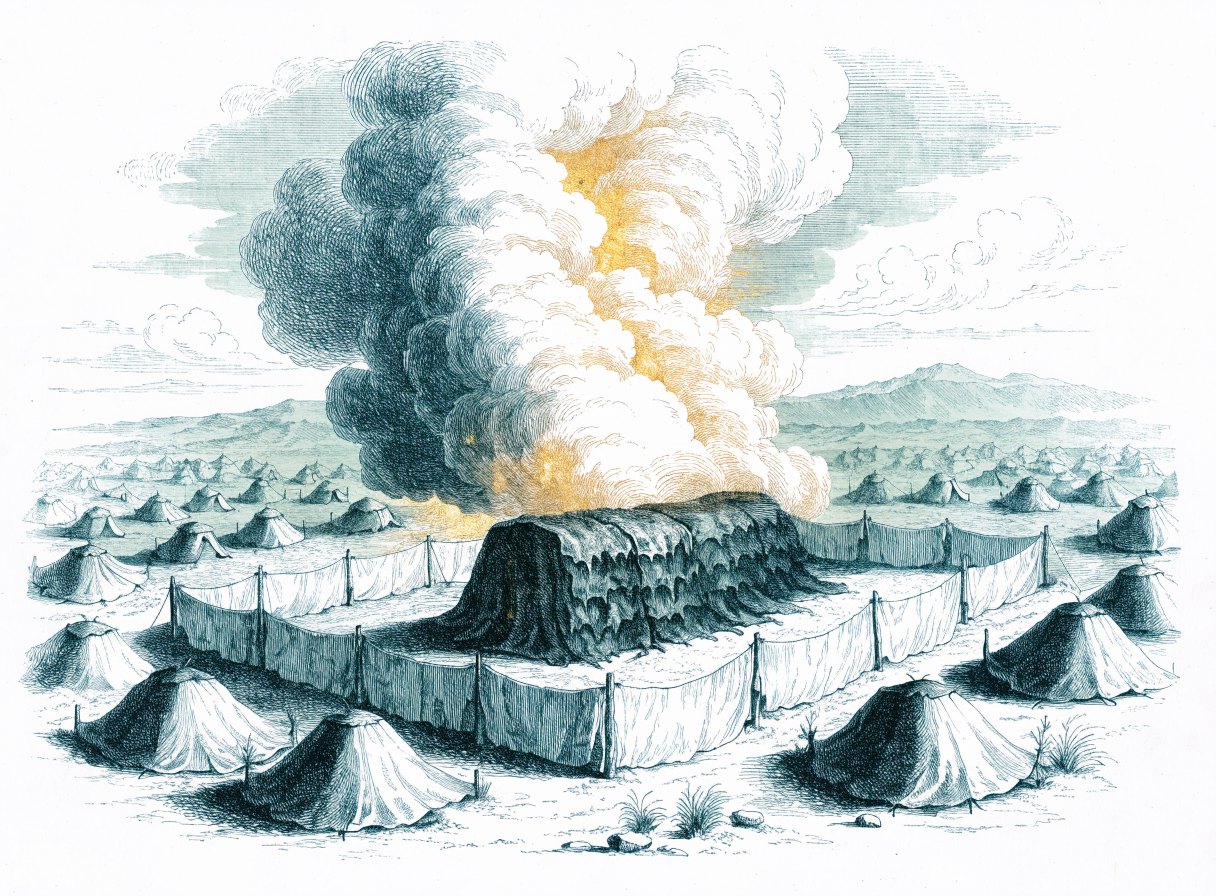
On our timeline, this is about 1445 BC. Israel is still camped at the foot of Sinai, about a year after leaving Egypt. And at the end of Exodus, the cloud of God’s glory comes down and fills the tent. These two weeks walk you through that tent. This week we go piece by piece from the gate to the inner room and see how every piece points to Jesus.
The Word: Dwelling Place
Part One: A Pattern from the Mountain
God did not leave the design to Israel’s imagination. “Exactly as I show you concerning the pattern of the tabernacle… so you shall make it” (25:9). And again, “see that you make them after the pattern for them, which is being shown you on the mountain” (25:40). The book of Hebrews explains why the details mattered so much: the tabernacle was “a copy and shadow of the heavenly things” (Heb. 8:5). The tent on earth was a model of a greater reality, the true dwelling place of God.
Two details in these chapters are worth noticing. First, God paid for his house through willing gifts: “From every man whose heart moves him you shall receive the contribution for me” (25:2). The people gave so generously that the craftsmen had to come to Moses and say, “The people bring much more than enough,” and Moses had to tell everyone to stop giving (36:5–7). That is what grace does to slaves who have just been set free.
Second, God chose a craftsman named Bezalel and said, “I have filled him with the Spirit of God, with ability and intelligence, with knowledge and all craftsmanship, to devise artistic designs, to work in gold, silver, and bronze” (31:3–4). Bezalel is the first person in the Bible said to be filled with the Spirit of God, and he was an artist. Beauty and skill in the service of God are gifts of the Spirit.
Part Two: A Walk Through the Tent
Imagine you are an Israelite walking toward the tabernacle. It sits in the very center of the camp, with the twelve tribes encamped around it on every side. Here is what you would find.
The courtyard and the one gate. A fence of white linen curtains surrounds a courtyard. There is only one way in, a single gate on the east side. You cannot come to God by any entrance you choose.
The bronze altar. The first thing you meet inside the gate is a large altar of wood covered in bronze, with a horn on each corner (27:1–2). This is where the animals were sacrificed. Before anyone could go one step closer to God, something had to die. In Week 21 we will look closely at the sacrifices offered here.
The bronze basin. Between the altar and the tent stood a large bronze basin of water, where the priests washed their hands and feet before serving, “so that they may not die” (30:19–21). Even after the sacrifice, the one who comes near must be made clean.
The Holy Place. The tent itself had two rooms. The first, called the Holy Place, held three pieces of gold furniture. On one side, a golden lampstand with a central stem, six branches, and seven lamps, its cups shaped like almond blossoms so it looked like a flowering tree (25:31–40). It was the only light in the room. On the other side, a table with twelve loaves of bread (Lev. 24:5–9), called “the bread of the Presence,” set out “before me regularly” (25:30), one loaf for each tribe, as if Israel were always eating at God’s table. And in front of the inner curtain, a small golden altar of incense, where sweet-smelling incense burned every morning and evening (30:1–8).
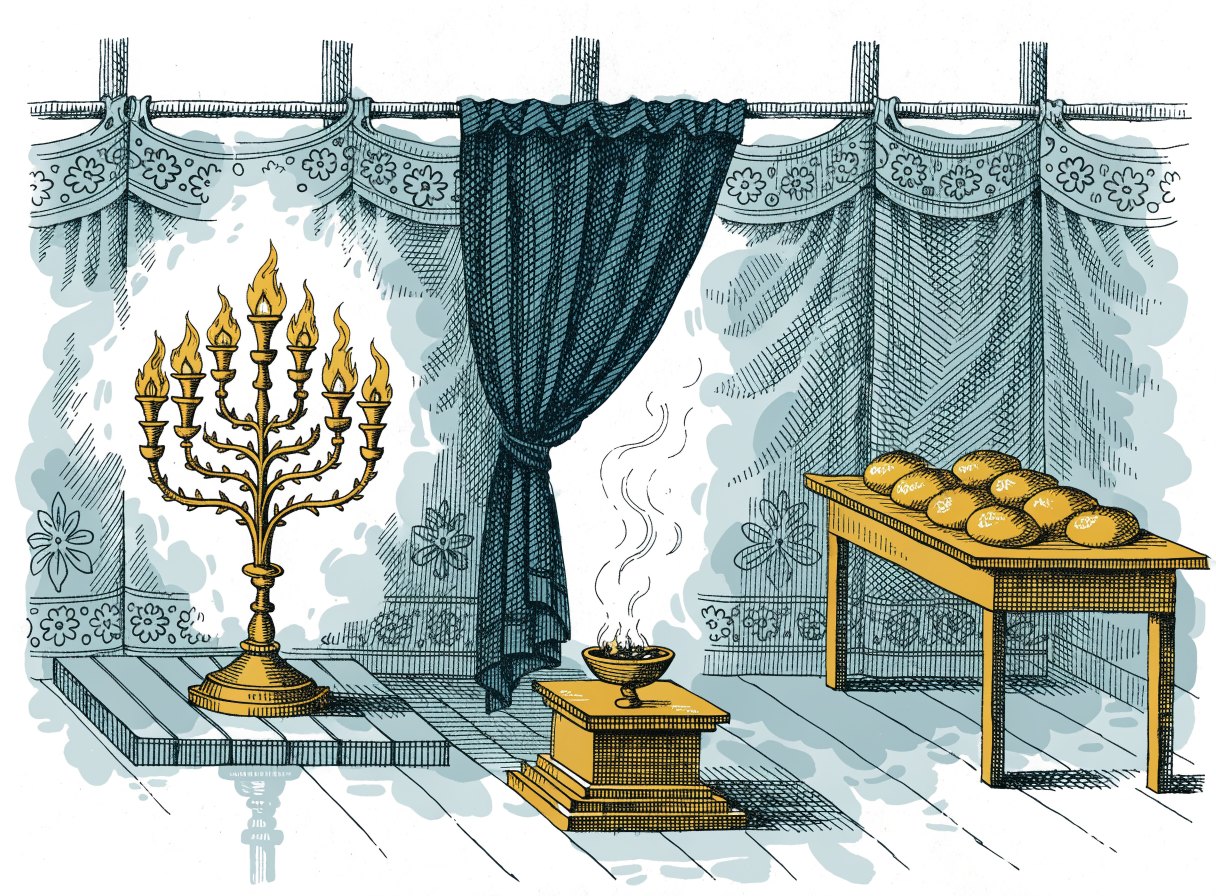
The veil. Between the Holy Place and the inner room hung a heavy curtain, a veil “of blue and purple and scarlet yarns and fine twined linen… with cherubim skillfully worked into it” (26:31). Remember the cherubim from Week 8, guarding the way back to Eden? Here they are again, woven into the curtain. The way into God’s presence was still guarded.
The Most Holy Place. Behind the veil was a small square room with one piece of furniture: the ark of the covenant, a wooden chest covered in gold. Inside it were the stone tablets of the Ten Commandments (25:16). On top of it was a lid of pure gold called the mercy seat, with two golden cherubim facing each other, their wings stretched over it (25:17–20). And God said, “There I will meet with you, and from above the mercy seat, from between the two cherubim that are on the ark of the testimony, I will speak with you about all that I will give you in commandment for the people of Israel” (25:22).
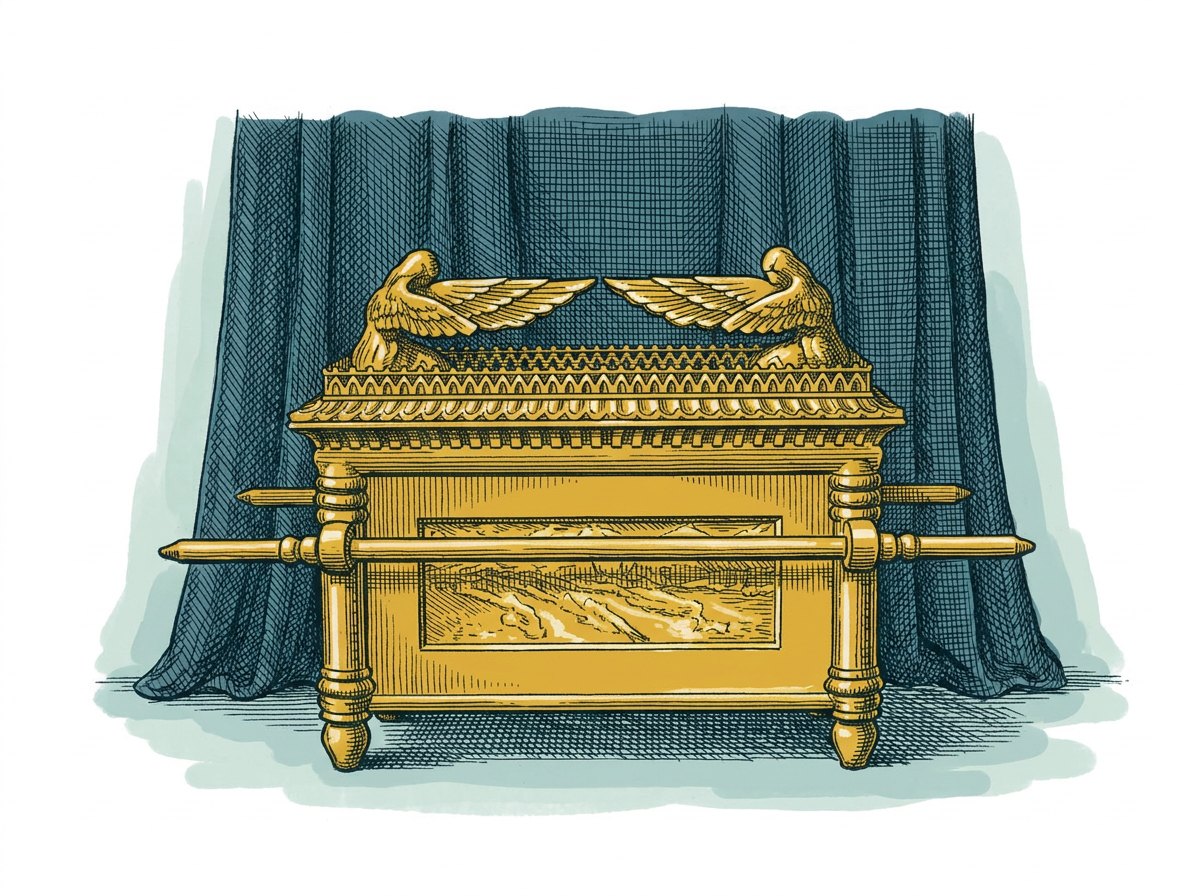
Think about the picture. Inside the ark was the law Israel would break, the law that on its own could only condemn them. Over the law was the mercy seat. And over the mercy seat was the presence of God. The place where God met his people was a lid of mercy covering the law they could not keep. Once a year the high priest would sprinkle blood on that very lid. We will see it in Week 22.
God is holy. He is utterly pure and set apart from everything sinful and ordinary, and his glory is beyond us. That is why the tabernacle had a curtain and why sinners could not simply walk into his presence. Only a sacrifice and a priest could open the way.
The Turn: Every Piece Points to Him
Walk back through the tent with Jesus in mind. He is the one gate: “I am the door” (John 10:9). He is the sacrifice on the altar. He is the light of the world (John 8:12) and the bread of life (John 6:35). And when he died, the curtain in the temple, the successor to this very veil, “was torn in two, from top to bottom” (Matt. 27:51). Now “we have confidence to enter the holy places by the blood of Jesus, by the new and living way that he opened for us through the curtain, that is, through his flesh” (Heb. 10:19–20). Paul even uses the word for the mercy seat when he says God put Christ forward “as a propitiation by his blood” (Rom. 3:25), the place where God’s anger at sin is turned away and mercy meets us.
God wanted to live with Israel, and Israel could not simply walk in. In Jesus, God came to live with us and opened the way. Next week we meet the priests who served in the tent, and watch the glory of God come down and fill it.
Living It: Three Practices for This Week
Before Week 20: Read Exodus 28 and 33:12–23, then 40:16–38. Week 20 meets the priests and watches the glory fill the tent.
For Discussion
- Exodus spends thirteen chapters on the tabernacle. Why do you think God cared so much about the details of his dwelling place?
- The people gave so much that Moses told them to stop. What makes a person give like that?
- Walk through the tabernacle from the gate to the ark. What does the order of the furniture teach about coming to God?
- Inside the ark was the law; over it was the mercy seat. What does that picture say to you?
Sources & For Further Study
- On מִשְׁכָּן and שָׁכַן: Brown, Driver, and Briggs, Hebrew and English Lexicon; Koehler and Baumgartner, HALOT, s.v. On σκηνόω in John 1:14: Bauer, Danker, Arndt, and Gingrich (BDAG), s.v.
- For further reading: Philip Graham Ryken, Exodus: Saved for God’s Glory (Preaching the Word); Vern S. Poythress, The Shadow of Christ in the Law of Moses; L. Michael Morales, Who Shall Ascend the Mountain of the Lord?
Leading a small group? This week comes as a beautifully formatted, printable PDF, along with a 2-page Small Group Guide: a discussion page for your group and leader notes with a session plan and answer key. Both are free when you join the weekly list.