

“But the word of God increased and multiplied.” Acts 12:24
Introduction: Scattered and Sent
Last week the Holy Spirit came at Pentecost. Peter preached, three thousand believed and were baptized, and the church was born.
This week the church meets its first opposition: arrests, beatings, and the death of Stephen. Then the gospel breaks out of Jerusalem to Samaria, to an Ethiopian on a desert road, and into the house of a Roman soldier.
Part Three: Bold Under Fire
The religious leaders who had condemned Jesus soon arrested Peter and John after they healed a crippled man in Jesus’ name and preached that Jesus had risen (3:1–4:3). Peter, “filled with the Holy Spirit,” told the council, “there is salvation in no one else, for there is no other name under heaven given among men by which we must be saved” (4:8, 12). When they were ordered to stop speaking about Jesus, Peter and John answered, “we cannot but speak of what we have seen and heard” (4:20). Later, when all the apostles were arrested, Peter and the others said, “We must obey God rather than men” (5:29). After being beaten, they left “rejoicing that they were counted worthy to suffer dishonor for the name” (5:41).
Then came the first martyr. Stephen was one of seven men chosen to care for the church’s widows (6:1–6), and he preached boldly before the council. “Full of the Holy Spirit,” he looked up and saw “the Son of Man standing at the right hand of God” (7:55–56). They dragged him out of the city and stoned him, and as he died he prayed, “Lord, do not hold this sin against them” (7:60), just as Jesus had prayed on the cross. Watching, holding the coats of the men throwing the stones, was a young man named Saul (7:58).
A wave of persecution followed, and the believers scattered throughout Judea and Samaria, though the apostles stayed in Jerusalem (8:1). But look what happened: “Now those who were scattered went about preaching the word” (8:4). The persecution meant to stop the church spread it. And Saul, the persecutor, was stopped in his tracks on the road to Damascus by a light from heaven and a voice: “Saul, Saul, why are you persecuting me?… I am Jesus, whom you are persecuting” (9:4–5). The church’s fiercest enemy would become its greatest missionary. That is Week 47.
Part Four: To the Ends of the Earth
Jesus had given the plan in Acts 1:8: Jerusalem, then Judea and Samaria, then the end of the earth. Acts follows that plan step by step, and Weeks 47 and 48 carry it all the way to Rome.
Philip, another of the seven chosen with Stephen (not the apostle Philip), preached in Samaria, among the people the Jews despised, and many believed. Then the Spirit sent him to a desert road, where an Ethiopian official was riding in his chariot reading Isaiah 53: “Like a sheep he was led to the slaughter” (8:32). “Do you understand what you are reading?” Philip asked. “How can I, unless someone guides me?” And “beginning with this Scripture he told him the good news about Jesus” (8:30–31, 35). The man believed and was baptized, and he went on his way rejoicing, carrying the gospel toward Africa.
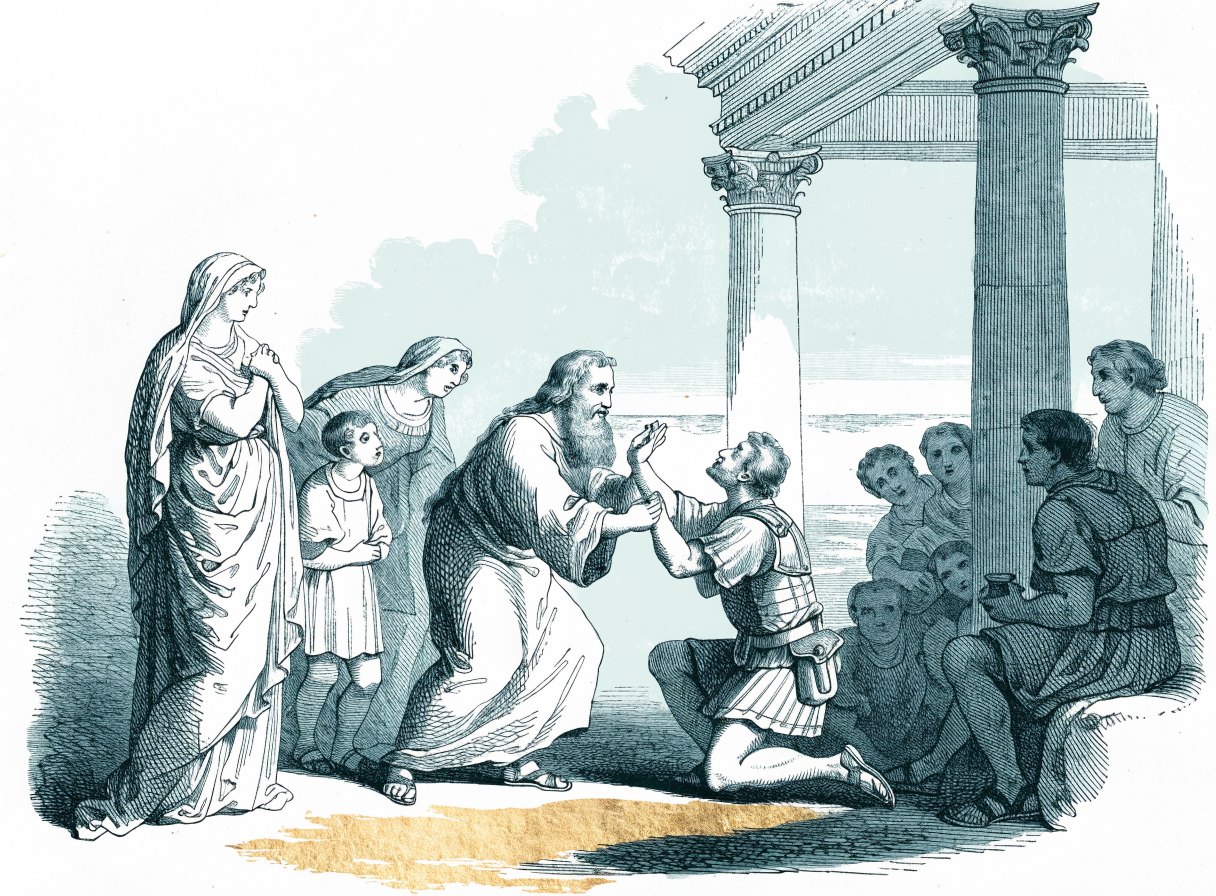
Then came the hardest barrier of all. Peter, a devout Jew, would never have entered the home of a Gentile, someone who was not a Jew (10:28). God gave him a vision of unclean animals and a voice: “What God has made clean, do not call common” (10:15). While Peter was still puzzling over it, messengers arrived from Cornelius, a Roman army officer who feared God. Peter went to his house and said, “Truly I understand that God shows no partiality” (10:34). While Peter was still preaching about Jesus, “the Holy Spirit fell on all who heard the word,” and Peter had them baptized (10:44, 48). When the church in Jerusalem heard Peter’s report, they fell silent and then praised God: “Then to the Gentiles also God has granted repentance that leads to life” (11:18).
In Antioch, a great city to the north, Jews and Gentiles worshiped together, and “in Antioch the disciples were first called Christians” (11:26). The promise to Abraham, “in you all the families of the earth shall be blessed” (Gen. 12:3; Week 11), was coming true. King Herod killed the apostle James and threw Peter in prison, but an angel led Peter out (12:1–11). Kings and councils tried to stop it, but Luke closes this part of the story simply: “But the word of God increased and multiplied” (12:24).
The Turn: The Promise Is for You
On the day of Pentecost, the crowd asked the most important question anyone can ask: “Brothers, what shall we do?” Peter’s answer still stands: turn from your sin to Jesus, receive his forgiveness and the gift of the Holy Spirit, and be baptized as the sign that you belong to him. “For the promise is for you and for your children and for all who are far off, everyone whom the Lord our God calls to himself” (Acts 2:39). “All who are far off” meant the nations, people with no connection to Israel at all. If you feel far off, that line is for you, and God is calling you through these very words.
And notice that the first Christians did not follow Jesus alone. They joined his people. They devoted themselves to God’s word, to each other, to the Lord’s Supper, and to prayer. The Christian life is meant to be lived in a church, where the Spirit uses ordinary means to grow ordinary people. “Not neglecting to meet together… but encouraging one another” (Heb. 10:25).
The same Spirit who came at Pentecost gives new life today. God “saved us, not because of works done by us in righteousness, but according to his own mercy, by the washing of regeneration and renewal of the Holy Spirit” (Titus 3:5). That washing is the Spirit’s own work inside us, giving us a new heart. Baptism is the outward sign of it. If you have never turned to Christ, ask God for his Spirit, turn from your sin, and trust Jesus as Lord and Christ. And if you have, find your place among God’s people, and be his witness where you are.
Living It: Three Practices for This Week
Before Week 47: Read Acts 9:1–31, 13–14, and 16–17. Week 47 follows Saul, the persecutor who became an apostle.
For Discussion
- Persecution scattered the believers, and they preached wherever they went. Have you seen hardship spread the gospel?
- Peter had to learn that “God shows no partiality.” What barriers between people does the gospel break down today?
- Why does the Christian life need to be lived in a church, and not just privately?
- As he died, Stephen prayed, “Lord, do not hold this sin against them.” Where do you need grace to pray like that?
Sources & For Further Study
- On Acts: Dennis E. Johnson, The Message of Acts in the History of Redemption; John Stott, The Message of Acts.
- For further reading: Mark Dever, What Is a Healthy Church?; Michael Green, Evangelism in the Early Church.
Leading a small group? This week comes as a beautifully formatted, printable PDF, along with a 2-page Small Group Guide: a discussion page for your group and leader notes with a session plan and answer key. Both are free when you join the weekly list.