

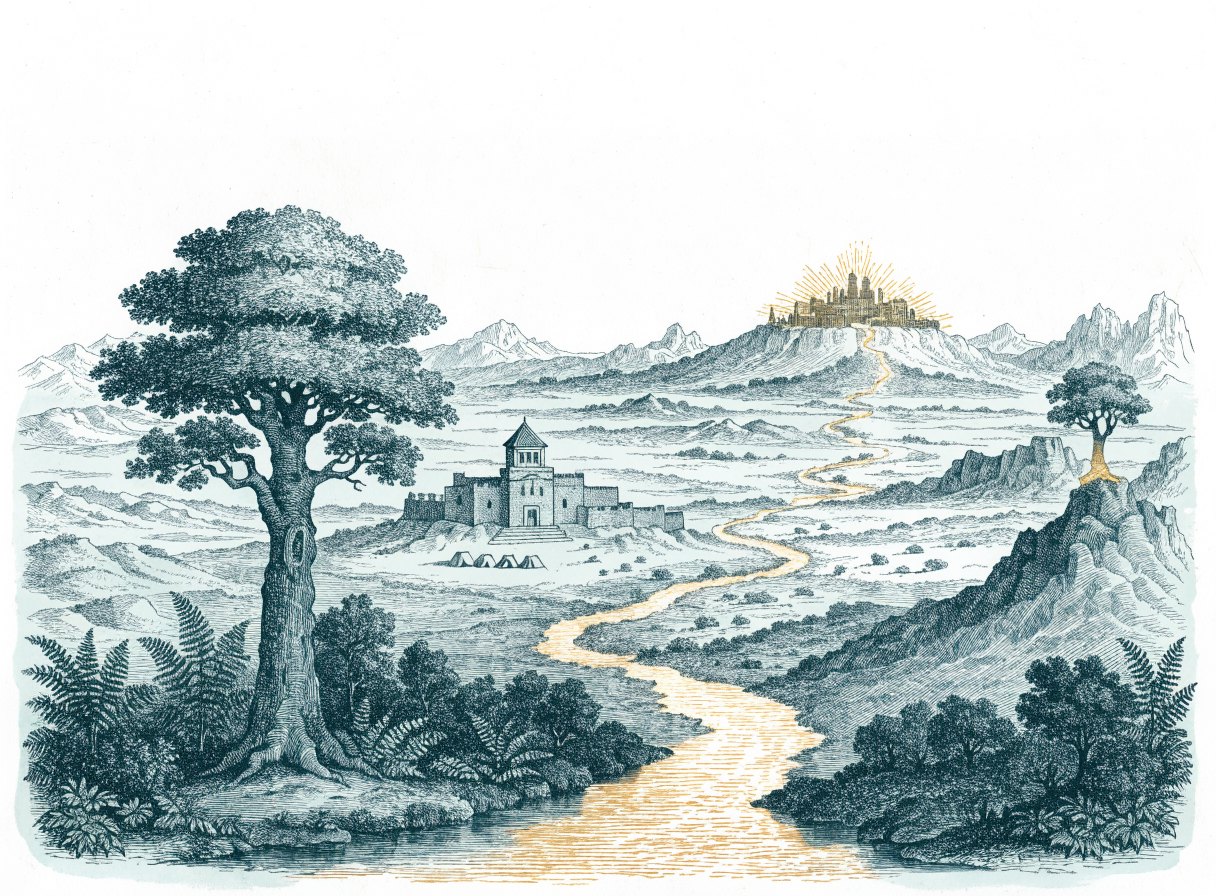
“Behold, I am making all things new.” Revelation 21:5
Introduction: From the Road to the Whole Story
Last week we walked with two discouraged disciples on the road to Emmaus and watched Jesus open the Scriptures to them, “beginning with Moses and all the Prophets” (Luke 24:27). We saw that the Bible is one book made of sixty-six, with one Author and one subject.
This week we step back and look at the whole story at once. Jesus did not hand those two disciples a pile of verses. He showed them a story, and every story has a shape. Before we spend the rest of the year on the details, we need that shape in one glance: four acts, a timeline with real dates, and two threads that run from the first page to the last.
Part Four: The Whole Story in Four Acts
So what is the story? Christians through the centuries have summed it up in four acts. Learn these four words and you will never be completely lost in the Bible again, because every page you read belongs to one of them.
Act One: Creation. “In the beginning, God created the heavens and the earth” (Gen. 1:1). Before anything else existed, God was. He made everything out of nothing, and he made it good. He made human beings in his own image, to know him, to love him, and to rule his world under him. And he came near to them. He placed them in a garden and spoke with them there (Gen. 2:15–22). Even after they sinned, they heard him walking in the garden (Gen. 3:8).
Act Two: The Fall. In Genesis 3 the first man and woman listened to a lying voice and reached for what God had forbidden. They wanted to be like God without God. Everything broke at once: their trust in God, their love for each other, their bodies, the ground they worked. Death entered the world, and every one of us has been born on this side of that door. And it goes deeper than the world around us. We are born guilty in Adam and with hearts bent away from God (Rom. 5:12), and each of us adds our own sins to his (Rom. 3:23). It is why the world feels the way it does.
Act Three: Redemption. Then comes the wonder: God did not abandon what he had made. In the same chapter where sin enters, he makes a promise: one born of the woman will crush the serpent’s head, though the serpent will strike his heel (Gen. 3:15). The rest of the Bible, from Genesis 3 to Revelation 20, is the story of God keeping that promise. He chooses Abraham. He rescues Israel from Egypt. He gives the law and the tabernacle (a tent where he would live among them). He raises up David. He sends the prophets. And at last he sends his own Son, who lives the life we failed to live, dies the death we deserved, and rises again. Most of the Bible lives in this act, and so will most of our weeks.
Act Four: Restoration. The story does not end with the world as it is now. Jesus is coming back, and when he does he will make all things new. The last two chapters of the Bible show a new heaven and a new earth, and a voice from the throne says, “Behold, the dwelling place of God is with man. He will dwell with them, and they will be his people, and God himself will be with them as their God” (Rev. 21:3). He will also judge the world in righteousness, and the new creation belongs to those who belong to him (Rev. 21:7, 27). That is where it is all going.
Look at how the Bible ends, because it tells you how the Bible begins. Genesis 2 has a garden, a river flowing out of it, and the tree of life in the middle. Revelation 22 has a river “bright as crystal, flowing from the throne of God and of the Lamb,” and on either side of it, “the tree of life with its twelve kinds of fruit” (Rev. 22:1–2). The last page answers the first. Everything lost in the garden is restored, and more than restored. The garden has become a city, full of people from every nation, and “they will see his face” (22:4).
Part Five: When It Happened
The Bible is not a book of myths that float free of history. It names kings we can find in Assyrian and Babylonian records. It gives ages, reigns, and the number of years between events. Luke opens his Gospel by telling us he “followed all things closely” and wrote “an orderly account” (Luke 1:3). God worked in real time, in real places, with real people. So in this study we are going to keep a timeline in front of us the whole way.
A word on how these dates are worked out. From the divided kingdom onward, Israel’s kings can be checked against Assyrian and Babylonian records, and most scholars place Solomon within about a decade. This study uses Edwin Thiele’s widely followed dates. Jerusalem fell to Babylon in 586 BC (some count 587). Solomon began building the temple in 966 BC. The Bible itself then gives us a bridge backward: Solomon started the temple “in the four hundred and eightieth year after the people of Israel came out of the land of Egypt” (1 Kings 6:1). Count back 480 years and you reach the Exodus in 1446 BC. A year later, “in the first month in the second year, on the first day of the month, the tabernacle was erected” (Ex. 40:17). That was the tent where God lived among his people in the wilderness, almost five hundred years before Solomon built the temple in stone.
Before Abraham, the dates come from the ages listed in the family records of Genesis 5 and 11. Counted at face value, they put Adam roughly six thousand years ago and Noah’s flood around 2450 BC, about forty-five hundred years ago. You may have heard of Archbishop James Ussher, who in 1650 dated creation to 4004 BC. He used the same method, but he read the 430 years of Exodus 12:40 as starting with Abraham’s call instead of as Israel’s time in Egypt. That shortens the count by about two centuries, which is the main reason his date runs about a century younger than ours.
You should know that faithful Christians, including Reformed ones, have read those early chapters differently. In 1890 the Princeton scholar William Henry Green argued that the genealogies in Genesis skip generations, the way Matthew’s list of Jesus’ ancestors does (Matthew 1:8 says “Joram the father of Uzziah,” skipping three kings listed in 1 Chronicles 3:11–12). Others place the Exodus later, around 1260 BC. This study uses the dates you get by taking those numbers at face value, and where good Christians disagree we will say so honestly instead of pretending the question does not exist. What no faithful reader disputes is the part that matters most: Adam was a real man, the fall was a real event, and God’s promises unfolded in real history until the Son of God was born in Bethlehem while Herod was king.
Every week from here on will open with a small “You are here” marker on this timeline. By the end you will be able to sketch it from memory, and when you read any page of the Bible you will know roughly where you are standing.
Part Six: Two Threads to Follow
Long stories have threads, ideas that appear early, disappear for a while, and come back stronger. If you notice them, the story holds together. The Bible has many, but we are going to follow two of them from Genesis to Revelation, because together they carry the whole gospel.
The first thread is God dwelling with his people. In Eden God spoke with the man and woman he had made. After the fall, that closeness was lost, and the rest of the Bible is God making a way back. He came down to live in a tent in the middle of Israel’s camp (the tabernacle), and then in a house of stone in Jerusalem (Solomon’s temple). Neither building could contain God, as Solomon himself said (1 Kings 8:27); each was the place God chose to meet with his people and show his presence among them. When that temple was destroyed, a smaller one was rebuilt after the exile. Then John writes a sentence no one expected: “And the Word became flesh and dwelt among us” (John 1:14). The word for “dwelt” means he pitched his tent among us. Jesus is where God lives with man. Now, through his Spirit, his people are called God’s temple (1 Cor. 3:16). And at the end, “the dwelling place of God is with man” (Rev. 21:3). Garden to tent to temple to Jesus to the church to the city of God.
The second thread is the Lamb. When Adam and Eve sinned, God himself “made for Adam and for his wife garments of skins and clothed them” (Gen. 3:21). Something died so that their shame could be covered. From there the thread runs through Abel’s offering, to Abraham on Mount Moriah telling his son, “God will provide for himself the lamb” (Gen. 22:8), to the Passover lamb whose blood marked the doors in Egypt, to the Day of Atonement, the one day each year when Israel’s sins were covered, when the high priest carried blood behind the curtain into the Most Holy Place, the inner room of God’s presence. Thousands upon thousands of animals died on Israel’s altars. And yet the book of Hebrews says something startling: “For it is impossible for the blood of bulls and goats to take away sins” (Heb. 10:4). Those sacrifices were real, and God used them, but they were temporary. They were pointing at someone. When John the Baptist saw Jesus walking toward him, he said, “Behold, the Lamb of God, who takes away the sin of the world!” (John 1:29). And the song of heaven is this: “Worthy are you to take the scroll and to open its seals, for you were slain, and by your blood you ransomed people for God from every tribe and language and people and nation” (Rev. 5:9).
Watch for one more thing, because we will come back to it in Week 12. God sent Abraham to offer his son “on one of the mountains” in “the land of Moriah” (Gen. 22:2), and there God provided a ram instead. More than a thousand years later Solomon built the temple “on Mount Moriah” (2 Chron. 3:1). Jewish and Christian readers have long taken these as the same place. If they are, the two threads meet on one hill. Where God provided the sacrifice, God came to dwell. Every week from here on will include a “Thread Watch” box showing where these two threads surface in that part of the story.
The Road Ahead: Fifty-Two Weeks
This is where the year goes. Each unit is one stretch of the story, and each week takes one step. Every week follows the same pattern: where we are on the timeline, the passage to read, the story itself, how it points to Jesus, a few practices for the week, and questions to talk through.
| Unit | Weeks |
|---|---|
| 1. Foundations | 1 The Road to Emmaus · 2 The Whole Story in Four Acts · 3 The God Who Is There · 4 One God in Three Persons · 5 Out of Nothing, by a Word · 6 Made in His Image · 7 “Did God Actually Say?” · 8 The Curse and the Promise · 9 Cain and Abel · 10 The Flood and Babel |
| 2. The Promise | 11 The Call and the Covenant · 12 The Mountain of Moriah · 13 Isaac, Jacob, and the Twins · 14 Joseph: Meant for Good |
| 3. Rescue and Covenant | 15 Slaves in Egypt · 16 The Lamb and the Sea · 17 The Ten Words · 18 What the Law Is For · 19 A Walk Through the Tent · 20 The Priests and the Glory · 21 A Life for a Life · 22 The Day of Atonement · 23 Forty Years in the Desert · 24 Into the Land |
| 4. The Kingdom | 25 The Downward Spiral · 26 Ruth: Grace in the Dark · 27 A King Like the Nations · 28 A House Forever · 29 Wisdom and the Temple · 30 The Glory and the Fall · 31 Fire on the Mountain · 32 Prophets Sent, Prophets Ignored · 33 The Temple Falls · 34 Faithful in Babylon · 35 Rebuilding the House · 36 The Last Prophet and the Silent Years |
| 5. The King Arrives | 37 The Word Became Flesh · 38 Who Do You Say I Am? · 39 The King Arrives · 40 Already and Not Yet · 41 The Supper and the Garden · 42 The Cross · 43 The Empty Tomb · 44 Why It Matters, and the Ascension |
| 6. The Church and the End | 45 Pentecost and the First Church · 46 To the Ends of the Earth · 47 The Persecutor Becomes the Apostle · 48 The Gospel in a Letter · 49 Hebrews and James · 50 Peter, John, and Jude · 51 The Throne and the Lamb · 52 All Things New |
The Turn: Known in the Breaking of the Bread
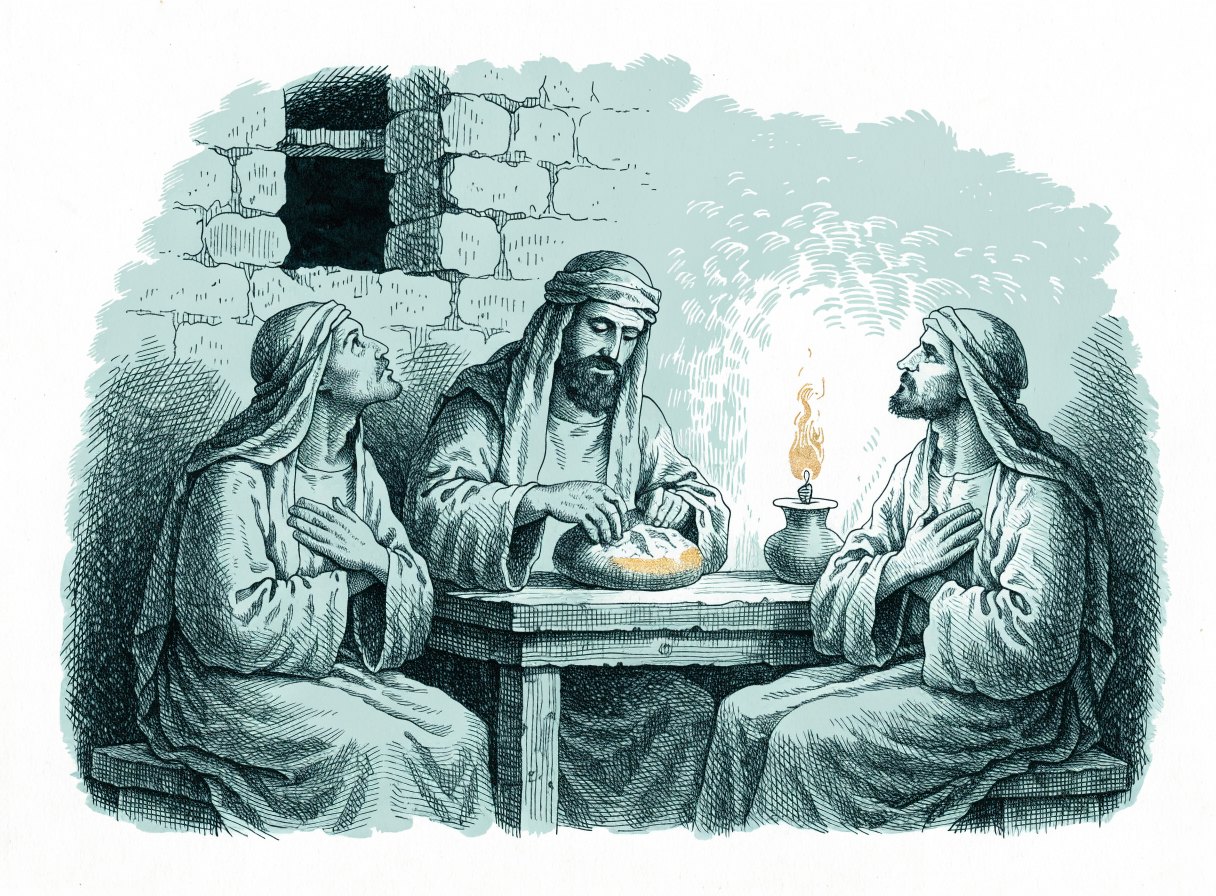
Go back to the road. By the time Jesus finished, the sun was going down and the two disciples had reached their village. He “acted as if he were going farther,” and they begged him, “Stay with us, for it is toward evening and the day is now far spent” (24:28–29). So he came in. At the table, the guest did what only the host should do. He took the bread, blessed it, broke it, and gave it to them. And in that moment their eyes were opened. It was Jesus. Then he was gone.
Their first words to each other are worth memorizing: “Did not our hearts burn within us while he talked to us on the road, while he opened to us the Scriptures?” (24:32). Their hearts started burning before they knew who he was. It happened while he was explaining the Bible. That is what the Scriptures do when Christ opens them. And that is the whole purpose of this study. We are going to learn dates, books, covenants, and kings, but the goal was never a head full of Bible facts. Cleopas already had a head full of facts. The goal is to meet the Person the whole story is about.
Then look at what they did. Seven miles is a long walk, and it was dark. They “rose that same hour and returned to Jerusalem” (24:33). They had been walking away from the city with their faces down. Now they went back to it with news. The road, the dark, and the seven miles were the same. What had changed was that they had seen him alive.
Now the part you most need to hear. When Jesus summed up the whole Bible for his disciples that night, he did not end with the cross and the resurrection. He went one more step: “that repentance for the forgiveness of sins should be proclaimed in his name to all nations” (24:47). All nations. That means the story does not stop at the edge of the page. It reaches all the way to where you are sitting right now. The God who made you, whom you have wronged in more ways than you can count, has made a way back to himself through the death and resurrection of his Son. The Lamb was provided. Forgiveness is offered in his name, and it is offered to you. He calls you to turn from your sin and trust him. That turning is what “repentance” means.
Maybe you are reading this as someone who has just come to faith. Then welcome home. You have stepped into a story that started long before you and will go on long after you, and you have a place in it. Maybe you are not sure yet what you believe. Then come and walk the road anyway. Bring your questions. Jesus was patient with two slow, confused, disappointed disciples. He will be patient with you. And if, somewhere along the way, the Scriptures begin to persuade you that Jesus is who he said he is, do not put him off. Turn to him, trust him, and ask him to receive you. He has promised, “whoever comes to me I will never cast out” (John 6:37).
Living It: Three Practices for This Week
Before Week 3: Read Genesis 1 and Psalm 19. Week 3 asks the first question of the story: who is the God who is there?
For Discussion
- Before this study, how would you have described what the Bible is about in one sentence? How would you describe it now?
- Of the four acts (Creation, Fall, Redemption, Restoration), which one do you think people around you understand least? Which one do you most need to hear right now?
- Read Genesis 2:8–10 and Revelation 22:1–5 side by side. What do you notice? What is the same, and what is better at the end?
- Which of the two threads, the Lamb or God with his people, are you most curious to follow this year? Why?
Sources & For Further Study
- On the dating of the temple and the Exodus: 1 Kings 6:1; Edwin R. Thiele, The Mysterious Numbers of the Hebrew Kings (for the chronology of the kings); the Babylonian Chronicle (for Jerusalem’s first capture in 597 BC, from which the 586 date is counted).
- James Ussher, Annales Veteris Testamenti (1650). William Henry Green, “Primeval Chronology,” Bibliotheca Sacra (1890).
- For further reading: Graeme Goldsworthy, Gospel and Kingdom; Vaughan Roberts, God’s Big Picture; Geerhardus Vos, Biblical Theology.
Leading a small group? This week comes as a beautifully formatted, printable PDF, along with a 2-page Small Group Guide: a discussion page for your group and leader notes with a session plan and answer key. Both are free when you join the weekly list.