

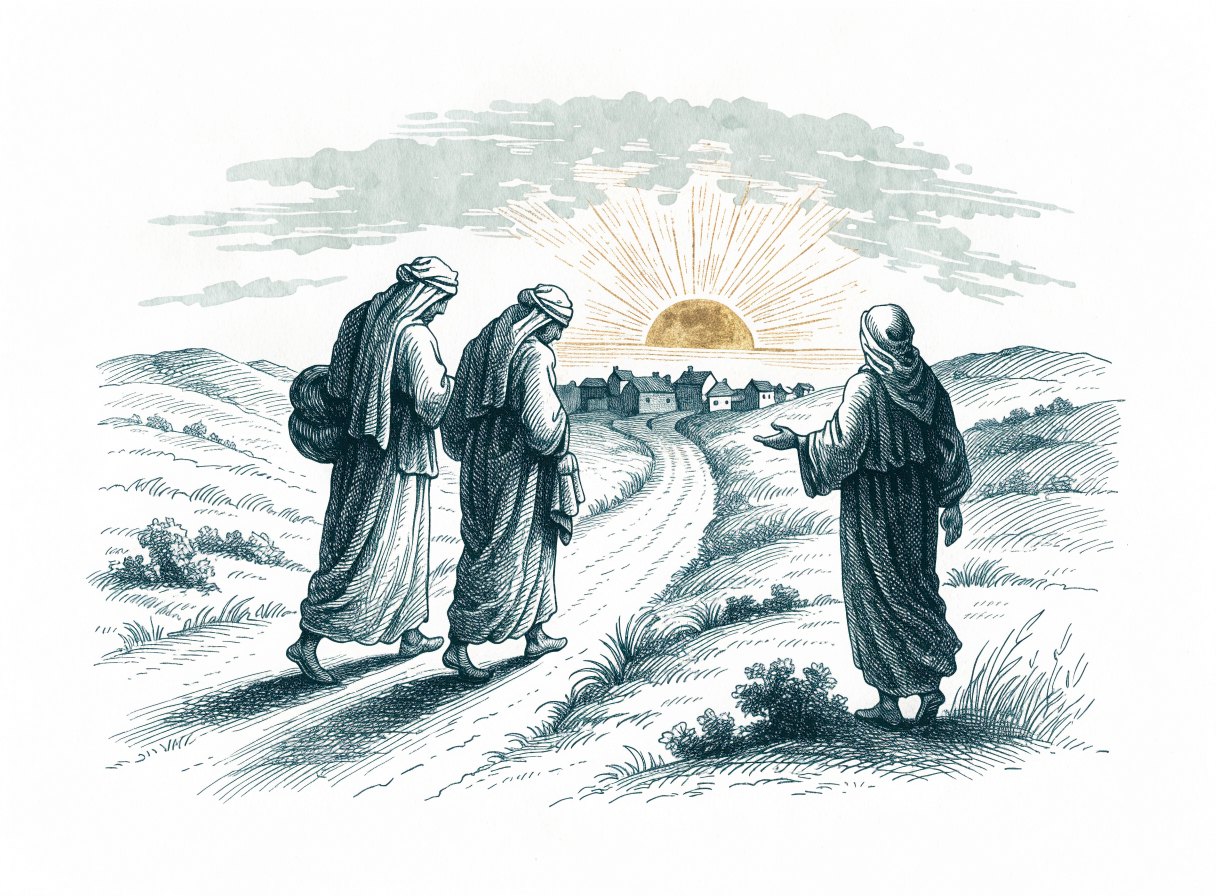
“Did not our hearts burn within us while he talked to us on the road, while he opened to us the Scriptures?” Luke 24:32
Introduction: Walking Home Without the Story
It was Sunday afternoon, and two people were walking home from the worst weekend of their lives.
Luke tells us one of them was named Cleopas. We never learn the other’s name. They had followed Jesus of Nazareth. They had heard him teach and watched him heal, and they had come to believe he was the one God promised to send. Then, on Friday, they watched the authorities nail him to a Roman cross. By Sunday the whole thing was over, or so they thought. So they left Jerusalem and started the seven miles back to a village called Emmaus, talking it over the way grieving people do, going around and around the same few facts.
The strange thing about that walk is that they had all the facts. They knew Jesus was a prophet “mighty in deed and word.” They knew he had been crucified. They had even heard that his tomb was empty that morning and that angels were saying he was alive. Every piece of the good news was already in their hands. And they were walking away from Jerusalem with their faces down, because they did not have the story that held the pieces together.
A lot of people meet the Bible that way. You may know a few pieces: a baby in a manger, a man and an ark full of animals, a verse on a coffee mug, a cross on a wall. Maybe you tried to read the Bible straight through once and got lost somewhere in the laws about mildew in Leviticus. The pieces never seemed to connect, so the Book felt like a pile of old religious writings that only experts could sort out.
This study is for you. Over the next fifty-two weeks we are going to walk through the whole Bible, from the first page to the last, and learn the one story it tells. We will put real dates on it so you can see when Abraham lived and when the temple was built. We will follow two threads that run all the way through it. And we are going to start where Jesus himself started when he wanted two confused disciples to understand their Bibles: on the road to Emmaus.
The Word: He Interpreted
The stranger who joined them on the road was Jesus himself, risen from the dead, though “their eyes were kept from recognizing him” (Luke 24:16). He let them pour out their disappointment. Then he did something they never expected. He could have started by showing them his hands. He opened their Bibles instead. And Luke chose a careful word for what he did with them:
Keep that word in your pocket for all fifty-two weeks. It describes exactly what this study is trying to do. We are asking the one who wrote the Bible to interpret it to us, the way he did on that road.
Part One: “We Had Hoped”
Listen to that phrase: “We had hoped.” It is one of the saddest lines in the Bible. They are speaking in the past tense about the one who should have been their greatest hope. Cleopas thought the cross was the end of the story. It never occurred to him that the cross might be the point of the story.
Why could he not see it? He had been told. Jesus had told his disciples plainly, more than once, that he would be handed over, killed, and raised on the third day (Luke 9:22; 18:31–33). The women had reported the empty tomb. Peter had seen the grave clothes. Cleopas had the facts and still walked away sad, because his idea of the Messiah had no room for a cross. (Messiah is Hebrew for “anointed one,” the King God promised; Christ is the same word in Greek.) He was expecting a king who would throw off Rome. A crucified Messiah did not fit his story, so he concluded the story had failed.
Jesus’ diagnosis is blunt, and it is also kind: “O foolish ones, and slow of heart to believe all that the prophets have spoken!” (24:25). Mark the word all. They believed some of what the prophets said. They loved the promises about a glorious king. They skipped the parts about a servant who would be “pierced for our transgressions” (Isa. 53:5). They had read the Bible in pieces, kept the pieces they liked, and so they missed the shape of the whole.
That is the danger this study is meant to guard you against. When you only know pieces of the Bible, you will fill the gaps with your own expectations. You will decide what God ought to be like and what he ought to do, and when life does not match, you will say, “We had hoped.” The cure is the whole story, read the way its Author reads it.
Part Two: Beginning with Moses
“Was it not necessary that the Christ should suffer these things and enter into his glory?” (24:26). The word necessary matters. Jesus is saying the cross was written into the plan from the beginning. So he starts “with Moses,” which means the first five books of the Bible, and walks them through “all the Scriptures.”
Later that same night he appeared to the rest of the disciples in Jerusalem and said it again, even more fully:
“The Law of Moses and the Prophets and the Psalms.” Jesus’ words match the three-part shape the Hebrew Bible still has: the Law (Genesis through Deuteronomy), the Prophets (Joshua, Judges, Samuel, and Kings, along with the prophets themselves), and the Writings, whose best-known book is the Psalms. English Bibles arrange the same books differently, as we will see in a moment. So when Jesus names all three, he is putting his hand on the whole Old Testament and saying, “This is about me.”
Think about what that means for how we read. Some Christians treat the Old Testament as a long preface they politely skim before getting to the good part. Jesus treated it as the first half of one story, aimed at him from its opening chapters. Augustine, the great North African pastor, put it in a line Christians have repeated for sixteen hundred years: “The New is hidden in the Old, and the Old is made plain in the New” (Questions on the Heptateuch 2.73).
The Reformers saw this clearly, and the Westminster Confession of Faith (a 1640s summary of what Scripture teaches, still used by Presbyterian churches; “WCF” from here on) puts it carefully. God’s one way of saving sinners, which the Confession calls the covenant of grace (a covenant is a binding promise God makes to his people, sealed by his own word), was administered, or handed out, in two ways. In the time of the law it came through “promises, prophecies, sacrifices, circumcision, the paschal lamb, and other types and ordinances delivered to the people of the Jews, all foresignifying Christ to come” (WCF 7.5). In the time of the gospel it comes through the preaching of the Word and the sacraments. But “there are not therefore two covenants of grace, differing in substance, but one and the same, under various dispensations” (WCF 7.6).
Put plainly: Abraham, Moses, and David were saved the same way anyone is saved: by grace, through faith, in the Messiah God promised. The Confession says those old signposts were enough, by the Spirit’s work, to build up God’s people “in faith in the promised Messiah, by whom they had full remission of sins” (WCF 7.5). They looked forward to him. We look back to him. The lambs on the altar, the priests, the temple, the promises to David were all signposts, and every one of them pointed down the road to the same place. When you learn to see the signposts, the Old Testament stops being a maze. It becomes a road, and Jesus is walking it with you.
Also read: John 5:39–40, 46; Acts 3:18; 1 Corinthians 15:3–4; 1 Peter 1:10–12; Romans 15:4
Part Three: One Book Made of Sixty-Six
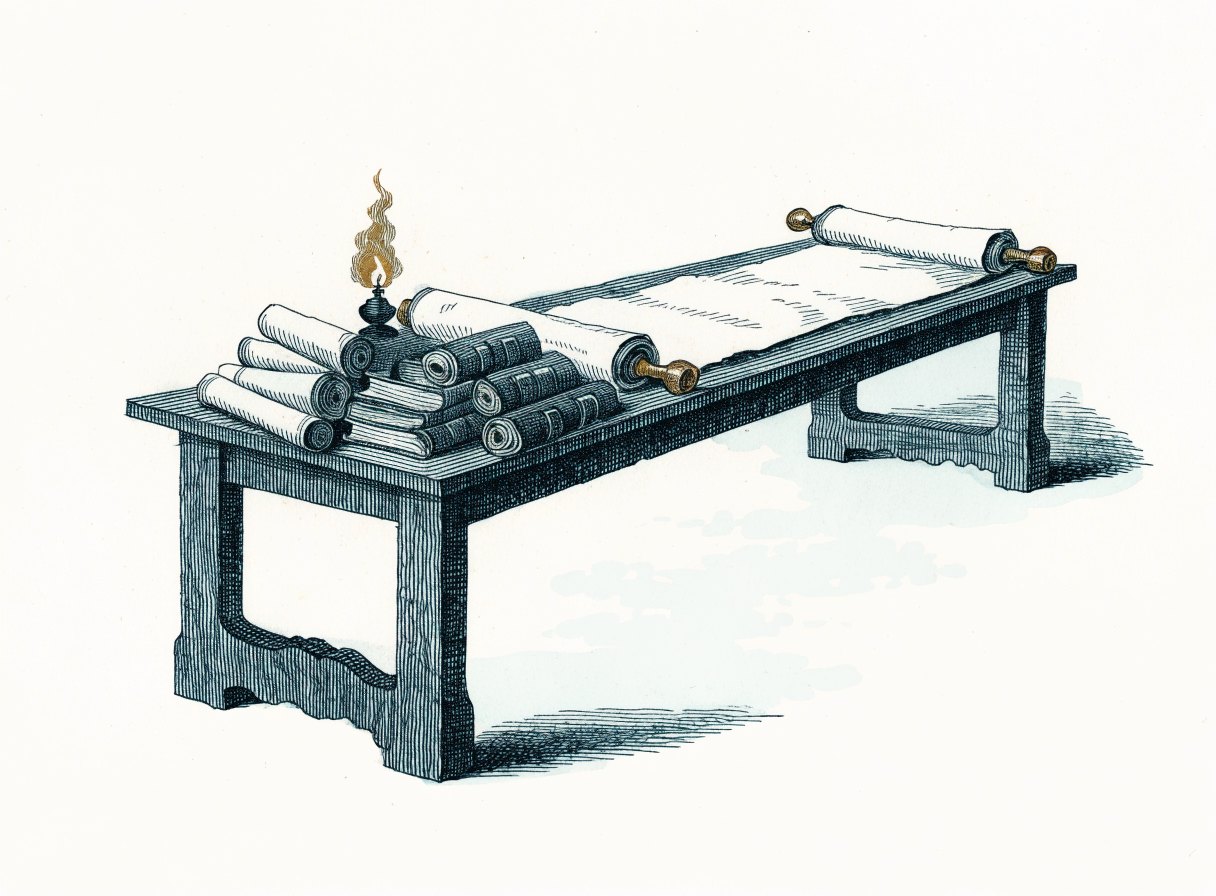
If you are new to the Bible, it helps to know what you are holding. The word Bible comes from a Greek word for “books,” and that is exactly what it is: a library of sixty-six books bound into one volume. Thirty-nine make up the Old Testament, written mostly in Hebrew (with a few chapters in Aramaic) before Jesus was born. Twenty-seven make up the New Testament, written in Greek in the decades after his resurrection. “Testament” is an old word for covenant. The Old Testament is the story of God’s covenant promises. The New Testament is the story of those promises kept in Jesus and carried to the nations.
The books are grouped by kind, not strictly by date, which surprises a lot of new readers. The first shelf of the Old Testament is the Law: five books from creation to Moses. Then come twelve books of history, from Joshua entering the land to Nehemiah rebuilding Jerusalem’s walls. Then five books of poetry and wisdom, including the Psalms and Proverbs. Then the prophets, five “major” and twelve “minor,” named for their size (Lamentations rides with Jeremiah), who preached during the history you just read about. The New Testament follows a similar pattern: four Gospels telling the life of Jesus, one book of history (Acts), twenty-one letters to churches and pastors, and one book of prophecy (Revelation).
A practical word if you have never looked up a verse. A reference like Luke 24:27 means the book of Luke, chapter 24, verse 27. The authors did not write chapter and verse numbers. Those were added much later (chapters in the 1200s, verse numbers in the 1400s and 1500s) to help us find our place. Most Bibles have a table of contents in the front, and there is no shame in using it. Everyone does at first.
These sixty-six books were written by about forty different people across roughly fifteen hundred years, from Moses in the desert to the apostle John on the island of Patmos. They include shepherds, kings, a tax collector, a doctor, fishermen, and a tentmaker. They wrote in palaces and prisons, in Israel, Babylon, and Rome. And they tell one story. That is because behind the many human authors stands one divine Author:
Peter’s word for “carried along” is the same verb Luke uses for a ship driven by the wind (Acts 27:15, 17). The writers really wrote. Their personalities, vocabularies, and circumstances show on every page. But the Spirit filled the sails, and he brought them all to the same harbor. The book of Hebrews opens by naming that harbor: “Long ago, at many times and in many ways, God spoke to our fathers by the prophets, but in these last days he has spoken to us by his Son” (Heb. 1:1–2). Many times, many ways, one Speaker, one final Word.
The Bible is God’s own word, written by human authors as the Holy Spirit carried them along. It is true in all it teaches, and it is the final authority over everything we believe and do. Traditions, feelings, and experts are tested by Scripture, never the other way around.
The Turn: Hearts That Burn
The two disciples on the road had all the facts and none of the story. What changed them was Jesus himself, opening the Scriptures and showing them that every page had been pointing to him. Later they said to each other, “Did not our hearts burn within us while he talked to us on the road, while he opened to us the Scriptures?” (Luke 24:32).
That is what this year is for. The Bible is God’s own word, one book with one Author, and it is about his Son. You can read it the way Cleopas first read his own life, with your face down, sure the story has ended badly. Or you can let Jesus open it. He is still the best teacher of his own book, and he still meets people on the road.
Living It: Three Practices for This Week
Before Week 2: Read Genesis 1–2 and Revelation 21–22. Week 2 steps back to see the whole story in four acts.
For Discussion
- Cleopas had all the facts about Jesus and still walked away sad. Why do you think facts alone did not help him? Where have you seen that in your own life?
- “We had hoped.” Have you ever been disappointed with God because he did not do what you expected? How might knowing the whole story change the way you see that disappointment?
- Jesus said the whole Old Testament was about him (Luke 24:27, 44). What difference does that make in how you approach books like Genesis or Leviticus?
- The two disciples said their hearts burned while Jesus opened the Scriptures (Luke 24:32). What would it look like for you to come to this study expecting to meet him, and not only to learn about him?
Sources & For Further Study
- Augustine, Quaestiones in Heptateuchum 2.73: “in Vetere Novum lateat, et in Novo Vetus pateat.”
- Westminster Confession of Faith (1646), 7.5–6, on the one covenant of grace under law and gospel.
- On διερμηνεύω: Bauer, Danker, Arndt, and Gingrich, A Greek-English Lexicon of the New Testament (BDAG), 3rd ed., s.v.; New Testament uses at Luke 24:27; Acts 9:36; 1 Cor. 12:30; 14:5, 13, 27.
- For further reading: Graeme Goldsworthy, Gospel and Kingdom; Vaughan Roberts, God’s Big Picture; Geerhardus Vos, Biblical Theology.
Leading a small group? This week comes as a beautifully formatted, printable PDF, along with a 2-page Small Group Guide: a discussion page for your group and leader notes with a session plan and answer key. Both are free when you join the weekly list.