

“Consequently, he is able to save to the uttermost those who draw near to God through him, since he always lives to make intercession for them.” Hebrews 7:25
Introduction: Who May Come Near?
Last week we walked through the tabernacle from the one gate to the ark: the bronze altar, the basin, the lampstand, the bread of the Presence, the altar of incense, the veil, and the mercy seat over the broken law. Every piece told Israel that God wanted to live with them, and that sinners could not simply walk in.
This week we meet the men who served in that tent, the high priest above all, and we watch the day the cloud of God’s glory came down and filled it.
Part Three: The Priests
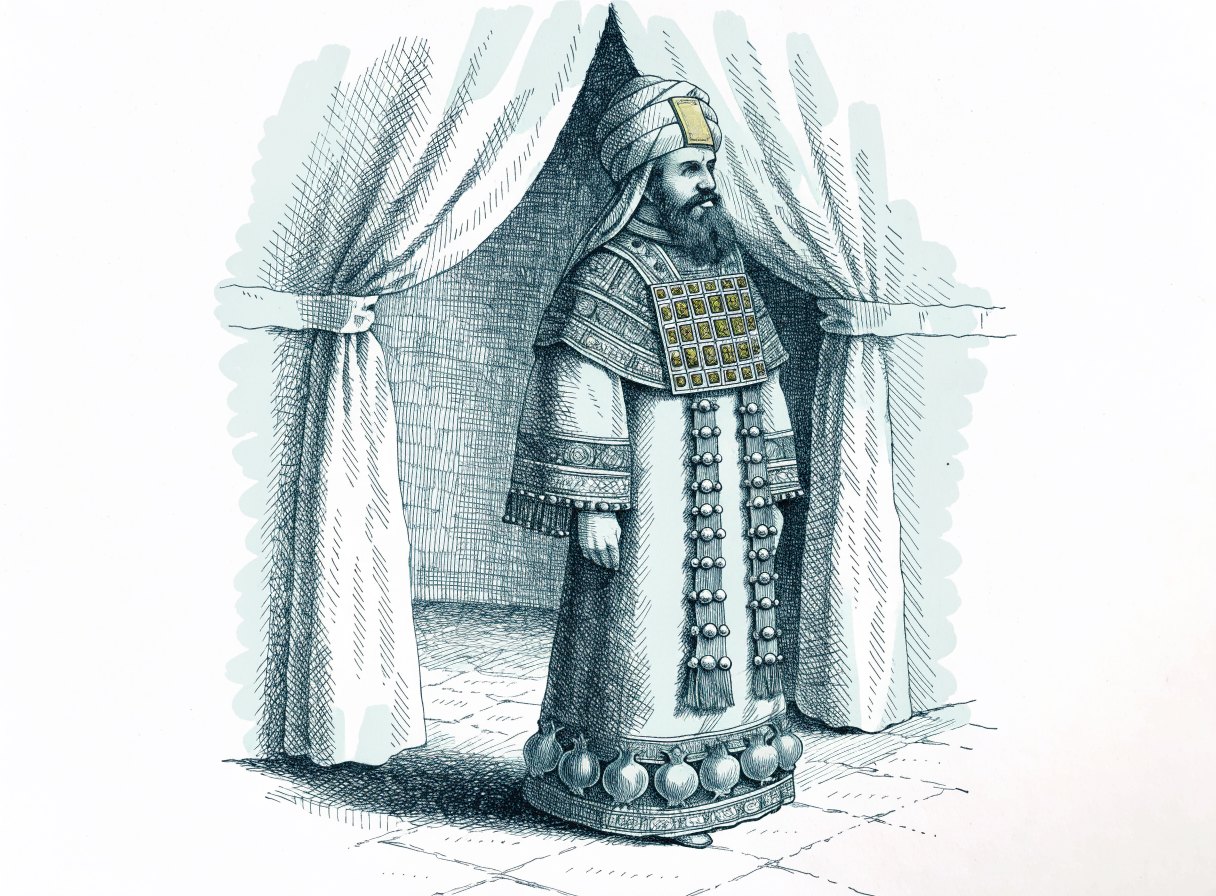
Sinful people living around a holy God needed a mediator, a go-between (remember that word from Week 10). God appointed Moses’ brother Aaron as high priest, and Aaron’s sons as priests (28:1). God told Moses to make them “holy garments… for glory and for beauty” (28:2).
Two details of the high priest’s clothing show you what his job was. On his chest he wore a breastpiece set with twelve precious stones, each engraved with the name of one of the tribes of Israel. “So Aaron shall bear the names of the sons of Israel in the breastpiece of judgment on his heart, when he goes into the Holy Place, to bring them to regular remembrance before the LORD” (28:29). Every time the high priest went in before God, he carried the people on his heart. And on his turban was a gold plate engraved with the words, “Holy to the LORD” (28:36), so that the people “may be accepted before the LORD” (28:38). Aaron was a sinner himself, so the plate was a promise more than a description. The people were accepted because their priest carried their guilt before God (28:38). One day a Priest would come who is holy all the way through (Heb. 7:26).
Part Four: The Glory Fills the Tent
Before the tabernacle was ever built, there was a crisis. After the golden calf, God told Moses he would still give Israel the land, “but I will not go up among you, lest I consume you on the way, for you are a stiff-necked people” (33:3). Moses interceded, and God promised: “My presence will go with you, and I will give you rest” (33:14). Moses held him to that promise: “If your presence will not go with me, do not bring us up from here” (33:15). He understood that the land without God was not worth having, and he knew the one thing that set Israel apart: “Is it not in your going with us, so that we are distinct, I and your people, from every other people on the face of the earth?” (33:16). And God answered, “This very thing that you have spoken I will do” (33:17).
So they built it. “In the first month in the second year, on the first day of the month, the tabernacle was erected” (40:17). Moses set up every piece exactly as God had shown him. And then:
The God of the burning bush, the God of the pillar of fire, the God of the smoking mountain had come to live in a tent among his people. From then on, whenever the cloud lifted, Israel packed up and followed it; when it stayed, they stayed. “For the cloud of the LORD was on the tabernacle by day, and fire was in it by night, in the sight of all the house of Israel throughout all their journeys” (40:38). That is how Exodus ends. A book that began with God’s people as slaves in Egypt ends with God himself living in the middle of their camp.
The Turn: The Word Pitched His Tent
Nearly fifteen hundred years later, the glory came to live among God’s people again. John writes, “And the Word became flesh and dwelt among us, and we have seen his glory, glory as of the only Son from the Father, full of grace and truth” (John 1:14). The eternal Son of God “tabernacled” among us. In Jesus, the glory that filled the tent walked the roads of Galilee, ate with sinners, and touched lepers. When Jesus said, “Destroy this temple, and in three days I will raise it up,” John explains, “he was speaking about the temple of his body” (John 2:19, 21).
And it goes further. Through his Spirit, God now lives in his people: “Do you not know that you are God’s temple and that God’s Spirit dwells in you?” (1 Cor. 3:16). You are being “built together into a dwelling place for God by the Spirit” (Eph. 2:22). At the end, there will be no temple at all, “for its temple is the Lord God the Almighty and the Lamb” (Rev. 21:22).
Last week we walked through the tent with Jesus in mind. The priests point to him too. He is our great high priest who carries our names before God, as Aaron carried Israel’s on his heart, and he “always lives to make intercession” for us (Heb. 7:25).
Moses could not enter the tent when the glory filled it. Because of Jesus, you are invited in. “Let us then with confidence draw near to the throne of grace, that we may receive mercy and find grace to help in time of need” (Heb. 4:16). Turn from your sin, trust the High Priest who opened the way, and come.
Living It: Three Practices for This Week
Before Week 21: Read Leviticus 1, 3, and 17:11. Week 21 stands at the altar and asks why God required all the blood.
For Discussion
- The high priest carried Israel’s names on his heart. Jesus carries the names of everyone who comes to God through him (Heb. 7:25). What would it mean for you to know he carries yours?
- Moses would rather stay in the desert than enter the Promised Land without God (Ex. 33:15). What would you be tempted to settle for without God?
- Christians together are now God’s temple (1 Cor. 3:16), and each believer’s body is a temple of the Spirit (1 Cor. 6:19). How should that change the way you treat your church, other believers, and your own body?
- When Jesus died, the temple curtain was torn in two from top to bottom (Matt. 27:51). What does that mean for how you come to God?
Sources & For Further Study
- On Eden and the tabernacle: Gordon J. Wenham, “Sanctuary Symbolism in the Garden of Eden Story” (1986); G. K. Beale, The Temple and the Church’s Mission.
- For further reading: Philip Graham Ryken, Exodus: Saved for God’s Glory (Preaching the Word); Vern S. Poythress, The Shadow of Christ in the Law of Moses; L. Michael Morales, Who Shall Ascend the Mountain of the Lord?
Leading a small group? This week comes as a beautifully formatted, printable PDF, along with a 2-page Small Group Guide: a discussion page for your group and leader notes with a session plan and answer key. Both are free when you join the weekly list.