

“without the shedding of blood there is no forgiveness of sins.” Hebrews 9:22
Introduction: Why All the Blood?
Leviticus is the book where most plans to read through the Bible quietly die. You come out of the drama of Exodus, and suddenly you are reading about the fat on a bull’s kidneys, which animals may be eaten, and what to do about mold on a wall. And there is blood everywhere. Bulls, goats, lambs, and birds, slaughtered and burned, day after day. For a modern reader it can feel primitive, even disturbing. Why would God want this?
Start where Leviticus starts. Exodus ended with the glory of God filling the tabernacle so powerfully that even Moses could not go in (Ex. 40:35). Leviticus opens with the very next moment: “The LORD called Moses and spoke to him from the tent of meeting” (Lev. 1:1). God has moved in. Now the question is urgent. How can sinful people live next door to a holy God and not be destroyed? Leviticus is God’s answer. Every sacrifice in it is a picture of the answer that would finally come in Jesus.
These two weeks walk through the sacrifices, the holiness that made them necessary, and the most solemn day of Israel’s year, the Day of Atonement. By the end you will see why the New Testament calls Jesus both our High Priest and our sacrifice, and why his work never needs to be repeated.
The Word: Atonement
Part One: A Life for a Life
Back in the garden, God told Adam that the day he ate from the forbidden tree he would “surely die” (Gen. 2:17). Paul sums up the whole Bible’s teaching in one line: “the wages of sin is death” (Rom. 6:23). Sin is not a small mistake that a holy God can wave away. It is rebellion against the source of all life, and its result is death.
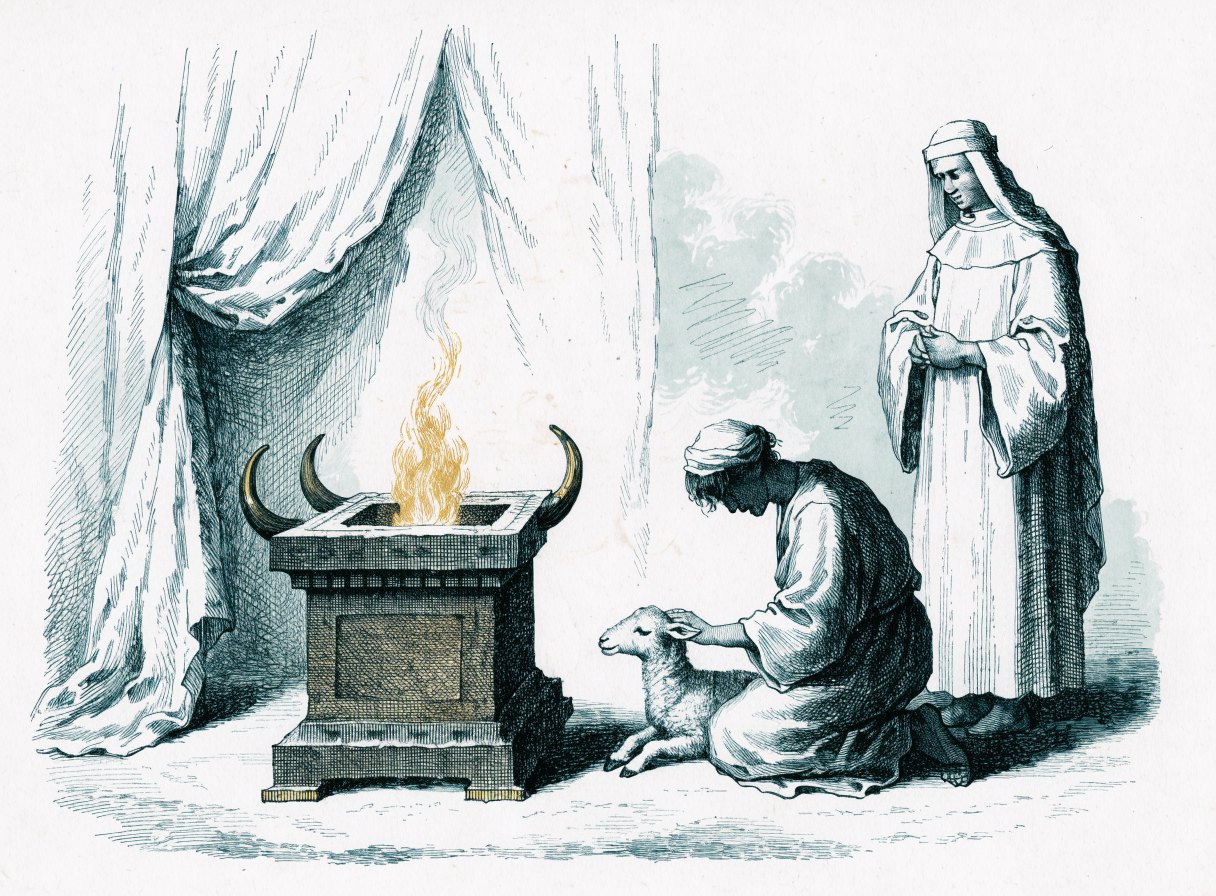
The sacrifices teach a second truth alongside the first. God, in mercy, would accept a substitute. Watch what an Israelite did when he brought a burnt offering. He chose an animal from his own herd, “a male without blemish,” and brought it to the entrance of the tent. Then “he shall lay his hand on the head of the burnt offering, and it shall be accepted for him to make atonement for him” (Lev. 1:3–4). Then he killed it himself (Lev. 1:5).
Picture it. Your hand on the warm head of an animal you raised. The life that leaves it is the life your sin deserved to lose. That is the meaning of the laid-on hand: this animal stands in my place. Theologians call it substitution, and it is the heart of the whole system. “It is the blood that makes atonement by the life” (Lev. 17:11). Hebrews puts it plainly: “without the shedding of blood there is no forgiveness of sins” (Heb. 9:22).
It was costly. A farmer’s best animal was his savings and his livelihood. And it was never meant to be mechanical. The prophets warned that God takes no pleasure in sacrifices offered by people who have no intention of changing (Isa. 1:11–17; Hos. 6:6; Amos 5:21–24). David, after his own great sin, wrote, “The sacrifices of God are a broken spirit; a broken and contrite heart, O God, you will not despise” (Ps. 51:17). The animal on the altar was meant to go with a heart bowed in repentance and trusting God’s promise.
Part Two: Five Offerings
Leviticus 1–7 describes five main offerings. You do not need to memorize the details, but it helps to see that they cover the whole of life with God: guilt removed, devotion given, thanks offered, and fellowship enjoyed.
Notice the peace offering. The fat was burned for God and a portion went to the priest, but most of the meat was given back to the worshiper, who ate it with his household “before the LORD” (Lev. 7:15, 31–34; Deut. 12:7). Sacrifice was not only about guilt. It ended at a table. The point of atonement was always fellowship: God and his people at peace, sharing a meal. Christians still eat at that kind of table. In the Lord’s Supper, believers really feed on Christ by faith, not by bringing a new sacrifice but by receiving the one already finished.
The Turn: This Animal Stands in My Place
Every Israelite who brought an animal to the altar was preaching a sermon with his hands. Sin deserves death. God will accept a substitute. And the substitute must be without blemish, a picture that only a sinless life can stand in for a sinful one.
The altar kept asking a question it could never answer: where is a substitute who can truly stand in for a human being? Peter gives the answer: “He himself bore our sins in his body on the tree, that we might die to sin and live to righteousness. By his wounds you have been healed” (1 Pet. 2:24). Jesus is the spotless one, and he went to the altar willingly: “No one takes it from me, but I lay it down of my own accord” (John 10:18). Next week we follow the high priest behind the veil on the most solemn day of Israel’s year.
Living It: Three Practices for This Week
Before Week 22: Read Leviticus 10:1–3 and 16, then Hebrews 9:11–14 and 10:11–18. Week 22 is the Day of Atonement.
For Discussion
- What was your first reaction to all the blood in Leviticus? How does this week change the way you see it?
- The worshiper laid his hand on the animal and then killed it himself. Why do you think God designed it that way?
- Most of the peace offering was eaten by the worshiper’s household “before the LORD.” Why do you think sacrifice ended in a meal?
- David wrote, “a broken and contrite heart, O God, you will not despise” (Ps. 51:17). Why does God care about the heart behind the sacrifice?
Sources & For Further Study
- On כִּפֶּר and כַּפֹּרֶת: Brown, Driver, and Briggs, Hebrew and English Lexicon; Koehler and Baumgartner, HALOT, s.v.
- On substitution and propitiation: Leon Morris, The Apostolic Preaching of the Cross; John Murray, Redemption Accomplished and Applied; Westminster Confession of Faith 8.5–8.6.
- For further reading: Jay Sklar, Leviticus (Tyndale Old Testament Commentaries); L. Michael Morales, Who Shall Ascend the Mountain of the Lord?; Philip E. Hughes, A Commentary on the Epistle to the Hebrews; John Owen, An Exposition of the Epistle to the Hebrews.
Leading a small group? This week comes as a beautifully formatted, printable PDF, along with a 2-page Small Group Guide: a discussion page for your group and leader notes with a session plan and answer key. Both are free when you join the weekly list.