

“Behold, the Lamb of God, who takes away the sin of the world!” John 1:29
Introduction: The Son of the Promise
Last week God called Abram out of Ur and promised him a land, a people, and a blessing for every family on earth. Abram believed, and God counted it to him as righteousness. Then God swore by himself to keep his word. The waiting was long. Abram and Sarai even tried to get the son their own way, through Sarai’s servant Hagar. Twenty-five years after the call, when Abraham was a hundred years old, the promised son was born, and they named him Isaac, “he laughs.”
This week God asks Abraham to give that son back. On a mountain called Moriah, a father, a son, a bundle of wood, and a ram caught in a thicket show us, two thousand years early, what God would do at the cross.
Part Three: The Mountain
This is one of the hardest chapters in the Bible to read, and you should feel its weight. God had given Abraham everything in this son: every promise of a nation, every hope of blessing to the world. Now God says, give him back. “Your son, your only son Isaac, whom you love.” Each phrase presses harder. (A burnt offering was an animal killed and burned whole on an altar, given entirely to God.)
Before you think God was asking for what he hated, notice two things. First, Genesis tells us from the first line that this was a test (22:1). God never intended Isaac to die, and he stopped it. Later God would forbid child sacrifice as something he hates (Deut. 12:31) and say of it, “which I did not command, nor did it come into my mind” (Jer. 7:31). Moriah is the one time he asked, and he asked as a test that he himself stopped. Second, Abraham did not obey in despair. He told his servants, “I and the boy will go over there and worship and come again to you” (22:5). We will come again. Hebrews explains what Abraham was thinking: “He considered that God was able even to raise him from the dead” (Heb. 11:19). Abraham believed God would keep his promise about Isaac even if it took a resurrection.
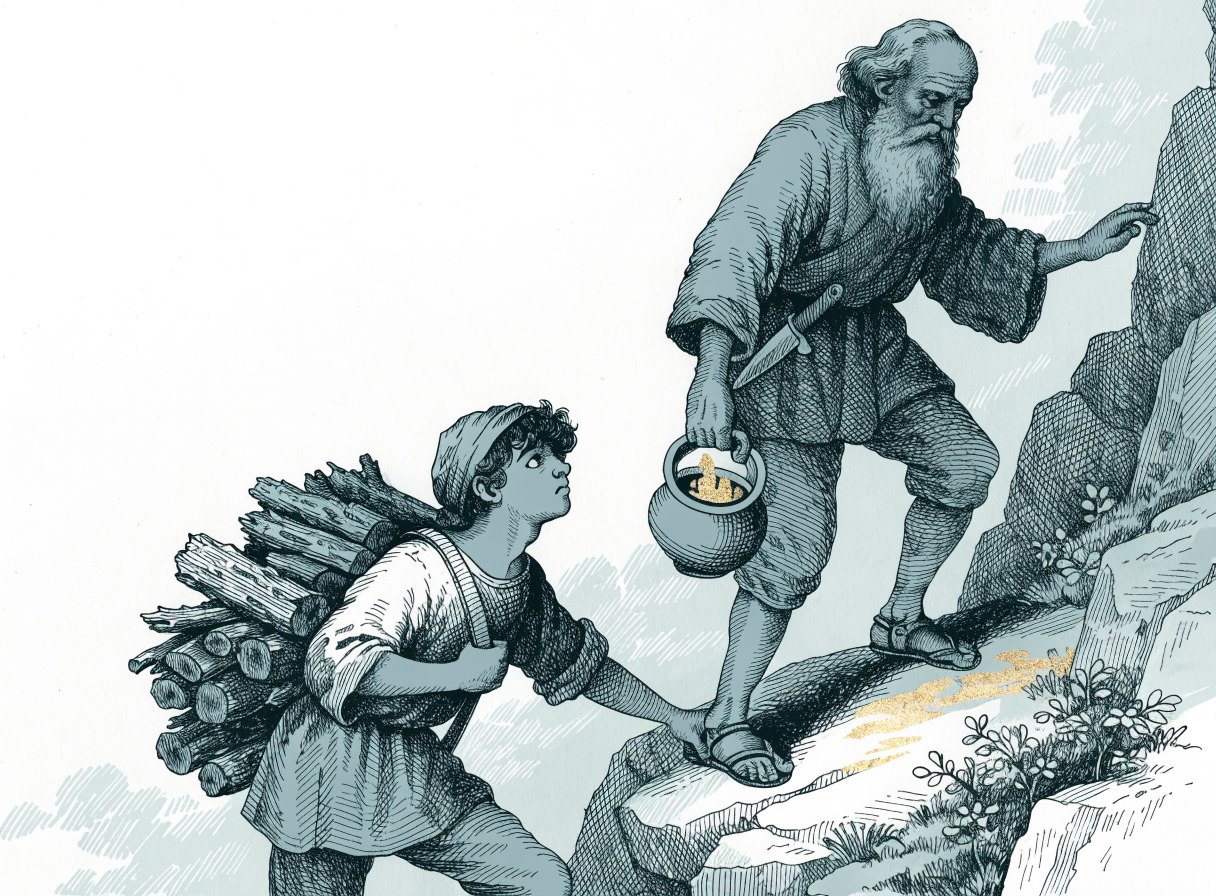
On the third day they saw the place. Abraham laid the wood on Isaac, and the two of them climbed together. Then the boy asked the question that echoes through the whole Old Testament: “Behold, the fire and the wood, but where is the lamb for a burnt offering?” And Abraham answered, “God will provide for himself the lamb for a burnt offering, my son” (22:7–8).
At the top, Abraham built the altar, laid the wood, bound his son, and raised the knife. And the angel of the LORD called from heaven: “Abraham, Abraham!… Do not lay your hand on the boy or do anything to him, for now I know that you fear God, seeing you have not withheld your son, your only son, from me” (22:11–12). This angel is no ordinary messenger. He speaks as God himself: “you have not withheld your son… from me” (22:12), and then, “By myself I have sworn, declares the LORD” (22:16). Many Christian teachers, from the early church through the Reformers, have seen him as the Son of God appearing before he was born in Bethlehem. Scripture does not say so outright, so hold it carefully. Abraham looked up, and “behold, behind him was a ram, caught in a thicket by his horns. And Abraham went and took the ram and offered it up as a burnt offering instead of his son” (22:13).
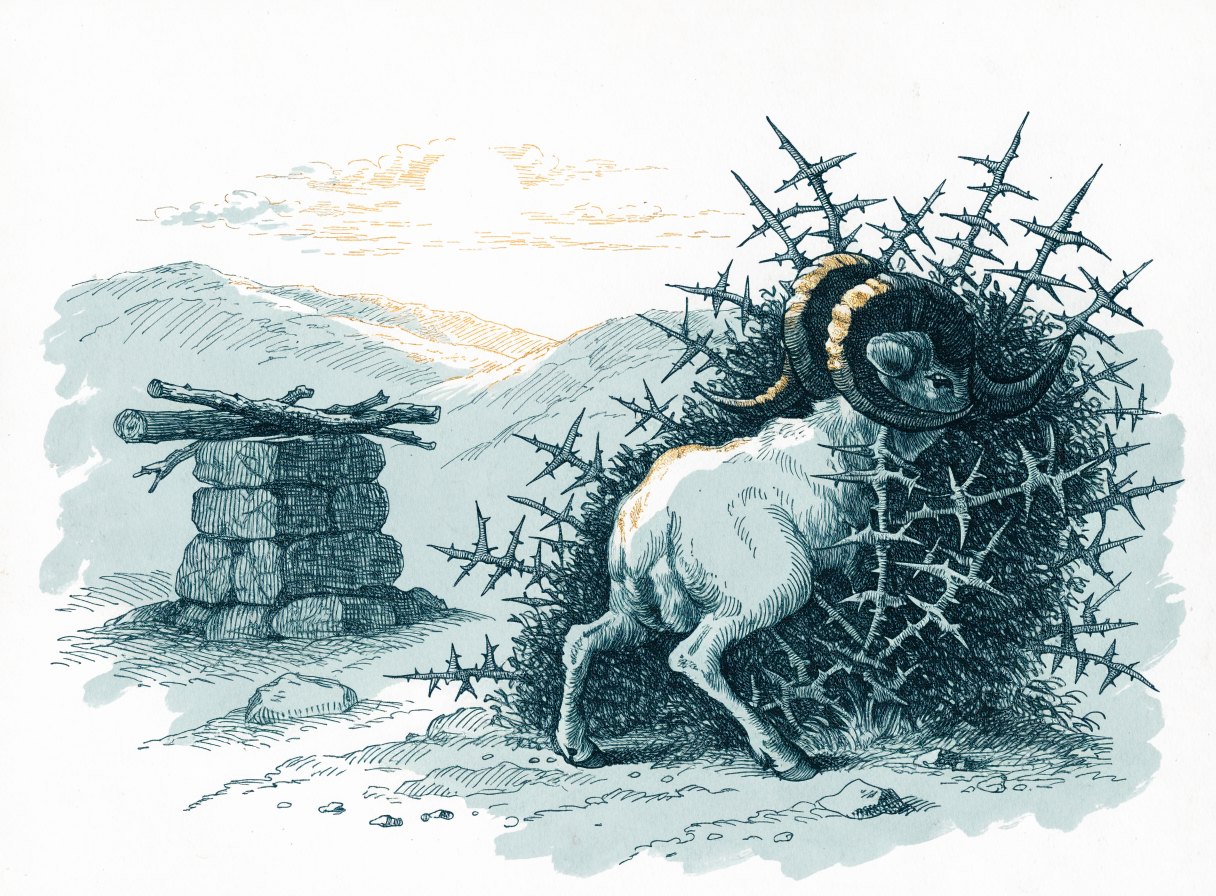
“Instead of his son.” Write those four words somewhere you will see them. Back in Eden an animal died to cover shame (Gen. 3:21). Here the Bible spells out the words: a substitute died in the place of the one who was supposed to die. “So Abraham called the name of that place, ‘The LORD will provide’; as it is said to this day, ‘On the mount of the LORD it shall be provided’” (22:14).
A word for later, when you read the letter of James. James says Abraham was “justified by works when he offered up his son Isaac on the altar” (James 2:21). That sounds like a contradiction of Genesis 15:6, but James quotes Genesis 15:6 himself and says Moriah “fulfilled” it (2:23). He is answering a different question. Paul asks how a sinner is declared righteous before God, and answers, by faith alone. James asks how you can tell faith is real, and answers, by what it does. Abraham was counted righteous by faith in Genesis 15, decades before Moriah. On Moriah his faith showed itself to be the real thing (James 2:22). Faith alone justifies, but justifying faith is never alone (WCF 11.2).
The Turn: He Did Not Spare His Own Son
Read Genesis 22 again with the New Testament in your hand, and you will see a picture you cannot unsee. A father takes his only beloved son up a mountain. The son carries the wood for his own sacrifice up the hill. Centuries later, another Son would go out “bearing his own cross” to a hill outside Jerusalem (John 19:17). The son goes with him. The father raises the knife.
But on Moriah, the knife stopped. A ram died instead of Isaac. On Calvary, the hill called “the Skull” outside Jerusalem, there was no voice from heaven to stop it, and no ram in the thicket. Because Jesus was the Lamb God had promised to provide. Paul draws the line from one mountain to the other: “He who did not spare his own Son but gave him up for us all, how will he not also with him graciously give us all things?” (Rom. 8:32). Abraham’s son was spared. God’s own Son was not (Rom. 8:32). The substitute that Moriah pointed to was the Son himself, dying “instead of” us.
Jesus said, “Your father Abraham rejoiced that he would see my day. He saw it and was glad” (John 8:56). Abraham looked forward to the promised Offspring. We look back. And God counts righteousness to us the same way he counted it to Abraham, through faith in the promised Offspring. Paul says the words “it was counted to him” were “not written for his sake alone, but for ours also. It will be counted to us who believe in him who raised from the dead Jesus our Lord, who was delivered up for our trespasses and raised for our justification” (Rom. 4:23–25).
This is the invitation of Genesis 15 and 22. You cannot work your way into God’s favor any more than Abram could produce the promised son by his own plan. He tried, with Hagar, and it brought only pain. You can only believe the promise and lean your whole weight on it. The Catechism describes saving faith as a grace “whereby we receive and rest upon him alone for salvation, as he is offered to us in the gospel” (WSC 86). Turn from your sin and from trusting yourself, and rest your whole weight on Jesus, who died and rose again. God will count you righteous for his sake. And “if you are Christ’s, then you are Abraham’s offspring, heirs according to promise” (Gal. 3:29).
Living It: Three Practices for This Week
Before Week 13: Read Genesis 25:19–34, 27:1–28:22, and 32:22–32. Week 13 follows the promise through Isaac to his twin sons, Esau and Jacob.
For Discussion
- Abraham told his servants, “I and the boy will go over there and worship and come again to you” (Gen. 22:5). What did he believe God would do (Heb. 11:19)?
- Look at the Moriah and Calvary diagram. Which parallel between Isaac and Jesus strikes you most, and why?
- James says Abraham was “justified by works” on Moriah, while Genesis 15:6 says he was counted righteous by faith. How do Paul and James fit together?
- Romans 8:32 says that if God did not spare his own Son, he will “graciously give us all things.” Where do you need to trust that promise this week?
Sources & For Further Study
- Westminster Shorter Catechism (1647), Q. 33 (justification) and Q. 86 (faith in Jesus Christ). Westminster Confession of Faith (1646), chapter 11, “Of Justification.”
- For further reading: Derek Kidner, Genesis (Tyndale Old Testament Commentaries); John Calvin, Commentary on Genesis, on chapters 15 and 22; Timothy Keller, Counterfeit Gods, chapter 1 (on Abraham and Isaac).
Leading a small group? This week comes as a beautifully formatted, printable PDF, along with a 2-page Small Group Guide: a discussion page for your group and leader notes with a session plan and answer key. Both are free when you join the weekly list.