

“So then it depends not on human will or exertion, but on God, who has mercy.” Romans 9:16
Introduction: A Family Like Ours
Most families have a drawer of photographs nobody shows company. The wedding where two brothers did not speak. The Christmas after the divorce. The picture with someone carefully cut out. If you want proof that the Bible is not a polished religious myth, read the second half of Genesis. It is the family album of Abraham’s descendants, and every page has a crack in the frame.
A father who plays favorites. A mother who helps her son deceive his blind father. Twin brothers, one of whom wants to kill the other. A man who marries two sisters and loves one more than the other, so that their rivalry spills into twelve sons. Brothers who throw their younger brother into a pit and sell him as a slave, then lie to their father about it for twenty-two years. This is the family God chose to carry the promise to the whole world.
In Week 11 God made three promises to Abraham: a land, a people, and a blessing for every family on earth. Genesis 25–50 follows those promises through three more generations, from about 2066 BC, when Isaac was born, to the 1800s BC, when Jacob’s whole family moves down to Egypt. And it answers a question every one of us asks: can God keep his promises through people like this, through families like mine?
Part One: Isaac and the Twins
The promise passed to Isaac, and the first thing we learn about his marriage is the same problem his parents had: “Isaac prayed to the LORD for his wife, because she was barren. And the LORD granted his prayer, and Rebekah his wife conceived” (Gen. 25:21). Again, the promised line depends on a gift only God can give.
Rebekah carried twins, and they fought inside her. When she asked the LORD why, he told her, “Two nations are in your womb… the older shall serve the younger” (25:23). Esau was born first. Jacob came out holding his brother’s heel, and they named him Jacob, which sounds like the Hebrew for “heel” and came to mean one who grabs or supplants (25:26; 27:36; Hos. 12:3). It fit him. Years later, Esau came home starving, and Jacob traded him a bowl of stew for his birthright, the eldest son’s double share of the inheritance (Deut. 21:17). “Thus Esau despised his birthright” (25:34). Hebrews calls him “unholy like Esau, who sold his birthright for a single meal” (Heb. 12:16).
Why did God choose Jacob, the younger and the grasper? Paul answers in Romans 9. Before the twins were born, while they “had done nothing either good or bad,” God said the older would serve the younger, “in order that God’s purpose of election might continue, not because of works but because of him who calls” (Rom. 9:11–12). Paul then quotes the prophet Malachi: “Jacob I loved, but Esau I hated” (Rom. 9:13). In Bible language, love and hate set side by side like this are words of choosing: God set his saving love on Jacob and passed Esau by. (Jesus uses a similar pairing in Luke 14:26, where “hate” means to love less by comparison.) God’s choice of Jacob did not rest on anything in Jacob. That is what Paul calls election: God choosing his people in Christ, by grace alone, “before the foundation of the world” (Eph. 1:4). The Westminster Confession says he chose them “out of his mere free grace and love, without any foresight of faith, or good works” (WCF 3.5). God did not choose Jacob because he saw ahead of time that Jacob would believe. God’s choice is the reason Jacob believed at all.
If that sounds unfair, Paul heard the objection coming: “Is there injustice on God’s part? By no means!” (Rom. 9:14). No one is owed mercy. When God passes someone by, he leaves them to what their own sin deserves. Esau’s descendants became the nation of Edom (Gen. 36:9), and the prophets announce judgment on Edom for its own violence against Israel (Obad. 10). When God chooses someone, he gives what no one deserves. If God chose people for their goodness, Jacob would never have been chosen. Neither would you.
Part Two: Jacob the Grasper
Jacob kept grasping. When their father Isaac was old and blind, Rebekah helped Jacob dress in goatskins and his brother’s clothes so Isaac would bless him instead of Esau. Jacob lied to his father’s face: “I am Esau your firstborn” (27:19). He got the blessing, and Esau swore to kill him, so Jacob fled north to his uncle Laban in Haran, the same region Abraham had left.
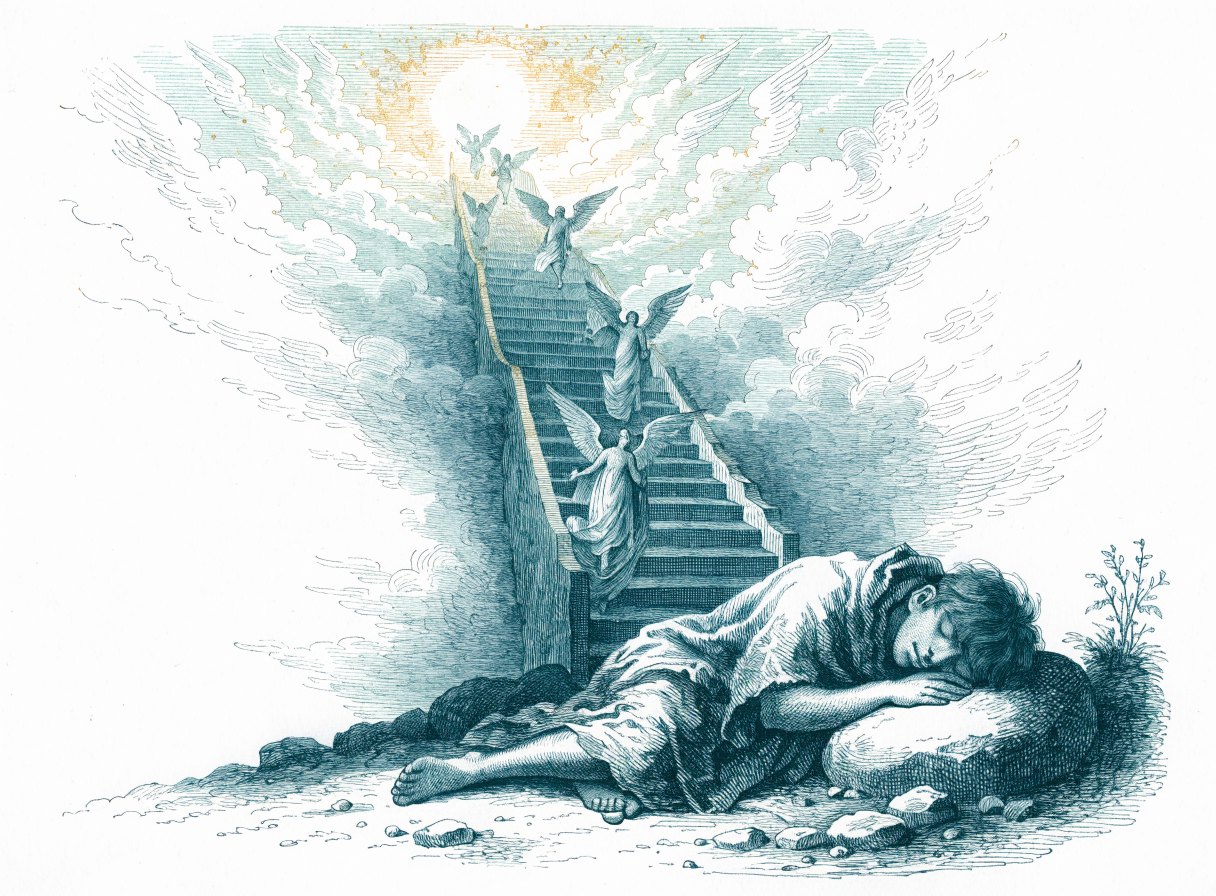
On the first night of his escape, alone, with a stone for a pillow, Jacob had a dream. “There was a ladder set up on the earth, and the top of it reached to heaven. And behold, the angels of God were ascending and descending on it!” (28:12). And the LORD stood above it and gave this liar and runaway the very promises he had given Abraham: the land, offspring like the dust of the earth, and “in you and your offspring shall all the families of the earth be blessed” (28:14). Then God added something personal: “Behold, I am with you and will keep you wherever you go, and will bring you back to this land” (28:15). Jacob had not repented. He had not even asked. God simply came to him in grace.
Jacob woke up shaken: “This is none other than the house of God, and this is the gate of heaven” (28:17). He named the place Bethel, which means “house of God.” But notice how he answers. He makes a bargain: “If God will be with me… then the LORD shall be my God” (28:20–21). Even after a vision of heaven, Jacob is still negotiating. God would spend twenty years wearing that out of him.
In Haran, Jacob the deceiver was deceived. He worked seven years for Laban’s younger daughter Rachel, whom he loved, and on the wedding night Laban gave him the older sister, Leah, instead. Jacob married both and worked seven more years. The rivalry between the two sisters and their servants, Bilhah and Zilpah, produced eleven sons in Haran and a twelfth, Benjamin, after they left. Their families became the twelve tribes of Israel. (A tribe is a large clan descended from one ancestor.)
Twenty years later, Jacob headed home with his family and flocks, terrified of meeting Esau. The night before, alone by the river Jabbok, “a man wrestled with him until the breaking of the day” (32:24). When the man could not overcome Jacob, he touched his hip and put it out of joint. Jacob, crippled, would not let go: “I will not let you go unless you bless me.” And the man asked his name. The last time someone asked Jacob his name, he lied and said, “Esau.” Now he says the truth: “Jacob.” Grasper. And the man renames him: “Your name shall no longer be called Jacob, but Israel, for you have striven with God and with men, and have prevailed” (32:26–28). Jacob walked away limping and blessed, saying, “I have seen God face to face, and yet my life has been delivered” (32:30). Who was this man? Jacob says he saw God face to face, and the prophet Hosea calls him “the angel”: “he strove with God. He strove with the angel and prevailed; he wept and sought his favor” (Hos. 12:3–4). Many readers take him to be the same angel of the LORD we met on Moriah, who speaks as God himself. Jacob “prevailed” with a dislocated hip. One touch had crippled him, and all he could do was weep and hold on until God blessed him. The nation of Israel takes its name from this night.
The Turn: Grace for the Grasper
Jacob spent half his life grabbing. He grabbed his brother’s heel, his brother’s birthright, and his father’s blessing. He even tried to bargain with God at Bethel. And God had chosen him before he was born, before he had done anything good or bad. At the river God wrestled with him, wounded him, and blessed him, and the grasper finally stopped grabbing and held on.
The blessing came through a wound. Ours does too, but the wound is not ours. Isaiah wrote of the coming Servant, “he was pierced for our transgressions; he was crushed for our iniquities; upon him was the chastisement that brought us peace, and with his wounds we are healed” (Isa. 53:5). Jesus was wounded so that graspers like Jacob, and like us, could be blessed. You cannot grab God’s blessing, and you cannot earn it. You can only stop grasping and hold on to him.
Living It: Three Practices for This Week
Before Week 14: Read Genesis 37, 39–41, 45, and 50:15–21. Week 14 follows Joseph from the pit to the palace.
For Discussion
- Why do you think God chose to carry his promise through such a broken family? What encouragement does that give you?
- Romans 9 says God chose Jacob “not because of works but because of him who calls.” How does that make you feel? Why is it good news?
- At Jabbok, Jacob finally told the truth about his name. Why does honesty about who we are matter so much in coming to God?
- At Bethel Jacob prayed, “If God will be with me… then the LORD shall be my God.” Why is it so hard simply to receive what God gives?
Sources & For Further Study
- Westminster Shorter Catechism (1647), Q. 11 (providence). Westminster Confession of Faith (1646), 3.5 (election) and 5.4 (providence and sin).
- On Hosea 12:3–4 and the wrestler at Jabbok: John Calvin, Commentary on Hosea, on 12:3–4. David S. Jones, Seventy Times Seven: On the God Who Forgives Past All Counting, chapters 8 and 18.
- For further reading: Derek Kidner, Genesis (Tyndale Old Testament Commentaries); John Calvin, Commentary on Genesis, on chapters 28, 32, and 45–50; Timothy Keller, Walking with God through Pain and Suffering; Jerry Bridges, Trusting God.
Leading a small group? This week comes as a beautifully formatted, printable PDF, along with a 2-page Small Group Guide: a discussion page for your group and leader notes with a session plan and answer key. Both are free when you join the weekly list.