

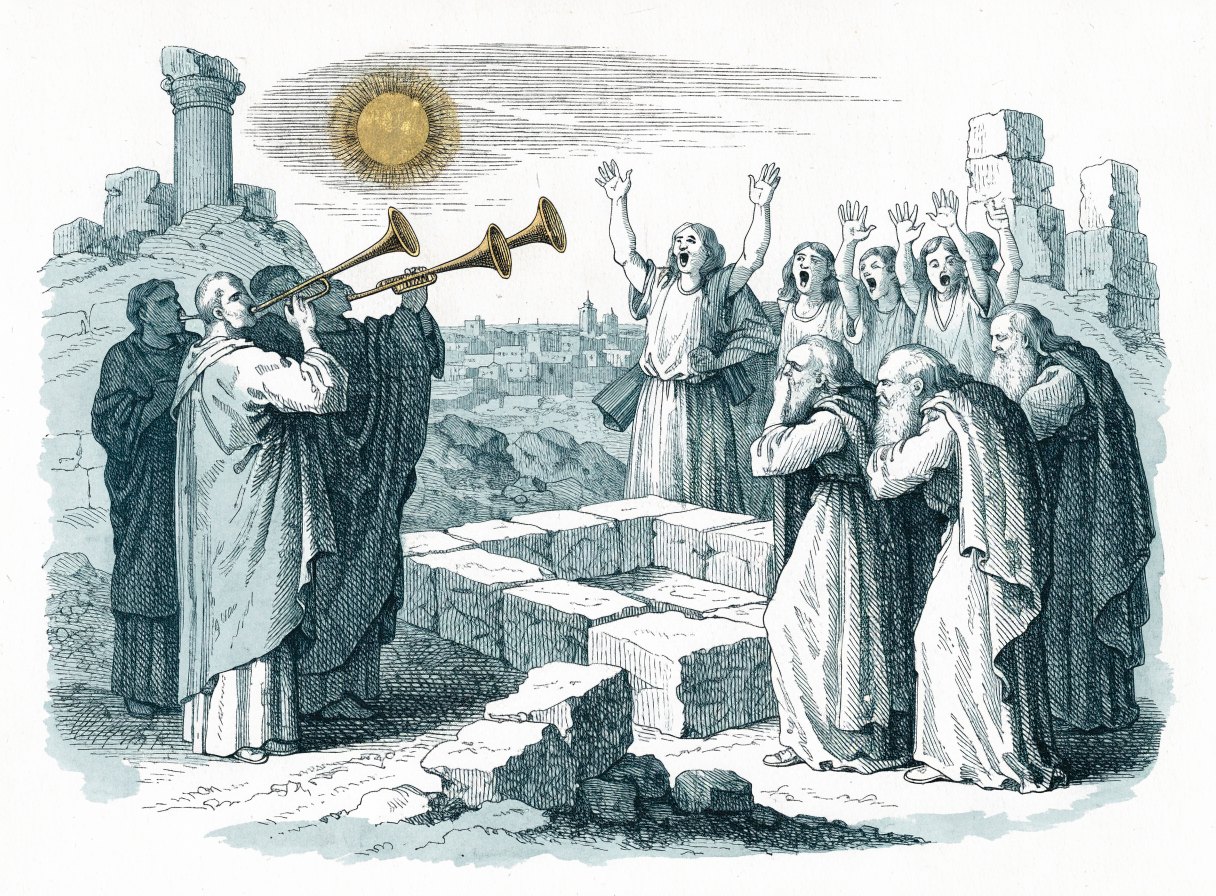
“And the Lord whom you seek will suddenly come to his temple.” Malachi 3:1
Introduction: The Last Word Before the Silence
Last week the exiles came home. They rebuilt the altar and the temple, and Nehemiah rebuilt the walls of Jerusalem in fifty-two days. Then Ezra read God’s law to the whole people, and they wept, and were told, “the joy of the LORD is your strength.”
This week the revival fades, and the last prophet of the Old Testament calls the people back. Then heaven goes quiet for four hundred years, and God sets the stage for the coming of his Son.
Part Three: The Last Prophet
Sadly, the revival did not last. When Nehemiah came back after a trip to Persia, he found the people had stopped supporting the temple and were breaking the Sabbath and marrying people who worshiped other gods (Neh. 13). The prophet Malachi, around 430 BC, describes a people who were going through the motions. The priests were offering blind and sick animals on God’s altar, the leftovers they would never give their governor (Mal. 1:8). God said, “If then I am a father, where is my honor?” (1:6).
Yet even Malachi is full of grace. “For I the LORD do not change; therefore you, O children of Jacob, are not consumed.… Return to me, and I will return to you” (3:6–7). And he closes the Old Testament, as our Bibles arrange it, looking forward. God would send a messenger to prepare the way, and then “the Lord whom you seek will suddenly come to his temple” (3:1). “But for you who fear my name, the sun of righteousness shall rise with healing in its wings” (4:2). And before that great day, “I will send you Elijah the prophet” (4:5).
And then the voice of prophecy went silent.
Part Four: The Silent Years
Between Malachi and the birth of Jesus are about four hundred years. No new prophet spoke, and no new book was added to the Old Testament. Christians sometimes call this time the intertestamental period, or simply the silent years. But silence did not mean God was absent. He was setting the stage.
The Greeks. In 332 BC Alexander the Great took the land of Israel on his way to conquering the whole Persian Empire, and Greek became the common language of the eastern Mediterranean world. Jewish scholars translated the Old Testament into Greek, and that translation, called the Septuagint, became the Bible many of the first Christians read. The New Testament itself would be written in Greek, so that it could travel everywhere.
The Maccabees. In 167 BC a Greek king named Antiochus IV tried to stamp out Jewish faith. He banned the law, outlawed circumcision, and had pigs sacrificed on the temple altar. (This history comes from 1 Maccabees, a Jewish book written soon after, not part of our Bible.) A family of Jewish fighters called the Maccabees rebelled, retook Jerusalem, and rededicated the temple in 164 BC. Jews still remember that at Hanukkah, the Feast of Dedication, which Jesus himself attended (John 10:22–23).
The Romans. In 63 BC the Roman general Pompey took Jerusalem. Rome kept a tense peace across its empire, and built the roads the apostles would one day walk. Rome made a man named Herod king of the Jews, and around 20 BC Herod began a huge rebuilding and expansion of the second temple. That is the temple Jesus would walk into.
And all through those years, in synagogues and homes, faithful people waited for God to keep his promises. Luke tells us about one of them, an old man named Simeon, “righteous and devout, waiting for the consolation of Israel” (Luke 2:25). Paul looks back on it all and says, “But when the fullness of time had come, God sent forth his Son” (Gal. 4:4). He was right on time.
A Note on “Seventy Sevens”
During the exile, Daniel received a vision about how long God’s people would wait: “Seventy weeks are decreed about your people and your holy city, to finish the transgression, to put an end to sin, and to atone for iniquity, to bring in everlasting righteousness” (Dan. 9:24). The word translated “weeks” means “sevens,” and most interpreters understand it as seventy sevens of years: 490 years. Christians have counted these years in different ways, and the details are debated. But many Reformed interpreters see the heart of this prophecy fulfilled in Jesus, who came to “put an end to sin” and “atone for iniquity.” Some readers notice another connection. When Peter asks how often he must forgive, Jesus answers, “seventy-seven times” (Matt. 18:22). The Greek can also be read “seventy times seven,” which the ESV gives in a footnote, and that reading comes to 490. Many scholars hear an echo of Lamech, who boasted of revenge “seventy-sevenfold” (Gen. 4:24), turned upside down into forgiveness. Daniel’s prophecy and Peter’s question are not about the same thing, so we should hold the link loosely. But both point the same way: in Jesus, God deals with sin completely, and those he forgives learn to forgive without keeping count.
God always keeps his word. He promised to bring his people home after seventy years, and he did. He promised to send a Messiah, and through four hundred silent years he did not forget. Every promise of God finds its yes in Jesus Christ.
The Turn: The Silence Breaks
After four hundred years of silence, God spoke again. An angel came to an old priest named Zechariah, and then to a young woman named Mary. Zechariah’s son grew up to be a voice in the wilderness. Mark begins his Gospel by quoting Malachi and Isaiah: “Behold, I send my messenger before your face, who will prepare your way, the voice of one crying in the wilderness: ‘Prepare the way of the Lord, make his paths straight’” (Mark 1:2–3). That messenger was John the Baptist, who came in the spirit of Elijah, just as Malachi promised. And right behind him came “the Lord whom you seek.”
Jesus did come suddenly to his temple, just as Malachi said. As a baby, he was carried into it, and Simeon said, “my eyes have seen your salvation” (Luke 2:30). As a man, he rode into Jerusalem on a donkey, exactly as Zechariah had foretold: “Behold, your king is coming to you… humble and mounted on a donkey” (Zech. 9:9; Matt. 21:5). Then he cleansed the temple, driving out the money-changers: “My house shall be called a house of prayer” (Matt. 21:13). And he said, “Destroy this temple, and in three days I will raise it up,” speaking about his body (John 2:19, 21). When he died, “the curtain of the temple was torn in two, from top to bottom” (Mark 15:38). The way into God’s presence was open.
The exiles came home to the land, but many never truly came home to God. The same invitation stands for you: “Return to me, and I will return to you.” You do not need to rebuild anything first or prove anything. Like the son in Jesus’ story, you only need to turn around and come. The Father runs to meet everyone who comes. Turn from your sin, trust Jesus, and come home.
Living It: Three Practices for This Week
Before Week 37: Read Luke 1–2 and John 1:1–18. Week 37 opens Unit 5: the silence breaks, and the Word becomes flesh.
For Discussion
- The exiles came home to the land but kept drifting from God. Why is it possible to return outwardly without returning in your heart?
- God was silent for four hundred years but kept working. Where have you seen God at work when he seemed silent?
- Haggai promised the second temple’s glory would be greater than the first. How did Jesus fulfill that?
- Malachi’s people offered God their leftovers (Mal. 1:8). Where are you tempted to give God what is left over?
Sources & For Further Study
- On the intertestamental period: Anthony J. Tomasino, Judaism Before Jesus. On Daniel 9: Iain M. Duguid, Daniel (Reformed Expository Commentary); O. Palmer Robertson, The Christ of the Prophets.
- For further reading: Derek Kidner, Ezra and Nehemiah (Tyndale Old Testament Commentaries); Iain M. Duguid, Haggai, Zechariah, Malachi (EP Study Commentary).
Leading a small group? This week comes as a beautifully formatted, printable PDF, along with a 2-page Small Group Guide: a discussion page for your group and leader notes with a session plan and answer key. Both are free when you join the weekly list.