

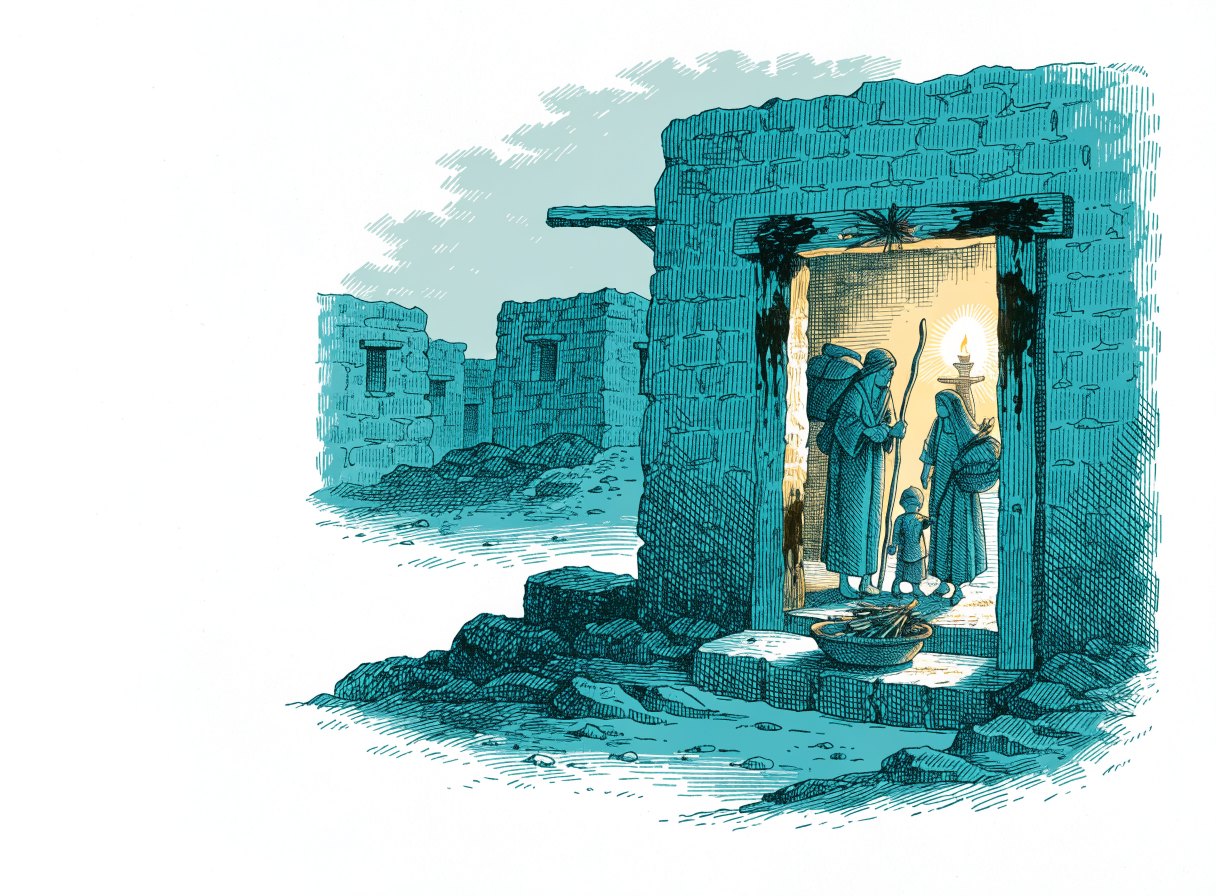
“For Christ, our Passover lamb, has been sacrificed.” 1 Corinthians 5:7
Introduction: The Last Plague
Last week Israel groaned in Egypt and God heard. He sent Moses, a reluctant rescuer, to tell Pharaoh, “Let my people go,” and Pharaoh answered, “Who is the LORD?” Nine plagues later, Egypt was in ruins and Pharaoh’s heart was still hard.
This week comes the tenth plague, the one God had warned about from the start. Every house in Egypt would face judgment on the same night. One word in Hebrew tells us how any house could be spared.
The Word: Passover
Part Three: The Lamb and the Blood
Before the last plague, God gave Israel instructions for a meal unlike any other. On the tenth day of the month, every household was to choose a lamb: “Your lamb shall be without blemish, a male a year old” (12:5). They kept it for four days, and on the fourteenth day, at twilight, every family killed its lamb. Then they took a bundle of hyssop (a small leafy plant), dipped it in the blood, and painted it on the two doorposts and the top beam of the door (12:7, 22). They roasted the lamb and ate it that night with unleavened bread (bread made without yeast, a sign of the haste of that night, 12:11, 39) and bitter herbs, which echo how Egypt “made their lives bitter” (1:14). And they ate dressed for a journey: “with your belt fastened, your sandals on your feet, and your staff in your hand. And you shall eat it in haste. It is the LORD’s Passover” (12:11).
At midnight, the judgment fell. “The LORD struck down all the firstborn in the land of Egypt, from the firstborn of Pharaoh who sat on his throne to the firstborn of the captive who was in the dungeon… there was not a house where someone was not dead” (12:29–30). But in the houses marked with blood, the LORD passed over.
Take a moment with this, because it is the heart of this week. Were the Israelite families saved because they were better people than the Egyptians? No. They had turned on Moses and would not listen to him (5:21; 6:9), and many of them clung to the idols of Egypt (Ezek. 20:7–8; Josh. 24:14). The LORD did not pass over the houses of good people. He passed over the houses with blood on the door, and he would not allow the destroyer to enter them (12:23). That night God asked one question of every house: is there blood on the door? A lamb had died in that house, in place of the firstborn.
That night Pharaoh finally broke. “Up, go out from among my people… and go, serve the LORD” (12:31). After 430 years in Egypt, “on that very day, all the hosts of the LORD went out from the land of Egypt” (12:40–41). That number fits our timeline: Jacob’s family came down around 1876 BC, and Israel came out in 1446 BC. Genesis gave the round number, four hundred; Exodus gives the exact one.
Israel did not leave alone. About six hundred thousand men walked out, besides women and children, and “a mixed multitude also went up with them” (12:37–38). Some Egyptians and other foreigners had seen enough of the LORD to throw in their lot with his people. God made room for them at the table: any foreigner who joined Israel and received the covenant sign could keep the Passover, and “he shall be as a native of the land” (12:48). Even on the night of the Exodus, God’s rescue was wider than one bloodline. What mattered was being under the blood, among his people.
God commanded Israel to keep the Passover every year, forever, so their children would ask, “What do you mean by this service?” and they would answer, “It is the sacrifice of the LORD’s Passover, for he passed over the houses of the people of Israel in Egypt” (12:26–27). They were also to set apart every firstborn son to God and “redeem” him, buy him back with a payment, because on Passover night the LORD killed Egypt’s firstborn and spared Israel’s (13:2, 13–15). Every firstborn in Israel grew up knowing he belonged to God because of the night of the lamb.
Part Four: Through the Sea
God led Israel out, and he went with them in a visible way: “the LORD went before them by day in a pillar of cloud to lead them along the way, and by night in a pillar of fire to give them light” (13:21). But he led them to a dead end. With the sea in front of them and Pharaoh’s chariots charging up behind (Pharaoh had changed his mind again, and the LORD had hardened his heart, 14:5, 8), the people panicked: “Is it because there are no graves in Egypt that you have taken us away to die in the wilderness?” (14:11).
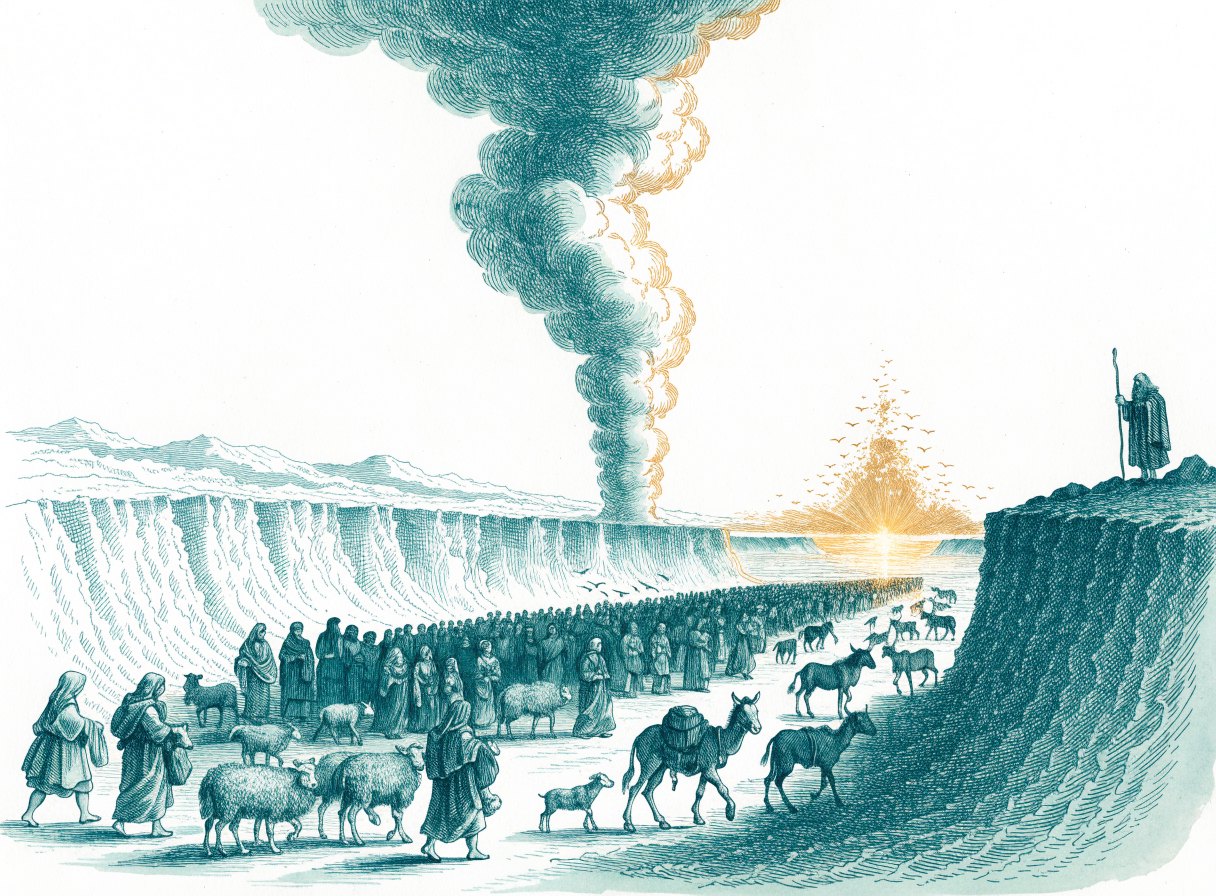
And Moses spoke one of the great sentences of faith: “Fear not, stand firm, and see the salvation of the LORD, which he will work for you today… The LORD will fight for you, and you have only to be silent” (14:13–14). Then Moses stretched out his hand, “and the LORD drove the sea back by a strong east wind all night and made the sea dry land, and the waters were divided. And the people of Israel went into the midst of the sea on dry ground” (14:21–22). When the Egyptian army followed, the waters returned and covered them.
“Thus the LORD saved Israel that day… so the people feared the LORD, and they believed in the LORD and in his servant Moses” (14:30–31). Then they sang, the first song of praise to God in the Bible: “I will sing to the LORD, for he has triumphed gloriously; the horse and his rider he has thrown into the sea. The LORD is my strength and my song, and he has become my salvation” (15:1–2).
Notice what Israel did to save themselves. Nothing. They stood still, and they walked through on ground God dried for them. That is the shape of salvation all through the Bible. God does the rescuing, and his people receive it by faith: “By faith the people crossed the Red Sea as on dry land” (Heb. 11:29). And notice the word God had used for it back in chapter 6: “I will redeem you with an outstretched arm and with great acts of judgment” (6:6). To redeem is to set a captive free, often by paying a price. The Exodus is the Old Testament’s great picture of redemption. From now on, whenever the prophets want to describe how God saves, they reach back to this story.
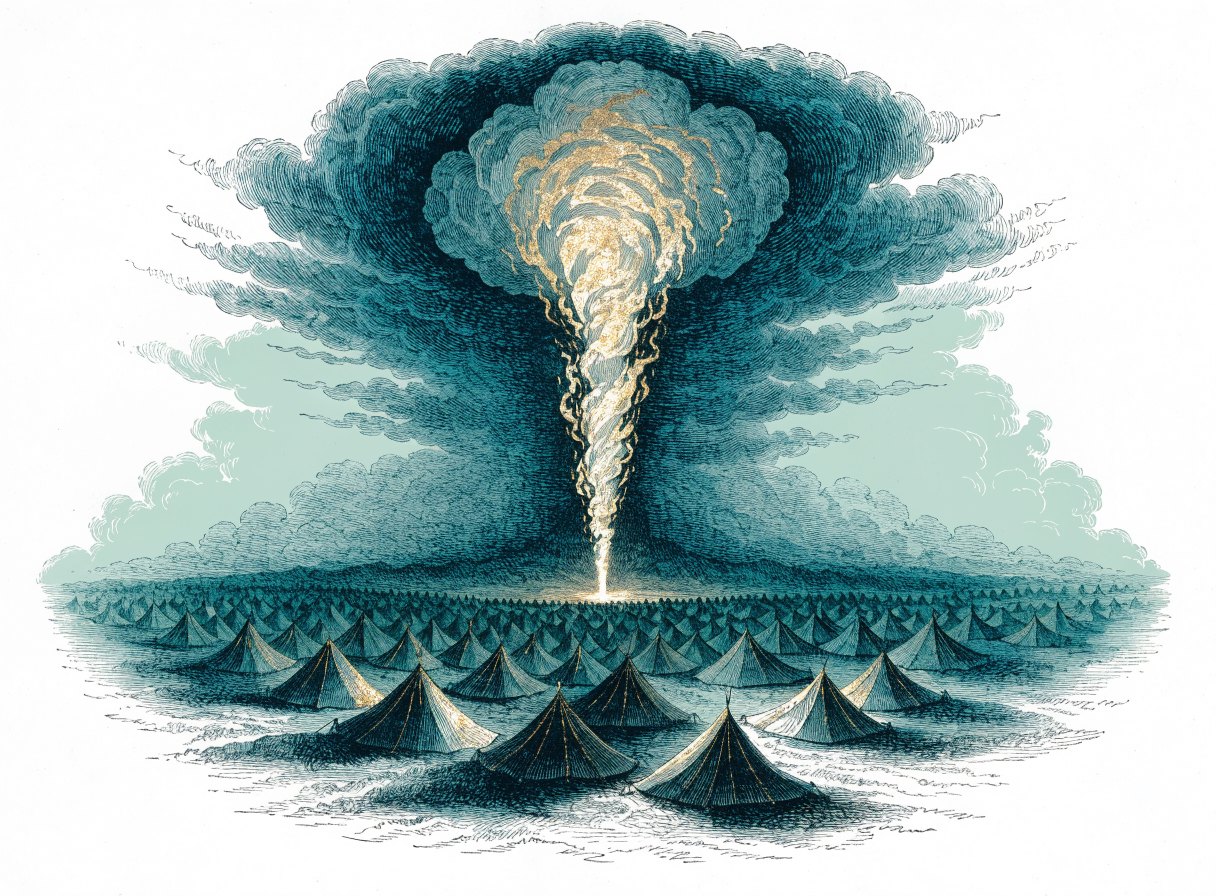
To redeem is to set a slave free by paying a price. God redeemed Israel from Egypt by the blood of the Passover lamb and the power of his arm. That rescue was a picture of a greater one: Christ redeems sinners from sin, death, and the devil by his own blood.
The Turn: Our Passover Lamb
Fifteen centuries later, Jesus sat down with his disciples in Jerusalem to eat the Passover. He said, “I have earnestly desired to eat this Passover with you before I suffer” (Luke 22:15). They were eating the meal that remembered the lamb whose blood saved Israel’s firstborn. And during that meal, Jesus took the bread and said, “This is my body, which is given for you. Do this in remembrance of me.” He took the cup and said, “This cup that is poured out for you is the new covenant in my blood” (Luke 22:19–20). In one evening he took Israel’s great meal of rescue and showed them it had always been about him. Christians still keep the meal Jesus gave that night, called the Lord’s Supper or Communion. Jesus took the Passover’s bread and cup and made them signs of the new covenant in his blood. When believers eat and drink in faith, they remember, and they also receive. The bread stays bread, yet Christ by his Spirit truly feeds our souls with himself and all the benefits of his death (1 Cor. 10:16; WSC 96).
A few hours later, on that same day by Jewish reckoning (their days began at sundown), during the Passover feast, Jesus was crucified. The soldiers broke the legs of the two men crucified beside him, but when they came to Jesus he was already dead, so they did not break his legs. John says this happened “that the Scripture might be fulfilled: ‘Not one of his bones will be broken’” (John 19:36), the very rule God gave for the Passover lamb (Ex. 12:46). When Moses and Elijah (a great prophet we will meet later) appeared with Jesus on a mountain where his glory shone out, they talked about “his departure, which he was about to accomplish at Jerusalem” (Luke 9:31). The Greek word is exodos. Jesus’ death, resurrection, and return to the Father were the true Exodus.
Every one of us was born a slave, though not to Pharaoh. Jesus said, “everyone who practices sin is a slave to sin… So if the Son sets you free, you will be free indeed” (John 8:34, 36). And apart from Christ, every one of us lives under God’s just judgment. There is only one question that matters on the night of judgment: is there blood on the door? Your goodness will not answer it, and neither will your religious record. Only the blood of the Lamb will. “Since, therefore, we have now been justified by his blood, much more shall we be saved by him from the wrath of God” (Rom. 5:9). (To be justified is to be declared right with God, as Abraham was when he believed.)
So come in under the blood. Turn from your sin and trust Jesus, the Lamb without blemish who died in your place. Then, like Israel on the far shore, you will have a song to sing: “The LORD is my strength and my song, and he has become my salvation.” And at the very end of the Bible, the redeemed stand by another sea and sing “the song of Moses, the servant of God, and the song of the Lamb” (Rev. 15:3).
Living It: Three Practices for This Week
Before Week 17: Read Exodus 19–20. Week 17 takes us to Mount Sinai, where the rescued people meet their God and hear his Ten Words.
For Discussion
- On Passover night, the only question was, “Is there blood on the door?” Why is that such good news for people who know they are not good enough?
- Look at the Passover and Christ diagram. Which connection surprises you most?
- Israel was saved by standing still and walking through on ground God dried. Where are you trying to save yourself instead of trusting God to fight for you?
- Jesus took the bread and cup of the Passover and made them the Lord’s Supper. How should remembering the Passover lamb shape the way you come to the table?
Sources & For Further Study
- On פֶּסַח and פָּסַח: Brown, Driver, and Briggs, Hebrew and English Lexicon; Koehler and Baumgartner, HALOT, s.v.
- Westminster Confession of Faith (1646), 5.6 (on God’s hardening of the wicked) and 29 (the Lord’s Supper). Westminster Shorter Catechism, Q. 96 (the Lord’s Supper).
- For further reading: Philip Graham Ryken, Exodus: Saved for God’s Glory (Preaching the Word); Alec Motyer, The Message of Exodus (The Bible Speaks Today).
Leading a small group? This week comes as a beautifully formatted, printable PDF, along with a 2-page Small Group Guide: a discussion page for your group and leader notes with a session plan and answer key. Both are free when you join the weekly list.