

“There is therefore now no condemnation for those who are in Christ Jesus.” Romans 8:1
Introduction: The Gospel Paul Preached
Last week Jesus stopped Saul the persecutor on the Damascus road and sent him to the nations. He carried the gospel through what is now Turkey and Greece and was stoned, beaten, and imprisoned. In a Philippian jail at midnight a jailer asked him how to be saved, and in Athens he preached the risen Christ to the philosophers.
This week Paul goes to Rome in chains, and the word of God goes with him. Then we open the letter he wrote to the Romans, and one courtroom word at the heart of the gospel.
The Word: Justified
Part Three: In Chains to Rome
About AD 57 Paul returned to Jerusalem, where a mob seized him in the temple. He was arrested, held for two years in Caesarea, and finally, as a Roman citizen, he appealed to the emperor (25:11). On the way to Rome his ship was caught in a storm for two weeks and wrecked on the island of Malta, but every one of the 276 people on board reached shore alive, just as God had promised Paul (27:24, 37, 44).
Acts ends with Paul under house arrest in Rome, the capital of the world, chained to a guard. “He lived there two whole years at his own expense, and welcomed all who came to him, proclaiming the kingdom of God and teaching about the Lord Jesus Christ with all boldness and without hindrance” (28:30–31). In Greek the very last word of Acts is akōlytōs, “unhindered,” which the ESV renders “without hindrance.” Paul was in chains, but as he later wrote, “the word of God is not bound!” (2 Tim. 2:9). Jesus had told his followers they would be his witnesses “to the end of the earth” (Acts 1:8). Now the message had reached the heart of the empire.
Church tradition tells us Paul was later released for a time, then arrested again and beheaded in Rome under Nero, around AD 64 to 67. His last letter, written as he waited for death, says, “I have fought the good fight, I have finished the race, I have kept the faith. Henceforth there is laid up for me the crown of righteousness” (2 Tim. 4:7–8).
Part Four: The Gospel in a Letter
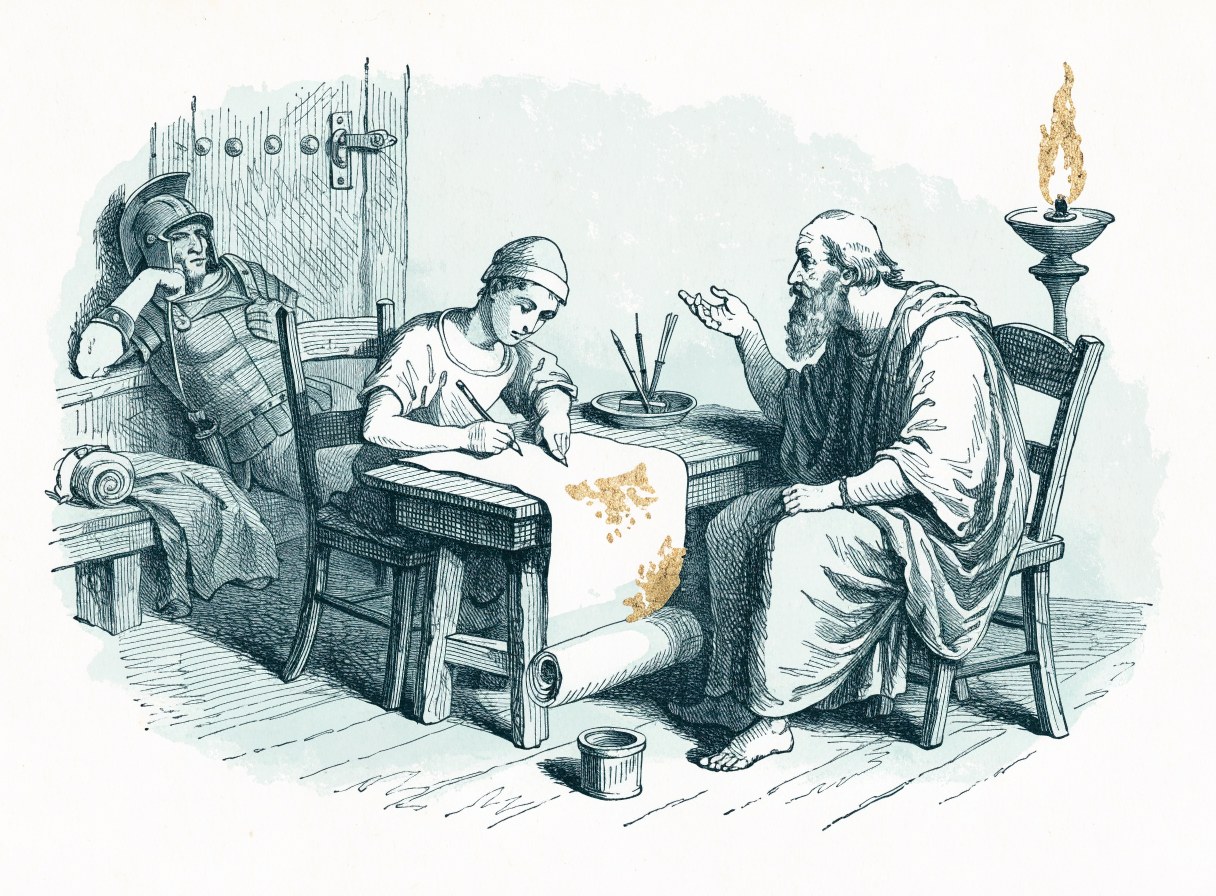
Paul could not stay in every church he planted, so he wrote to them. His letters answered their questions, corrected their mistakes, and above all explained the gospel. He wrote Romans about AD 57 to a church he had never visited, laying out the good news from beginning to end. Many Christians have found it the clearest explanation of the gospel ever written. Here is its argument in brief.
The bad news. Paul begins with everyone’s problem. “None is righteous, no, not one; no one understands; no one seeks for God” (Rom. 3:10–11). Religious people and irreligious people alike are guilty before God: “for all have sinned and fall short of the glory of God” (3:23).
The good news. Then the turn: we “are justified by his grace as a gift, through the redemption that is in Christ Jesus, whom God put forward as a propitiation by his blood, to be received by faith” (3:24–25). A propitiation is a sacrifice that turns away God’s just anger against sin. At the cross Jesus bore that anger in our place. God did this “so that he might be just and the justifier of the one who has faith in Jesus” (3:26). Justification is a gift, received by faith, not earned by works. “For by grace you have been saved through faith. And this is not your own doing; it is the gift of God, not a result of works, so that no one may boast” (Eph. 2:8–9).
God declares guilty sinners righteous in his sight. He pardons all their sins and counts Christ’s perfect righteousness as theirs. He does this only because of what Christ has done, never because of what they have done, and they receive it by faith alone. Good works follow as the fruit of being justified. They are never the reason for it.
The love behind it. “But God shows his love for us in that while we were still sinners, Christ died for us” (Rom. 5:8). God did not wait for us to clean ourselves up.
A new life. Does grace mean we can keep on sinning? “By no means! How can we who died to sin still live in it?” (6:1–2). Faith unites us to Christ, and in him God gives two gifts that always come together. He declares us righteous once for all, and he gives us his Spirit, who begins the lifelong work of making us holy. The first is a verdict and the second is a growth. They are different, but no one ever has one without the other. Good works are the fruit of salvation, never its root.
An unbreakable hope. Romans 8 begins, “There is therefore now no condemnation for those who are in Christ Jesus” (8:1), and ends with nothing in all creation “able to separate us from the love of God in Christ Jesus our Lord” (8:39). In between is a chain God himself holds together: “those whom he predestined he also called, and those whom he called he also justified, and those whom he justified he also glorified” (8:30). To be predestined means God set his love on his people before the world began. Paul writes this to comfort people who trust Christ: their salvation rests on God’s own purpose, so it cannot fail. No one has to solve the mystery of God’s choice before coming to him. Jesus said, “whoever comes to me I will never cast out” (John 6:37). God finishes what he starts.
A living sacrifice. Paul ends Romans with how to live. “I appeal to you therefore, brothers, by the mercies of God, to present your bodies as a living sacrifice, holy and acceptable to God, which is your spiritual worship” (12:1). We do not obey to be saved. We obey because we have been.
The Turn: Right with God
The Philippian jailer asked the only question that finally matters: “What must I do to be saved?” Paul answered with a Person to trust: “Believe in the Lord Jesus, and you will be saved.”
Most people assume that being right with God depends on being good enough, that God will weigh our good against our bad. Paul says that scale only condemns us. But God “justifies the ungodly” (Rom. 4:5). He takes guilty people, counts the perfect righteousness of Christ to them, and declares them right with him, as a gift, received by faith alone. Paul could write, “I have been crucified with Christ. It is no longer I who live, but Christ who lives in me. And the life I now live in the flesh I live by faith in the Son of God, who loved me and gave himself for me” (Gal. 2:20).
“If you confess with your mouth that Jesus is Lord and believe in your heart that God raised him from the dead, you will be saved” (Rom. 10:9). If you have never done that, do it today. And if you have, stop trying to earn what God has already given. Rest in it, and then go and live as a living sacrifice. Saul the persecutor became Paul the apostle by grace alone. That same grace is offered to you.
Living It: Three Practices for This Week
Before Week 49: Read Hebrews 1:1–4, 4:14–16, and 10:11–25, and James 2:14–26. Week 49 reads two letters to Christians under pressure.
For Discussion
- In your own words, what does it mean to be justified? Why does it matter that it is a verdict and a gift?
- Romans 3:23 says all have sinned. Why is that hard for many people to accept?
- If we are saved by grace and not by works, why do good works still matter?
- Which part of Romans 8 gives you the most hope? Why?
Sources & For Further Study
- On justification: Westminster Confession of Faith 11; Westminster Shorter Catechism 33; John Murray, Redemption Accomplished and Applied.
- On Paul and Romans: Douglas J. Moo, The Epistle to the Romans; John Stott, The Message of Romans; F. F. Bruce, Paul: Apostle of the Heart Set Free.
- For further reading: R. C. Sproul, Faith Alone; Timothy Keller, Romans 1–7 For You.
Leading a small group? This week comes as a beautifully formatted, printable PDF, along with a 2-page Small Group Guide: a discussion page for your group and leader notes with a session plan and answer key. Both are free when you join the weekly list.