

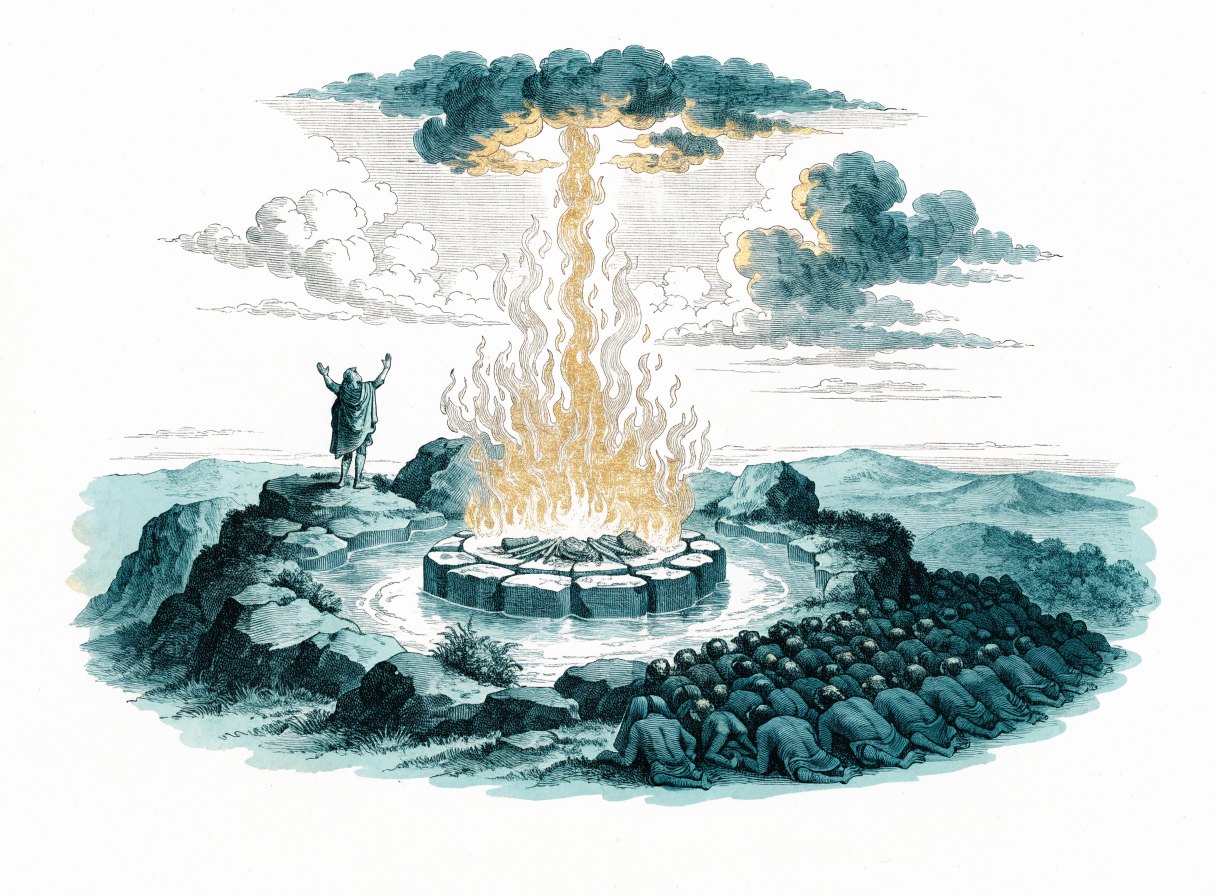
“Answer me, O LORD, answer me, that this people may know that you, O LORD, are God, and that you have turned their hearts back.” 1 Kings 18:37
Introduction: Two Kingdoms and a Long Goodbye
Week 30 ended with a warning: because Solomon’s heart turned away, the kingdom would be torn from his son. These two weeks cover what happened next, about two hundred years of history packed into 1 and 2 Kings. One nation became two. Kings came and went, most of them bad. Idols spread. And over and over, God did something remarkable. He did not walk away. He sent prophets.
The prophets were God’s messengers. They stood in front of kings and crowds and said, “Thus says the LORD.” They warned, they wept, they called people home. The greatest of them in this period was Elijah, whose showdown on Mount Carmel is one of the most dramatic scenes in the whole Bible. But the story ends in tragedy. The northern kingdom would not listen, and in 722 BC it was wiped off the map.
On our timeline: the kingdom splits in 931 BC, Elijah confronts King Ahab around 860 BC, and the Assyrian Empire destroys the northern kingdom in 722 BC.
The Word: Elijah
Part One: A Kingdom Torn in Two
When Solomon died, his son Rehoboam went to be crowned. The northern tribes asked him to lighten the heavy taxes and forced labor his father had demanded. The old advisers told him to listen. His young friends told him to get tougher. He took his friends’ advice: “My father made your yoke heavy, but I will add to your yoke. My father disciplined you with whips, but I will discipline you with scorpions” (1 Kings 12:14). The northern ten tribes walked out: “What portion do we have in David?… To your tents, O Israel!” (12:16).
From then on there were two kingdoms. The northern kingdom kept the name Israel, with its capital eventually at Samaria. The southern kingdom, made up mainly of the tribe of Judah, was called Judah, with its capital at Jerusalem and David’s descendants on the throne.
The first northern king, Jeroboam, had a problem. The temple was in Jerusalem, in the southern kingdom. If his people kept going there to worship, he feared they would drift back to Judah. So he made two golden calves, put one at Bethel and one at Dan, and told the people, “You have gone up to Jerusalem long enough. Behold your gods, O Israel, who brought you up out of the land of Egypt” (12:28). Those were almost exactly the words Israel had said around the golden calf at Sinai (Ex. 32:4; Week 18). The northern kingdom started with idolatry, and it never recovered. Not one of its kings is called good. Judah had a mix of good and evil kings. A few, like Hezekiah, trusted the LORD deeply (2 Kings 18:5). But Judah drifted too.
Part Two: Fire on the Mountain
About sixty years after the split, the worst of Israel’s kings took the throne. “Ahab the son of Omri did evil in the sight of the LORD, more than all who were before him” (16:30). He married Jezebel, a foreign princess who brought the worship of Baal, the Canaanite storm god, into Israel on a grand scale. Baal was supposed to bring the rain and make the crops grow.
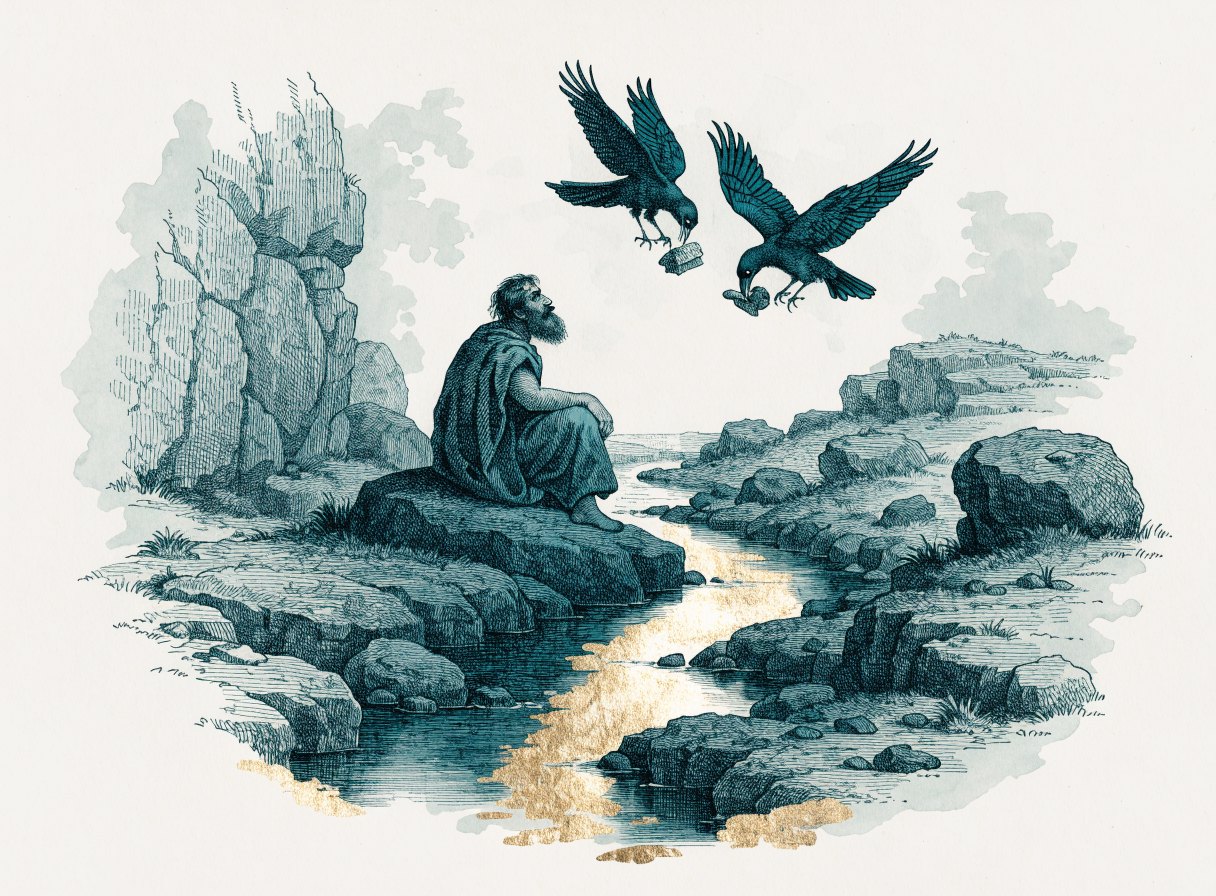
So God sent a prophet to Ahab with a message aimed straight at Baal: “As the LORD, the God of Israel, lives, before whom I stand, there shall be neither dew nor rain these years, except by my word” (17:1). No rain, in the land of the rain god. Then Elijah disappeared. God hid him by a brook, where “the ravens brought him bread and meat in the morning, and bread and meat in the evening” (17:6). Later God sent him to a poor widow in Zarephath, a foreign town, where her flour and oil never ran out. Jesus would point to her centuries later as a sign that God’s grace reaches outsiders (Luke 4:25–26).
After more than three years of drought, Elijah called for a showdown on Mount Carmel: 450 prophets of Baal against one prophet of the LORD. He put the question to the crowd first: “How long will you go limping between two different opinions? If the LORD is God, follow him; but if Baal, then follow him” (18:21). The people said nothing.
Each side would prepare a bull on an altar but light no fire. The god who answered by fire was God. Baal’s prophets cried out from morning until noon. They danced around their altar. At noon Elijah mocked them: maybe Baal was busy, or asleep. So they cut themselves and raved on until evening, “but there was no voice. No one answered; no one paid attention” (18:29).
Then Elijah rebuilt the LORD’s broken altar with twelve stones, one for each tribe. He had the people soak the sacrifice and the wood with water, three times, until it filled the trench. And he prayed a simple prayer: “Answer me, O LORD, answer me, that this people may know that you, O LORD, are God, and that you have turned their hearts back” (18:37). “Then the fire of the LORD fell and consumed the burnt offering and the wood and the stones and the dust, and licked up the water that was in the trench” (18:38). The people fell on their faces: “The LORD, he is God; the LORD, he is God” (18:39). Then Elijah had the prophets of Baal seized and put to death (18:40). That is hard to read. Israel was a nation under God’s direct rule, and its covenant law treated a prophet who led the people to other gods as a capital traitor (Deut. 13:5). Like the conquest in Week 24, this belonged to Israel’s unique place in history. It is not a pattern for the church. Christ’s people fight false teaching with the truth, never with the sword (2 Cor. 10:4).
The Turn: The God Who Answers
Jeroboam gave his people a religion that was easier to reach than Jerusalem, and Ahab gave them a god who promised rain. Both looked practical. Both were empty. On Carmel, Baal’s prophets shouted for a whole day, and “no one answered.” Idols always end that way. They demand everything and give nothing back.
The LORD answered with fire, and the people fell on their faces. The same living God has answered us in a greater way, in Jesus. Paul wrote to new believers who had done what Israel failed to do: “you turned to God from idols to serve the living and true God, and to wait for his Son from heaven, whom he raised from the dead, Jesus who delivers us from the wrath to come” (1 Thess. 1:9–10). Whatever your Baal is, it cannot answer you. Turn from it to the God who does. Next week we follow Elijah into the desert, worn out, and watch God send prophet after prophet to a people who would not listen.
Living It: Three Practices for This Week
Before Week 32: Read 1 Kings 19 and 2 Kings 17:1–23. Week 32 follows Elijah into the desert, and the prophets God kept sending.
For Discussion
- Rehoboam listened to the advice that flattered his pride. Where are you tempted to listen to voices that tell you what you want to hear?
- Jeroboam made idols to keep his people from going to Jerusalem. What “convenient” substitutes for God do people create today?
- Baal was the god of rain, crops, and success. Why was the drought such a direct challenge to him? What do people trust for security today?
- Elijah asked, “How long will you go limping between two different opinions?” Where are you limping?
Sources & For Further Study
- On the dates of the divided kingdom: Edwin R. Thiele, The Mysterious Numbers of the Hebrew Kings; Eugene H. Merrill, Kingdom of Priests.
- On Baal and the Carmel contest: Dale Ralph Davis, 1 Kings: The Wisdom and the Folly; Iain W. Provan, 1 and 2 Kings (Understanding the Bible Commentary).
- For further reading: O. Palmer Robertson, The Christ of the Prophets; Westminster Shorter Catechism 24 (Christ’s office as a prophet).
Leading a small group? This week comes as a beautifully formatted, printable PDF, along with a 2-page Small Group Guide: a discussion page for your group and leader notes with a session plan and answer key. Both are free when you join the weekly list.