

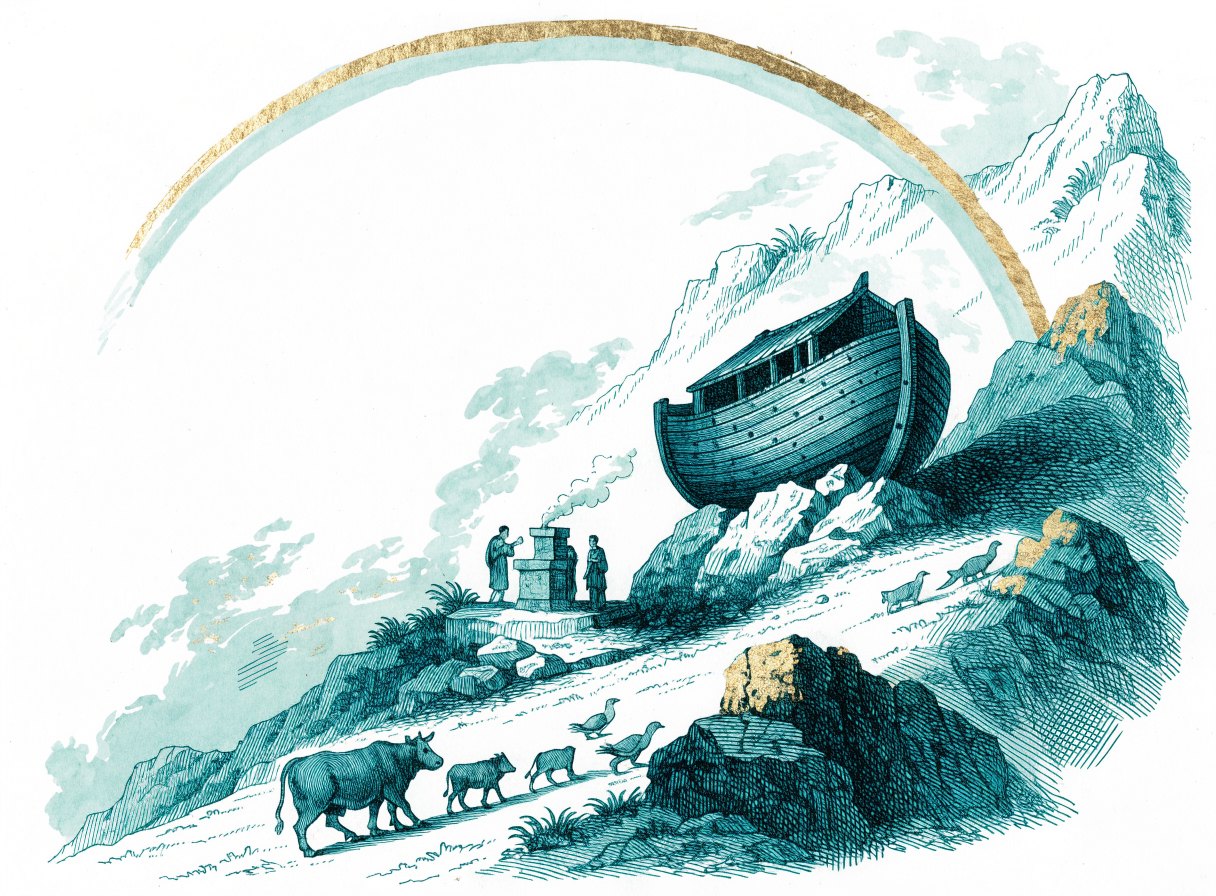
“I have set my bow in the cloud, and it shall be a sign of the covenant between me and the earth.” Genesis 9:13
Introduction: The Darkest Point, and Grace
Last week we watched sin grow up fast. Cain killed his brother, and a few generations later Lamech boasted of killing a young man for striking him. Two family lines ran side by side: one building its own name, and one calling on the name of the LORD.
This week the story reaches its darkest point before Abraham. The earth fills with violence, and God sends a flood. Yet in the middle of it stands one sentence that changes everything: “But Noah found favor in the eyes of the LORD.” Then, after the waters go down, people gather on a plain to build a tower to heaven and make a name for themselves.
Part Three: The Flood
Genesis 6 opens with one of the strangest passages in the Bible: “the sons of God saw that the daughters of man were attractive. And they took as their wives any they chose” (6:2). It also mentions the Nephilim (6:4). Faithful Christians read this in more than one way. Augustine and Calvin took “the sons of God” as the godly line of Seth marrying into Cain’s line, so that the people who called on the LORD were swallowed up by the world. Others take them as fallen angels (compare Jude 6), or as powerful rulers. You do not need to settle it this week. On any of these readings, the line between those who called on God and those who did not was disappearing.
By Genesis 6, the ruin has spread everywhere: “The LORD saw that the wickedness of man was great in the earth, and that every intention of the thoughts of his heart was only evil continually” (6:5). Read that slowly: every intention, continually. The earth was “filled with violence” (6:11). And Genesis says, “it grieved him to his heart” (6:6). The judgment that follows is the judgment of a holy God who takes evil with complete seriousness.
Does that mean God made a mistake, or changed his mind? Week 3 taught us that God does not change (Mal. 3:6), and Scripture says it outright: “he is not a man, that he should have regret” (1 Sam. 15:29). When Genesis says the LORD “regretted” and was “grieved,” it uses human language so we can grasp something true about him, the same way this passage speaks of “the eyes of the LORD.” The Westminster Confession says God is “without body, parts, or passions” (WCF 2.1). He is never knocked off balance by moods the way we are. The words still tell us something real. God is not indifferent to evil. His holy love, which never changes, stands against what humanity had become. The flood came from the same unchanging God who had said that sin leads to death (Gen. 2:17), now meeting a world that had changed for the worse.
“But Noah found favor in the eyes of the LORD” (6:8). As we saw last week, grace comes first; only in the next verse do we read that Noah was righteous. God told Noah to build an ark, a huge wooden box covered with pitch, and to bring his family and the animals into it. Noah obeyed. Peter calls him “a herald of righteousness” (2 Pet. 2:5), and the years of building were a warning to everyone watching, while “God’s patience waited in the days of Noah, while the ark was being prepared” (1 Pet. 3:20). Then “all the fountains of the great deep burst forth, and the windows of the heavens were opened” (7:11), and the rain fell for forty days and forty nights. One small detail is easy to miss: when everyone was inside, “the LORD shut him in” (7:16). Noah did not close the door; God closed it behind him.
Genesis says the waters covered “all the high mountains under the whole heaven” (7:19). The plain reading, and the one this study follows, is that the flood covered the whole earth. Some Christians who hold firmly to the Bible’s authority read “the whole earth” the way Genesis sometimes uses it, as the whole world of the people involved (compare 41:57), and take the flood as vast but regional. On either reading, the flood was a real judgment in real history, around 2450 BC on the timeline this study follows, and everyone outside the ark perished (7:23). Jesus spoke of it as history: “as in those days before the flood they were eating and drinking, marrying and giving in marriage, until the day when Noah entered the ark, and they were unaware until the flood came and swept them all away, so will be the coming of the Son of Man” (Matt. 24:38–39). The flood is a preview of the final judgment.
Then come four of the most hopeful words in Genesis: “But God remembered Noah” (8:1). To “remember” in the Bible means to act on a commitment. Before the rain ever fell, God had told Noah, “I will establish my covenant with you” (6:18), the first time the word “covenant” appears in the Bible. Now he acted on it. The waters went down, and Noah and his family stepped out onto a washed earth. The first thing Noah did was build an altar and offer sacrifices, and “the LORD smelled the pleasing aroma” (8:21).
Then God confirmed that covenant, a binding promise, with Noah and “every living creature” (9:10): “never again shall all flesh be cut off by the waters of the flood” (9:11). The sign was the rainbow. “While the earth remains, seedtime and harvest, cold and heat, summer and winter, day and night, shall not cease” (8:22). Reformed teachers have often called this a covenant of preservation. God promised to keep the world going, sun and rain and harvest for the just and the unjust (theologians call this common grace), so that his plan of rescue would have a world to unfold in. Every time you see a rainbow, you are looking at God’s promise to hold the world together until Jesus, the promised Offspring who has already come, comes again.
But notice why God made that promise. “I will never again curse the ground because of man, for the intention of man’s heart is evil from his youth” (8:21). The flood washed the earth, but it did not wash the human heart. Almost the next thing we read about Noah is that he got drunk and lay uncovered in his tent (9:20–21). The man who found grace was still a sinner who needed it. Something deeper was needed.
God is perfectly just. He does not overlook evil, and sin brings real judgment, as the flood shows. He is also rich in mercy. He saved Noah and his family, set his bow in the sky, and patiently holds back judgment so that people may turn to him.
“most loving, gracious, merciful, long-suffering, abundant in goodness and truth, forgiving iniquity, transgression, and sin; the rewarder of them that diligently seek him; and withal, most just, and terrible in his judgments, hating all sin, and who will by no means clear the guilty.” (Westminster Confession of Faith 2.1, describing God)
Part Four: Babel
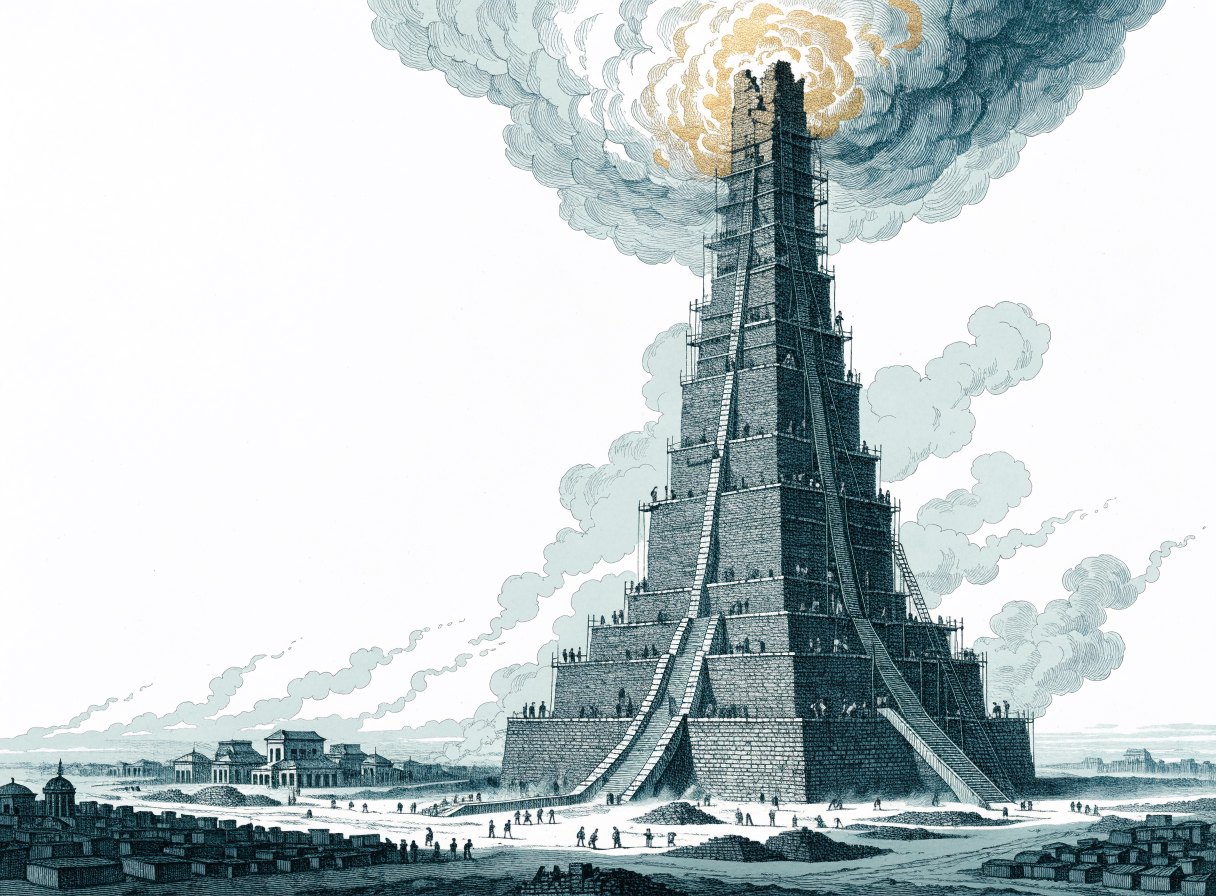
After the flood, as people migrated, they found a plain in the land of Shinar, later called Babylonia, and settled there (11:2). They had one language, and they had a plan: “Come, let us build ourselves a city and a tower with its top in the heavens, and let us make a name for ourselves, lest we be dispersed over the face of the whole earth” (11:4). Two things drove them. They wanted to make a name for themselves, and they refused to spread out and fill the earth as God had commanded (9:1). Babel was humanity building together for its own glory, against God’s word.
Then comes a line with a touch of holy humor: “And the LORD came down to see the city and the tower” (11:5). They built a tower “with its top in the heavens,” and God had to come down to see it. So God confused their language and scattered them over the earth. Even that was mercy. God said that if they went on as one, “nothing that they propose to do will now be impossible for them” (11:6). Scattering put a limit on what united human pride could do. The name Babel sounds like the Hebrew for “confused” (11:9).
Then the story turns. Genesis 11 closes with the family line from Shem down to a man named Abram, and one sad detail: “Sarai was barren; she had no child” (11:10–32). The very next chapter begins with God speaking to him: “And I will make of you a great nation, and I will bless you and make your name great… and in you all the families of the earth shall be blessed” (12:2–3). At Babel, people tried to make a name for themselves and ended scattered. To Abram, God promises to “make your name great,” and promises to bless the scattered families of the earth through him. That is next week.
The Turn: A Better Word Than Abel’s
Abel’s blood cried out from the ground, and it cried for justice. Every murder since has added its voice. So has every wrong done to you, and every wrong you have done. If the story ended there, the cry of the blood would be the last word.
But listen to how the book of Hebrews describes what Christians have come to: “to Jesus, the mediator of a new covenant, and to the sprinkled blood that speaks a better word than the blood of Abel” (Heb. 12:24). A mediator is a go-between who brings God and people together. Abel’s blood says, Guilty. Jesus’ blood says, Forgiven. Abel’s blood cried out against his brother. Jesus’ blood speaks for his brothers and sisters, even for some who had shouted for his death (Acts 2:36–41). Lamech multiplied revenge. Jesus took the full weight of our sin on himself and answered it with mercy past all counting.
And think about the ark. There was one ark, with one door, and God himself shut it. Everyone inside was safe, not because they were better swimmers or better people, but because they were in the ark. Peter connects it to Jesus directly. The eight in the ark “were brought safely through water,” and he goes on: “Baptism, which corresponds to this, now saves you, not as a removal of dirt from the body but as an appeal to God for a good conscience, through the resurrection of Jesus Christ” (1 Pet. 3:20–21). Baptism is the washing with water “in the name of the Father and of the Son and of the Holy Spirit” that Jesus gave his church as the sign of belonging to him (Matt. 28:19). Peter is careful. The water itself does not save, “not as a removal of dirt.” The risen Christ saves, received by faith, and baptism is God’s sign and seal of that rescue. The Westminster Confession puts it plainly: grace and salvation are not so tied to baptism that no one can be saved without it, or that everyone baptized is surely born again (WCF 28.5). If you have trusted Christ and have not been baptized, talk to a pastor about it. Like the ark’s one door, Jesus is the only way in. He said, “I am the door. If anyone enters by me, he will be saved” (John 10:9). Judgment is coming again. Not by water, because God promised that (Gen. 9:11), but by fire. Peter says the present world is “stored up for fire, being kept until the day of judgment” (2 Pet. 3:7). There is one place of safety: Christ.
And Babel? On the day of Pentecost, a Jewish harvest feast fifty days after Passover, after Jesus rose and ascended, God poured out his Spirit, and people “from every nation under heaven” heard the apostles “telling in our own tongues the mighty works of God” (Acts 2:5, 11). At Babel, God divided the languages to scatter proud people. At Pentecost, he spoke through the languages to gather humbled ones. And at the end of the story, John sees “a great multitude that no one could number, from every nation, from all tribes and peoples and languages, standing before the throne and before the Lamb” (Rev. 7:9). The scattered families of Babel will be gathered, around Jesus.
So come in. You do not have to build a tower to reach God. You cannot. He has come down. You do not have to keep score of every wrong done to you or carry your own guilt like Cain wandering the earth. Turn from your sin, and trust the Savior whose blood speaks a better word. The door is open, and while it is open, come.
Living It: Three Practices for This Week
Before Week 11: Read Genesis 12 and 15. Week 11 opens Unit 2: God calls Abraham and makes the covenant promise that carries the rest of the Bible.
For Discussion
- “Noah found favor” comes before “Noah was a righteous man.” Why does that order matter?
- The flood washed the earth but not the human heart (Gen. 8:21). What does that tell us about what we really need?
- At Babel, people tried to make a name for themselves. Where do you see that same drive today, in culture or in yourself?
- Hebrews says Jesus’ blood “speaks a better word than the blood of Abel” (Heb. 12:24). What “better word” do you need to hear from him this week?
Sources & For Further Study
- On חֵן and חָנַן: Brown, Driver, and Briggs, Hebrew and English Lexicon; Koehler and Baumgartner, HALOT, s.v. On the Noah/ḥen wordplay: Gordon J. Wenham, Genesis 1–15 (Word Biblical Commentary), on 6:8.
- On the covenant with Noah: O. Palmer Robertson, The Christ of the Covenants, chapter “The Covenant with Noah: The Covenant of Preservation.” Westminster Confession of Faith 2.1; 28.5.
- For further reading: Derek Kidner, Genesis (Tyndale Old Testament Commentaries); Bruce K. Waltke, Genesis: A Commentary.
Leading a small group? This week comes as a beautifully formatted, printable PDF, along with a 2-page Small Group Guide: a discussion page for your group and leader notes with a session plan and answer key. Both are free when you join the weekly list.