

“And he believed the LORD, and he counted it to him as righteousness.” Genesis 15:6
Introduction: One Man, Every Family
When a rescue team searches a flooded city, they do not try to lift the whole town at once. They go house by house, one boat at a time. Last week we saw the whole human race scattered at Babel, every family on earth under the curse and spreading out across the world. You might expect God’s next move to be something enormous: a voice from heaven to every nation, a sign in the sky. Instead, Genesis 12 zooms in on one old man in one city, with a wife who could not have children.
That is how God chose to rescue the world. Through one man, then one family, then one nation, and finally through one Offspring of that family, the blessing would reach “all the families of the earth” (Gen. 12:3). Every page of the Bible from here to the end of Revelation is the story of how God kept the promises he made to this man. His name was Abram, later Abraham. Jews, Christians, and Muslims all claim him as a father. The New Testament says who his children are: “it is those of faith who are the sons of Abraham” (Gal. 3:7).
This week opens Unit 2, “The Promise.” We are at about 2091 BC on our timeline, when Abram was seventy-five years old. Three scenes in his life give us the shape of the gospel: a call and a covenant this week, and a mountain next week.
The Word: Believed, Counted
Part One: The Call
Abram grew up in Ur of the Chaldeans, a wealthy city in southern Mesopotamia, in what is now Iraq. His family moved north to Haran (Gen. 11:31). Genesis does not mention it, but Joshua does: Abram’s family worshiped idols. Through Joshua, God reminded Israel, “Long ago, your fathers lived beyond the Euphrates, Terah, the father of Abraham and of Nahor; and they served other gods” (Josh. 24:2). God did not choose Abram because he was already seeking God. God came to an idol-worshiper’s son and called him. Stephen says, “The God of glory appeared to our father Abraham when he was in Mesopotamia” (Acts 7:2).
Look at what God asks and what God promises. He asks Abram to leave everything familiar for a land he has never seen. And he promises three things that run through the rest of the Bible like three strands of one rope: a land (“the land that I will show you”), a people (“a great nation,” which means offspring, though Abram and Sarai had no children), and a blessing that would spill over to “all the families of the earth.” Remember Babel, where people tried to make a name for themselves? Here God says, “I will… make your name great.”
Paul says something stunning about this promise: “the Scripture, foreseeing that God would justify the Gentiles by faith, preached the gospel beforehand to Abraham, saying, ‘In you shall all the nations be blessed’” (Gal. 3:8). (Gentiles is the Bible’s word for the nations, everyone outside Abraham’s family line.) Genesis 12 is the gospel in seed form. One day, through Abraham’s family, the blessing would reach every nation on earth.
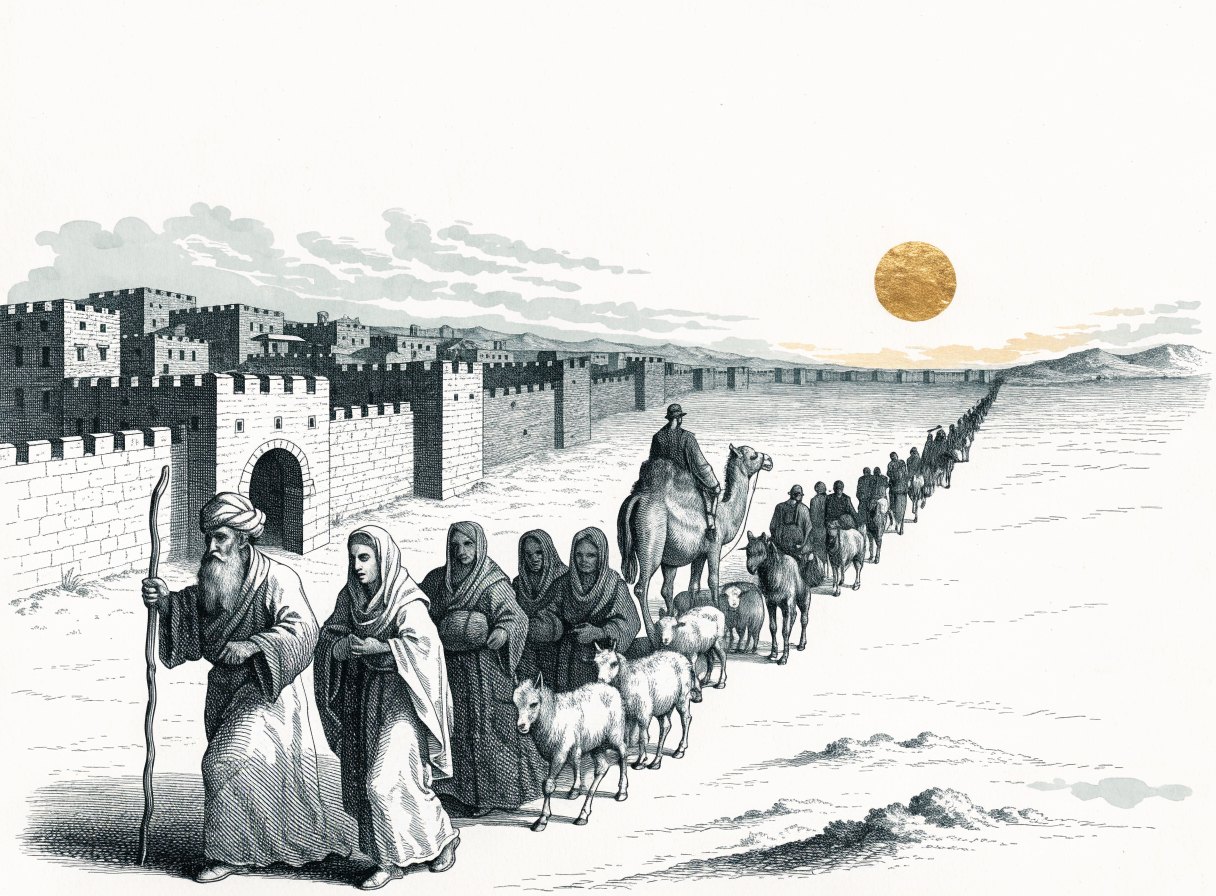
“So Abram went, as the LORD had told him” (12:4). He was seventy-five years old. Hebrews says he “went out, not knowing where he was going” (Heb. 11:8). Faith follows the One who called even when it cannot see the destination.
But do not make Abram a superhero. Almost as soon as he arrived in the land, a famine drove him down to Egypt, and he was afraid the Egyptians would kill him to take his beautiful wife. So he told Sarai to say she was his sister (12:10–13), and she was taken into Pharaoh’s house. The father of faith lied to save his own skin and put his wife in danger. God had to step in and rescue her. Genesis is honest about its heroes, and that honesty is good news. God’s promises rested on God’s faithfulness, not Abram’s.
Part Two: The Covenant
Two things happened first. Abram and his nephew Lot had grown so rich in flocks that they parted ways, and Lot chose the well-watered plain near Sodom, whose men “were wicked, great sinners against the LORD” (13:13). When raiding kings carried Lot off, Abram armed his household and rescued him. On the way home a mysterious priest-king named Melchizedek, king of Salem, “brought out bread and wine” and blessed Abram, and “Abram gave him a tenth of everything” (14:18–20). Remember that name. Hebrews will call Jesus “a high priest after the order of Melchizedek” (Heb. 5:10).
Years passed, and still no child. Abram came to God with an honest complaint: “O Lord GOD, what will you give me, for I continue childless” (15:2). God took him outside under the night sky and said, “Look toward heaven, and number the stars, if you are able to number them… So shall your offspring be” (15:5). An old man with no children, looking at the stars. And the next sentence is one of the most important in the Bible: “And he believed the LORD, and he counted it to him as righteousness” (15:6).
Then God did something strange and wonderful. He told Abram to bring a heifer, a goat, a ram, and two birds, and to cut the animals in half and lay the halves facing each other in two rows (15:9–10). In the ancient world, this was how people “cut a covenant.” The one making the promise would walk between the pieces, and the meaning was a solemn oath: may I become like these animals if I break my word. Jeremiah describes the same ceremony and its meaning: God would make covenant-breakers “like the calf that they cut in two and passed between its parts” (Jer. 34:18).
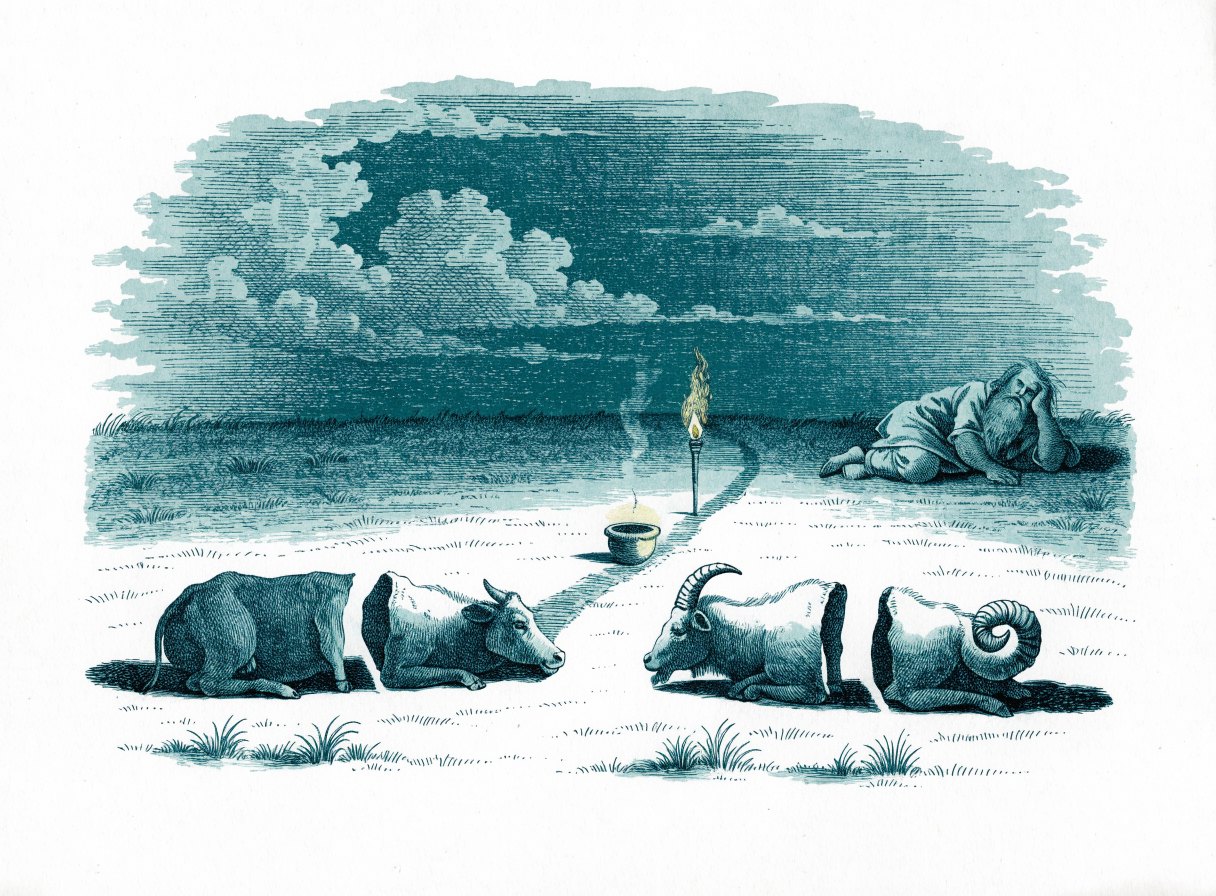
But look at who walked between the pieces. As the sun went down, a deep sleep fell on Abram (15:12). And in the darkness, “a smoking fire pot and a flaming torch passed between these pieces. On that day the LORD made a covenant with Abram” (15:17–18). Smoke and fire are signs of God’s presence (later he will lead Israel by a pillar of cloud and fire). God passed through alone. Abram was asleep. In effect, God took the whole oath on himself: may I be torn apart if this promise fails. God cannot die and cannot lie, and that is the point: the promise is as sure as God himself. (Some scholars read the scene more simply as God’s presence sealing the covenant. Jeremiah 34 supports the oath reading.) Years later, after Moriah, God would say it out loud: “By myself I have sworn, declares the LORD” (Gen. 22:16). Hebrews explains, “since he had no one greater by whom to swear, he swore by himself” (Heb. 6:13).
That night God also told Abram the hard part. His offspring would “be sojourners in a land that is not theirs and will be servants there, and they will be afflicted for four hundred years,” and then God would bring them out “with great possessions” (15:13–14). That is the story of the Exodus, which we will reach in Week 15. God told Abram what would happen to his family centuries before any of it happened.
The waiting went on. Sarai, still childless, gave Abram her servant Hagar to bear a child for her. Other records from that world show the practice was accepted, but it was an attempt to get the promised child by human planning, and it brought nothing but pain (Gen. 16). Hagar bore a son, Ishmael (16:15). Abram loved him and pleaded, “Oh that Ishmael might live before you!” (17:18). But God said the covenant would go through the son Sarah would bear (17:19–21). After Isaac was born, Ishmael was sent away, and God promised to make a nation of him too, “because he is your offspring” (21:12–13). Isaac was the one son of the promise. Earlier, before Isaac was born, when Abram was ninety-nine, God had renewed the covenant, changed his name from Abram (“exalted father”) to Abraham (“father of a multitude”), changed Sarai’s name to Sarah, and gave the sign of circumcision, the cutting away of the foreskin, for every male in his household (17:1–14). Paul explains that sign carefully: Abraham “received the sign of circumcision as a seal of the righteousness that he had by faith while he was still uncircumcised” (Rom. 4:11). For Abraham, the sign came after his faith and sealed it. God also commanded that his sons receive it at eight days old (17:12), because the promise was “to you and to your offspring after you” (17:7). Either way, it pointed to the righteousness that comes by faith.
And then, at last: “Sarah conceived and bore Abraham a son in his old age at the time of which God had spoken to him… Abraham was a hundred years old when his son Isaac was born to him” (21:2, 5). They named him Isaac, which means “he laughs.” Sarah said, “God has made laughter for me” (21:6). Twenty-five years after the call, the promised son arrived.
After the fall, God bound himself by solemn promise to save a people for himself. He announced that promise in Eden (Gen. 3:15), confirmed it to Abraham, and kept it in Jesus Christ. In this covenant God freely offers life and salvation to sinners through Christ, and he calls them to trust him.
The Turn: The God Who Speaks First
Abram was not looking for God. He was the son of an idol-worshiper, living in a city full of other gods, and God came to him first. He was no hero, either. He lied in Egypt to save his own skin, Later he tried to get the promised son by his own plan. But God had already bound himself to keep his promises, passing alone between the pieces while Abram slept.
That is how grace has always worked. God speaks first, and he keeps his word when we stumble. Abram’s part was to believe, and through that faith God counted him righteous, crediting to him a righteousness he did not have. Faith earned Abram nothing. It held on to the One who had promised. If you are waiting to become good enough before you come to God, Abram’s story says you have it backward. God has spoken his promise in Jesus. Believe him. Next week we climb a mountain with Abraham and see what keeping that promise would cost.
Living It: Three Practices for This Week
Before Week 12: Read Genesis 21:1–7 and 22:1–19. Week 12 climbs Mount Moriah with Abraham and Isaac.
For Discussion
- God chose to rescue the world through one man and one family. Why do you think he worked that way, instead of all at once?
- Abram’s family “served other gods” (Josh. 24:2). What does it tell you about grace that God called Abram before Abram was looking for him?
- Abram lied about Sarai in Egypt. Why do you think Genesis tells us about his failures? How does that encourage you?
- In the covenant ceremony of Genesis 15, only God passed between the pieces. What does that say about who is responsible for keeping God’s promises?
- “Believed… counted it to him as righteousness.” In your own words, what does it mean to be justified by faith?
Sources & For Further Study
- Westminster Shorter Catechism (1647), Q. 33 (justification) and Q. 86 (faith in Jesus Christ). Westminster Confession of Faith (1646), chapter 11, “Of Justification.”
- On אָמַן and חָשַׁב: Brown, Driver, and Briggs, Hebrew and English Lexicon; Koehler and Baumgartner, HALOT, s.v.
- On the covenant ceremony of Genesis 15: O. Palmer Robertson, The Christ of the Covenants; Meredith G. Kline, By Oath Consigned.
- For further reading: Derek Kidner, Genesis (Tyndale Old Testament Commentaries); John Calvin, Commentary on Genesis, on chapters 15 and 22; Timothy Keller, Counterfeit Gods, chapter 1 (on Abraham and Isaac).
Leading a small group? This week comes as a beautifully formatted, printable PDF, along with a 2-page Small Group Guide: a discussion page for your group and leader notes with a session plan and answer key. Both are free when you join the weekly list.