

“For the LORD was moved to pity by their groaning because of those who afflicted and oppressed them.” Judges 2:18
Introduction: The Dark Ages of Israel
This week opens Unit 4, “The Kingdom.” Week 24 ended on a high note. God had kept every promise and brought his people into the land. But it ended with a question too: would Israel finish what God had started? The book of Judges answers with a sad no. Tribe after tribe “did not drive out” the Canaanites who remained (Judg. 1:27–28). And then came a sentence that should chill anyone who has ever tried to pass on faith to their children:
Moses had told parents to teach God’s words to their children at home, on the road, at bedtime, and first thing in the morning (Deut. 6:7). Within one generation, it had stopped happening. What followed was more than three hundred years of spiritual chaos, roughly 1375 to 1050 BC, the dark ages of Israel’s history.
But in the middle of those dark years, the Bible tucks a small, beautiful book about a widow, a foreigner, and a kind farmer. It opens, “In the days when the judges ruled” (Ruth 1:1). Judges shows how bad things got. Ruth shows what God was quietly doing anyway. These two weeks put the two side by side: Judges this week, and Ruth next week.
Part One: The Downward Spiral
Judges 2 gives a summary of the whole book before it tells a single story. The pattern goes like this. Israel “did what was evil in the sight of the LORD and served the Baals” (2:11). God handed them over to their enemies. They were “in terrible distress” (2:15). They groaned under it (2:18), and later chapters say they cried out to the LORD (3:9). And “the LORD raised up judges, who saved them out of the hand of those who plundered them” (2:16). The land had peace while the judge lived. Then the judge died, and the people “turned back and were more corrupt than their fathers” (2:19).
The diagram draws it as a loop, but every time around, Israel sank lower. It is a spiral, and it goes down. The word “judge” here does not mean someone in a courtroom robe. These judges were mostly military rescuers whom God raised up to save his people.
Watch God’s heart in this cycle. His anger burned against their idolatry, because they had broken his covenant and given his glory to idols, and those idols were destroying them. But “the LORD was moved to pity by their groaning because of those who afflicted and oppressed them” (2:18). Later, when they put away their foreign gods, the text puts it in strikingly human terms: “he became impatient over the misery of Israel” (10:16). Even when their repentance was shallow, his compassion moved him to rescue them again and again. That is grace.
Part Two: Flawed Rescuers
The first judge, Othniel, is the model: “The Spirit of the LORD was upon him, and he judged Israel.… So the land had rest for forty years” (3:10–11). After him, the rescuers get more complicated.
Deborah was a prophetess who settled Israel’s disputes under a palm tree (4:4–5). Through her, God summoned Barak to lead Israel’s army. Barak would not go without her, so she went, and the decisive blow fell to another woman, Jael (4:6–9, 21). Deborah’s song calls her “a mother in Israel” (5:7).
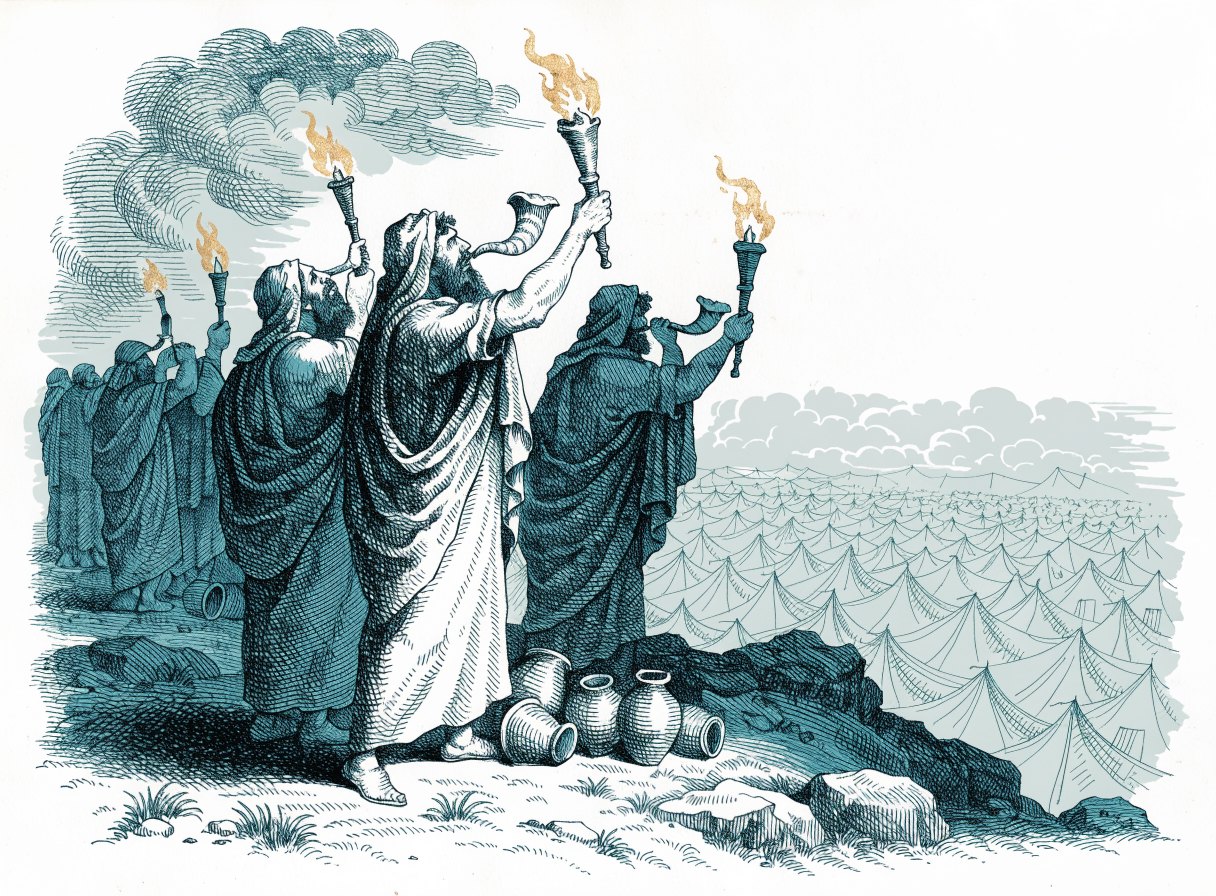
Gideon was hiding from the enemy when the angel of the LORD found him, threshing wheat in a winepress and doubting God. “If the LORD is with us, why then has all this happened to us?” (6:13). He called himself the least member of the weakest clan (6:15). God cut his army from thirty-two thousand to three hundred, so that no one could say, “My own hand has saved me” (7:2). At night the three hundred broke their jars, held up torches, blew their trumpets, and the LORD turned the enemy’s swords against each other until the whole army fled (7:19–22).
Afterward the people begged Gideon to be their king. He gave a great answer: “I will not rule over you, and my son will not rule over you; the LORD will rule over you” (8:23). And then he made a golden ephod, a priestly garment, and “all Israel whored after it there, and it became a snare to Gideon and to his family” (8:27). Whored is the Bible’s blunt word for spiritual unfaithfulness. The rescuer led them back into idolatry.
Samson had astonishing God-given strength and was one of the weakest men in the Bible. Set apart as a Nazirite “from the womb” to “begin to save Israel” (13:5), he spent much of his life chasing women and revenge. He died blind, a prisoner of the Philistines, calling on the LORD one last time and pulling their temple down on himself and them (16:28–30).
Hebrews still names Gideon and Samson among the people of faith (Heb. 11:32). That is not because God approved of everything they did. It is because God works through weak, sinful people who trust him, even a little. Every judge saved Israel for a while. None of them could change Israel’s heart, and none of them could stay. Israel needed a better rescuer.
The Turn: A Rescuer Who Changes Hearts
Many of us know the cycle of Judges from the inside. We sin, we land in trouble, we cry out, God helps, and a few months later we are back where we started. Israel’s story tells anyone caught there that God’s patience runs deeper than we think, and that getting out of trouble is not the same as getting a new heart.
God was teaching his people to want more than a way out. In Jesus he sent the Rescuer who changes the heart itself, and he does not leave his work half done: “he who began a good work in you will bring it to completion at the day of Jesus Christ” (Phil. 1:6). If you are tired of your own cycle, bring it to him. Next week we see how dark those days became, and meet a Moabite widow who found refuge under God’s wings.
Living It: Three Practices for This Week
Before Week 26: Read Judges 21:25 and the whole book of Ruth. Week 26 shows how dark the days of the judges became, and what God was quietly doing anyway.
For Discussion
- Judges 2:10 describes a generation that “did not know the LORD.” How can faith be lost in a single generation? What guards against it?
- Where do you see the cycle of Judges in your own life: sin, trouble, crying out, rescue, and back again?
- God used Gideon and Samson despite their failures. Is that encouraging, troubling, or both? Why?
- Gideon said, “the LORD will rule over you,” and then made an ephod that became a snare. How can a good start go wrong?
Sources & For Further Study
- On the downward spiral in Judges: Daniel I. Block, Judges, Ruth (New American Commentary); Dale Ralph Davis, Judges: Such a Great Salvation.
- For further reading: Sinclair B. Ferguson, Faithful God: An Exposition of the Book of Ruth; Iain M. Duguid, Esther and Ruth (Reformed Expository Commentary).
Leading a small group? This week comes as a beautifully formatted, printable PDF, along with a 2-page Small Group Guide: a discussion page for your group and leader notes with a session plan and answer key. Both are free when you join the weekly list.