

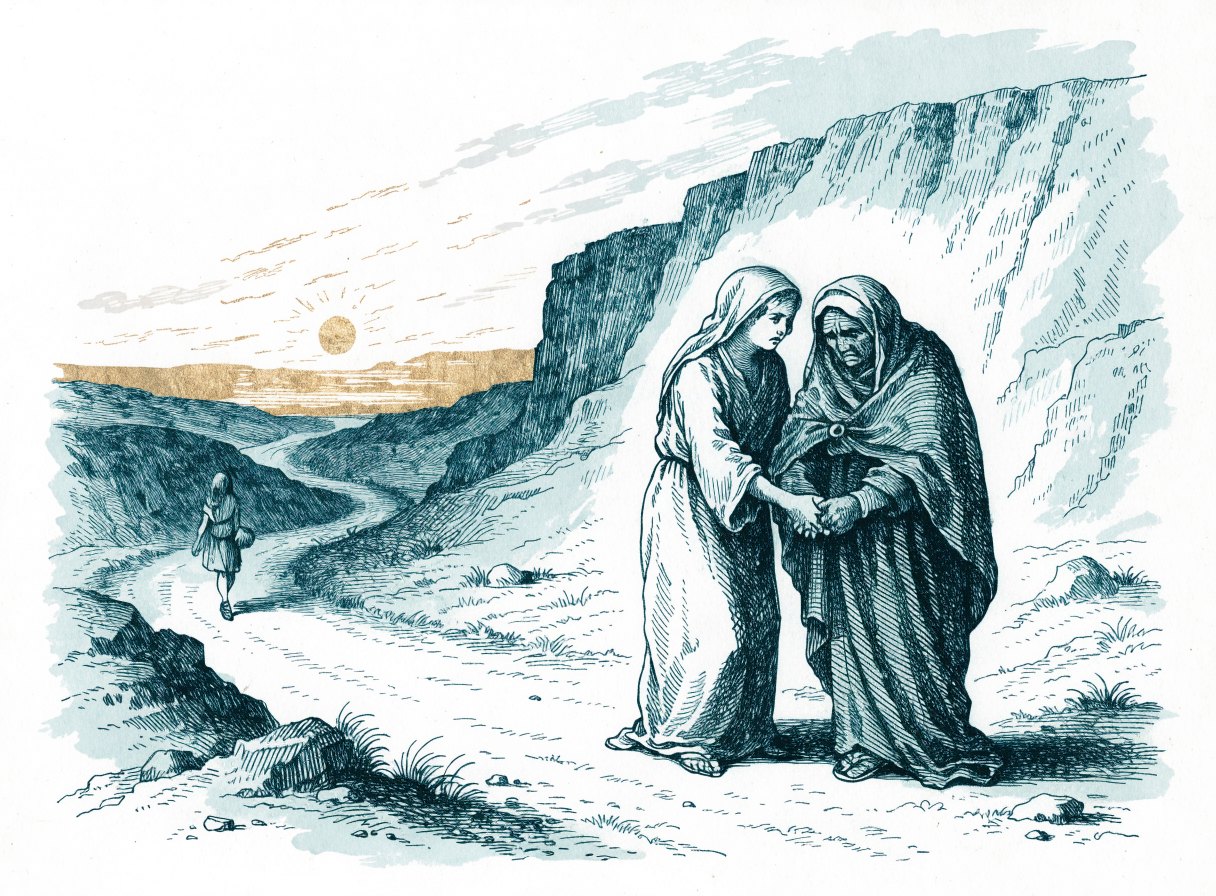
“Blessed be the LORD, who has not left you this day without a redeemer.” Ruth 4:14
Introduction: Grace in the Dark
Last week we watched Israel spiral downward through the days of the judges: sin, trouble, crying out, rescue, and back again. God raised up Othniel, Deborah, Gideon, and Samson, and every one of them saved Israel for a while. None of them could change Israel’s heart.
This week we see how dark it got when everyone did what was right in his own eyes. Then, in the same dark years, the Bible tells a quiet story about a Moabite widow, a bitter mother-in-law, and a kind farmer who was willing to pay.
The Word: Redeemer
Part Three: Right in His Own Eyes
The last chapters of Judges stop following the judges and show what ordinary life had become. A man named Micah keeps idols made from silver his mother dedicated “to the LORD” (17:3), sets up a private shrine, and hires a wandering Levite as his priest. A whole tribe steals that priest and his idols. And the book ends with a crime and a civil war so terrible that they are among the darkest chapters in the Bible (Judg. 19–21). Four times the writer says “there was no king in Israel,” and the book ends on the full line:
That sentence sounds almost modern. “Do what is right for you.” Judges shows where it leads. When everyone becomes his own king, the weak get crushed. The book is crying out for a king who will do what is right in God’s eyes and lead his people to do the same.
Part Four: Ruth: Grace in the Dark
Now turn the page to Ruth. A famine hits Bethlehem, and a man named Elimelech takes his wife Naomi and their two sons to Moab, a pagan nation east of the Dead Sea. Elimelech dies there. The sons marry Moabite women, Orpah and Ruth. About ten years later, both sons die too. Naomi is left with nothing: no husband, no sons, no grandchildren, in a foreign land.
When Naomi hears that God has given food to Bethlehem again, she starts home and tells her daughters-in-law to go back to their own families. Orpah kisses her and goes. But Ruth clings to her and says some of the most beautiful words in the Bible:
This is more than loyalty to a mother-in-law. It is conversion. Ruth leaves her gods for Naomi’s God. And remember who she is: a Moabite. God’s law said, “No Ammonite or Moabite may enter the assembly of the LORD” (Deut. 23:3). Ruth is the ultimate outsider. The law shut Moabites out of the assembly because Moab had met Israel with curses instead of bread (Deut. 23:4). Ruth comes the other way, as a Moabite who blesses Israel and takes refuge under Israel’s God. The prophets later promised that foreigners who hold fast to the LORD would be welcomed into his house (Isa. 56:3–7). Ruth is an early taste of that promise. She is coming in by faith.
Back in Bethlehem, Naomi is bitter. “Do not call me Naomi” (the name means “pleasant”); “call me Mara” (“bitter”), “for the Almighty has dealt very bitterly with me. I went away full, and the LORD has brought me back empty” (1:20–21). She is honest about her pain, and the book does not scold her for it. But she is wrong about one thing. She is not empty. She has Ruth, and God is already at work.
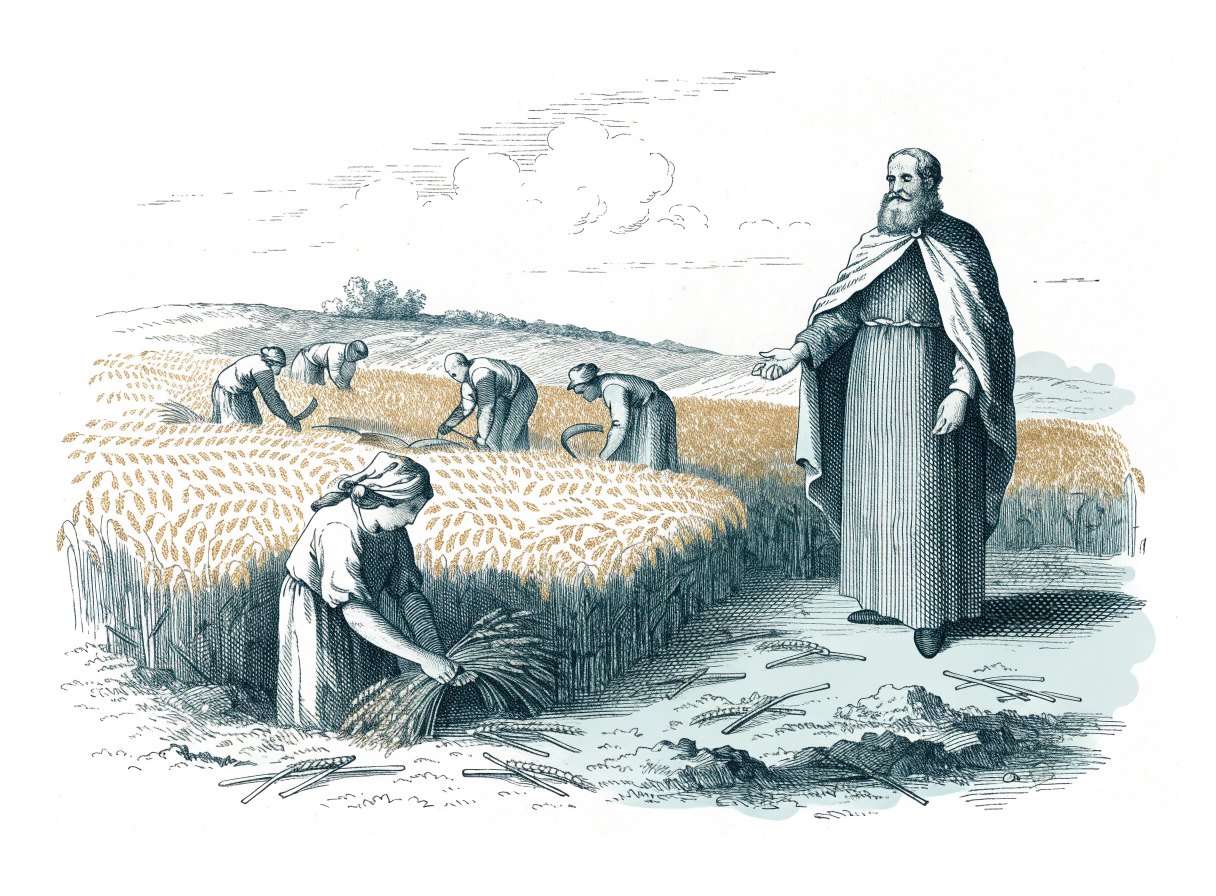
To feed them both, Ruth goes out to glean, picking up the grain the harvesters leave behind, which God’s law required farmers to leave for the poor, the foreigner, and the widow (Lev. 19:9–10; Deut. 24:19). Ruth was all three. “And she happened to come to the part of the field belonging to Boaz” (2:3). She “happened” to. The writer smiles as he says it. There are no accidents in God’s world. Boaz is a relative of Naomi’s late husband, and he is a good man. He protects Ruth, feeds her, and blesses her: “a full reward be given you by the LORD, the God of Israel, under whose wings you have come to take refuge!” (2:12).
At Naomi’s urging, Ruth goes to the threshing floor where Boaz is sleeping beside his grain, lies down at his feet, and waits. When he wakes at midnight, she asks him to marry her, using his own words: “Spread your wings over your servant, for you are a redeemer” (3:9). The Hebrew word for “wings” also means the corner of a cloak, and spreading it over a woman was a way of promising marriage and protection (Ezek. 16:8). Boaz calls her “a worthy woman” (3:11) and sends her home before dawn with her honor protected (3:14). Boaz is willing. But there is a closer relative with the first right. Boaz meets him at the town gate, in front of the elders. That man wants the land but backs out when he learns that Ruth comes with it: “I cannot redeem it for myself, lest I impair my own inheritance” (4:6). Any son born to Ruth would carry Mahlon’s name and inherit that land, so he would be paying for property his own family would never keep. Boaz pays the price himself. “Ruth the Moabite, the widow of Mahlon, I have bought to be my wife” (4:10).
The story ends with a baby on Naomi’s lap. The women of the town say, “Blessed be the LORD, who has not left you this day without a redeemer” (4:14). The woman who came home empty is full again. And then the last line turns a family story into world history. The baby’s name was Obed. “He was the father of Jesse, the father of David” (4:17). The Moabite widow became the great-grandmother of Israel’s greatest king.
Salvation begins with God, not with us. Before the world began God chose a people to save, not because of anything good in them, but out of his own love. He calls outsiders like Ruth, a Moabite widow, into his family. Grace is undeserved, and it is the only reason anyone is saved.
The Turn: Our Kinsman-Redeemer and King
Judges leaves us longing for a King who will do right. Ruth leaves us longing for a Redeemer who will pay. Both point to the same Person, born about eleven hundred years later in the same little town of Bethlehem, a descendant of Ruth and Boaz (Matt. 1:5–6).
Remember the three things a redeemer had to be. First, a close relative. So the Son of God became one of us. “Since therefore the children share in flesh and blood, he himself likewise partook of the same things” (Heb. 2:14). He is not ashamed to call us his brothers (2:11). Second, able to pay. Our debt was not silver or gold. “You were ransomed… not with perishable things such as silver or gold, but with the precious blood of Christ, like that of a lamb without blemish or spot” (1 Pet. 1:18–19). Third, willing. The nearer relative in Ruth would not risk his own inheritance. Jesus gave up everything. “God sent forth his Son, born of woman, born under the law, to redeem those who were under the law, so that we might receive adoption as sons” (Gal. 4:4–5).
And he is the King Judges was crying out for. The judges rescued Israel for a few years and died. Jesus rose from the dead, and “he is able to save to the uttermost those who draw near to God through him, since he always lives to make intercession for them” (Heb. 7:25). He beats our enemies, and he changes our hearts, so we stop doing what is right in our own eyes and start loving what is right in his.
Maybe you feel like Naomi: you went out full and came back empty. Or maybe you feel like Ruth, an outsider who has no right to be among God’s people. The book of Ruth is for you. Come the way Ruth came. Leave your old gods behind and say what Ruth said: “your God my God.” Turn from your sin, trust him, and take refuge under his wings. He is your Redeemer, and he is willing.
Living It: Three Practices for This Week
Before Week 27: Read 1 Samuel 8, 16, and 17. Week 27 tells how Israel got its first king, and how God chose the next one.
For Discussion
- “Everyone did what was right in his own eyes.” Where do you see that in our culture? Where do you see it in yourself?
- Naomi said, “The LORD has brought me back empty.” Was she right? How does the rest of the story answer her?
- Ruth was a Moabite, an outsider by law. What does her place in Jesus’ family tree teach about who can belong to God?
- Walk through the three things a redeemer had to be. How does Jesus fulfill each one?
Sources & For Further Study
- On גֹּאֵל and the redeemer laws: Robert L. Hubbard Jr., The Book of Ruth (NICOT); Brown, Driver, and Briggs, Hebrew and English Lexicon, s.v.
- For further reading: Sinclair B. Ferguson, Faithful God: An Exposition of the Book of Ruth; Iain M. Duguid, Esther and Ruth (Reformed Expository Commentary).
Leading a small group? This week comes as a beautifully formatted, printable PDF, along with a 2-page Small Group Guide: a discussion page for your group and leader notes with a session plan and answer key. Both are free when you join the weekly list.