

“he entered once for all into the holy places, not by means of the blood of goats and calves but by means of his own blood, thus securing an eternal redemption.” Hebrews 9:12
Introduction: The Most Solemn Day
Last week we stood at the bronze altar. An Israelite laid his hand on the head of an animal, and its life was given in place of his. Burnt offerings, sin offerings, peace offerings: Leviticus covers the whole of life with God, and it all rests on one truth, that “it is the blood that makes atonement by the life.”
This week begins with a warning about coming near to God carelessly. Then we follow the high priest on the one day of the year when he went behind the veil.
Part Three: Holy, Holy, Holy
The reason for all this is the holiness of God. Leviticus says it again and again: “You shall be holy, for I the LORD your God am holy” (Lev. 19:2). Holy means set apart, utterly pure, in a class by himself. And Leviticus shows that God’s holiness is not safe to treat casually.
Right at the start of the priests’ work, two of Aaron’s sons, Nadab and Abihu, “offered unauthorized fire before the LORD, which he had not commanded them. And fire came out from before the LORD and consumed them” (Lev. 10:1–2). Moses told Aaron what the LORD had said: “Among those who are near me I will be sanctified, and before all the people I will be glorified” (10:3). Leviticus 16, the chapter on the Day of Atonement, begins by looking back to that day: “The LORD spoke to Moses after the death of the two sons of Aaron, when they drew near before the LORD and died” (16:1). That day was burned into Israel’s memory. You cannot walk into God’s presence on your own terms.
Holiness touched every part of ordinary life too. Leviticus is the book that first says, “You shall love your neighbor as yourself” (Lev. 19:18), the command Jesus called the second greatest. A holy God wants a holy people, in worship and in the way they treat one another.
Part Four: The Day of Atonement
Once a year, “in the seventh month, on the tenth day of the month” (16:29), all Israel stopped. No one worked. The people were to “afflict” themselves, which means humbling themselves before God, usually by fasting. And the high priest did something he did on no other day. He went behind the veil into the innermost room, the Most Holy Place (Leviticus 16 calls it “the Holy Place inside the veil”), before the mercy seat.
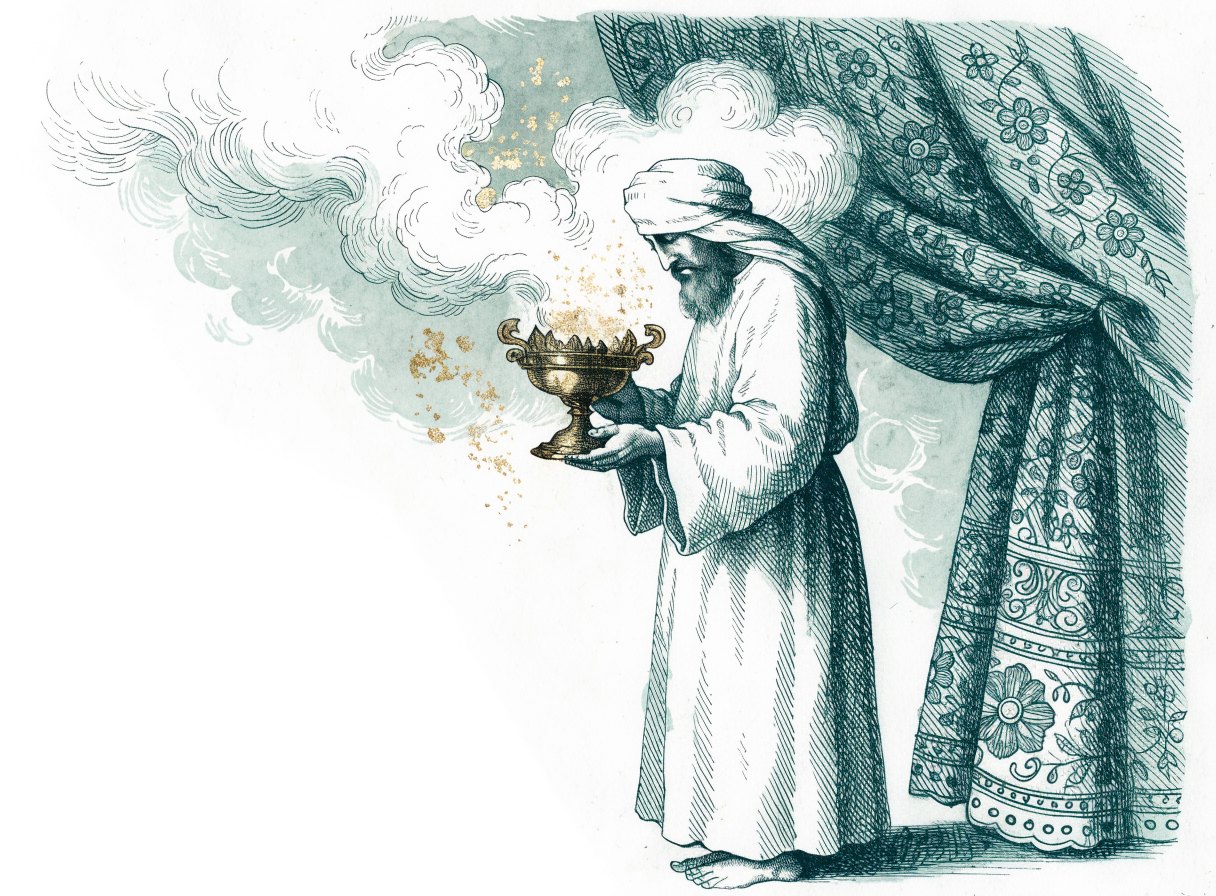
Here is how the day unfolded.
He came humbly. The high priest bathed and put on plain white linen, not his gold and jeweled garments (16:4). On this day he came before God stripped of glory.
He atoned for himself first. He sacrificed a bull “as a sin offering for himself” and for his household (16:6, 11). The man who stood between God and the people was a sinner too.
He went behind the veil. He carried a censer of burning coals and two handfuls of incense into the Most Holy Place, so “that the cloud of the incense may cover the mercy seat… so that he does not die” (16:12–13). Then he sprinkled the bull’s blood on the mercy seat and in front of it seven times (16:14).
The goat for the LORD. Two goats had been chosen by casting lots. The first was killed as a sin offering for the people, and its blood was carried behind the veil and sprinkled on the mercy seat, just like the bull’s (16:15). Remember what was inside the ark: the law Israel had broken. Now the blood of a substitute covered it, in the presence of God.
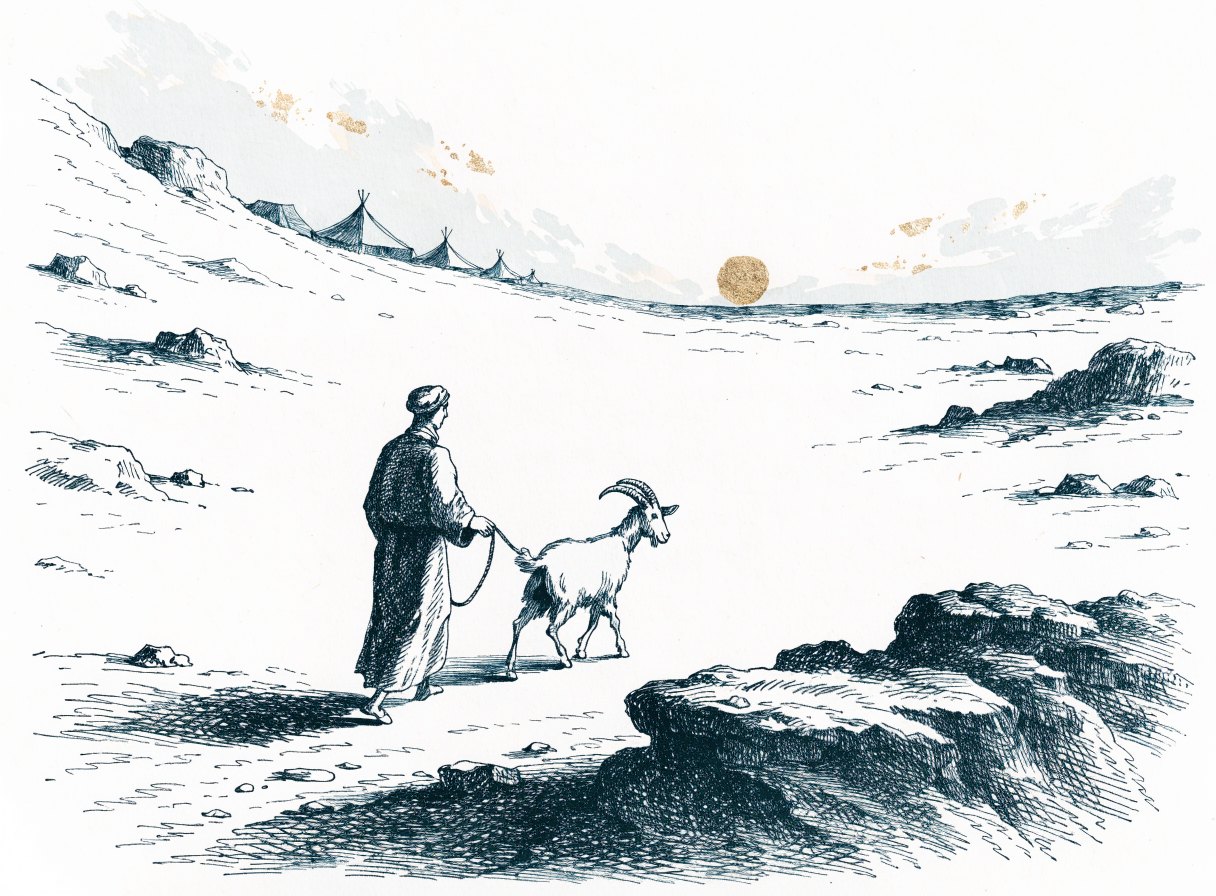
The goat sent away. Then came the most unforgettable moment of the day. “Aaron shall lay both his hands on the head of the live goat, and confess over it all the iniquities of the people of Israel, and all their transgressions, all their sins. And he shall put them on the head of the goat and send it away into the wilderness” (16:21). Imagine standing in the crowd as your sins walked out of the camp and disappeared over the horizon. “The goat shall bear all their iniquities on itself to a remote area” (16:22). This is where our word scapegoat comes from: William Tyndale translated the Hebrew as “the scapegoat,” the goat that escapes. The goat is sent “to Azazel” (16:8, 10), a Hebrew word whose exact meaning is debated, but the picture is clear: the sins are carried away, never to return.
The two goats show two sides of one atonement. The first goat died, and its blood answered God’s just anger against sin. The second goat carried the guilt away. Sin is paid for, and sin is removed. David sang about it later: “as far as the east is from the west, so far does he remove our transgressions from us” (Ps. 103:12).
And the result? “For on this day shall atonement be made for you to cleanse you. You shall be clean before the LORD from all your sins” (16:30). It was good news. But it came with a sentence that hung over the whole system: “atonement may be made for the people of Israel once in the year” (16:34). Next year they would have to do it all again. And the year after that. For fifteen centuries. Hebrews calls it “a reminder of sins every year” (Heb. 10:3).
How Were Old Testament Believers Saved?
If the sacrifices had to be repeated, did they actually work? Leviticus says the worshiper “shall be forgiven” (Lev. 4:31). Yet Hebrews says plainly, “it is impossible for the blood of bulls and goats to take away sins” (Heb. 10:4). Both are true. The forgiveness was real, but the power behind it was never in the animal. An animal cannot truly stand in for a human being. So how were faithful Israelites forgiven?
The same way we are: by grace, through faith in the Savior God promised. The sacrifices were real, God-given signs. When a believing Israelite laid his hand on the animal, he was trusting God’s promise of forgiveness, and that promise was always resting on the sacrifice still to come. The Westminster Confession says the benefits of Christ’s death were given to believers in every age “in and by those promises, types, and sacrifices” that pointed to him (WCF 8.6). Think of it like this. A friend whose word never fails promises to pay your debt in full on a set day. The moment you trust his promise you are free, even though the payment is still coming. The sacrifices were God’s signed promise in advance. The Confession says they were enough to build up believers “in faith in the promised Messiah, by whom they had full remission of sins, and eternal salvation” (WCF 7.5). Paul says that “in his divine forbearance he had passed over former sins,” and the cross shows that God was right to do so (Rom. 3:25–26).
On the cross Jesus took the place of sinners. He bore the penalty our sins deserved and satisfied God’s justice, so that God can forgive us and still be just. The Day of Atonement pictured it with two goats: one died, and one carried the people’s sins away.
The Turn: Once for All
Read Leviticus 16 and then read Hebrews 9 and 10, and you will see that the New Testament writer had the Day of Atonement open in front of him. Every detail finds its answer in Jesus.
The high priest had to offer a sacrifice for his own sins first. Jesus did not. He is “holy, innocent, unstained, separated from sinners,” and has no need “to offer sacrifices daily, first for his own sins and then for those of the people, since he did this once for all when he offered up himself” (Heb. 7:26–27). He is both the priest and the sacrifice.
The high priest went into a tent made by human hands, carrying the blood of animals. Christ “entered once for all into the holy places, not by means of the blood of goats and calves but by means of his own blood, thus securing an eternal redemption” (Heb. 9:12). He entered “into heaven itself, now to appear in the presence of God on our behalf” (9:24).
He is the goat for the LORD. On the cross Jesus bore the punishment our sins deserved, and God’s just anger against our sin fell on him instead of us. Paul’s word for this is propitiation: a sacrifice that turns away God’s wrath by bearing it. God “put forward” Jesus “as a propitiation by his blood, to be received by faith,” so that God might be “just and the justifier of the one who has faith in Jesus” (Rom. 3:25–26). And he is the goat sent away, carrying our sins out of sight. “The LORD has laid on him the iniquity of us all” (Isa. 53:6). The bodies of the Day of Atonement sacrifices were burned outside the camp, and “so Jesus also suffered outside the gate in order to sanctify the people through his own blood” (Heb. 13:12).
Look again at the furniture of the tabernacle from Week 19. There was a lampstand, a table, two altars, a basin, and an ark. There was no chair for the priest. The only seat in the tabernacle was the mercy seat, and that belonged to God. Nothing in that tent invited a priest to sit down and rest, because his work was never finished. “Every priest stands daily at his service, offering repeatedly the same sacrifices, which can never take away sins. But when Christ had offered for all time a single sacrifice for sins, he sat down at the right hand of God” (Heb. 10:11–12). Jesus sat down because the work was finished.
That means something enormous for you. “Where there is forgiveness of these, there is no longer any offering for sin” (Heb. 10:18). You do not need to bring God anything to pay for your sins. No good deeds, no years of feeling bad. Everything that had to be paid has been paid. What God asks is that you lay your hand, so to speak, on the head of the Lamb. Trust him as the one who died in your place, and turn from your sin to him. Faith receives the gift. Repentance always comes with it. “For our sake he made him to be sin who knew no sin, so that in him we might become the righteousness of God” (2 Cor. 5:21).
Living It: Three Practices for This Week
Before Week 23: Read Numbers 13–14 and 21:4–9. Week 23 follows Israel to the border of the Promised Land, and forty years in the desert.
For Discussion
- Why did God take the sin of Nadab and Abihu so seriously? What does that teach about coming to God on our own terms?
- The two goats show sin paid for and sin removed. Which of those do you most need to believe today?
- If animal blood could not take away sin, how were believers in Israel forgiven? How is their faith like yours?
- Jesus sat down because his work was finished. What would change in your life if you really believed nothing is left to pay?
Sources & For Further Study
- On “Azazel”: Gordon J. Wenham, The Book of Leviticus (NICOT), on 16:8.
- On substitution and propitiation: Leon Morris, The Apostolic Preaching of the Cross; John Murray, Redemption Accomplished and Applied; Westminster Confession of Faith 8.5–8.6.
- For further reading: Jay Sklar, Leviticus (Tyndale Old Testament Commentaries); L. Michael Morales, Who Shall Ascend the Mountain of the Lord?; Philip E. Hughes, A Commentary on the Epistle to the Hebrews; John Owen, An Exposition of the Epistle to the Hebrews.
Leading a small group? This week comes as a beautifully formatted, printable PDF, along with a 2-page Small Group Guide: a discussion page for your group and leader notes with a session plan and answer key. Both are free when you join the weekly list.