

“So we see that they were unable to enter because of unbelief.” Hebrews 3:19
Introduction: An Eleven-Day Trip That Took Forty Years
Deuteronomy opens with a detail that is easy to read past: “It is eleven days’ journey from Horeb by the way of Mount Seir to Kadesh-barnea” (Deut. 1:2). Horeb is Mount Sinai. Kadesh-barnea sits on the southern edge of the land God promised to Abraham. From the mountain where God gave his law to the doorstep of the Promised Land was less than two weeks on foot.
It took Israel forty years.
These two weeks cover that whole stretch of the story, the books of Numbers, Deuteronomy, and Joshua. It is a story of failure and faithfulness: a people who refused to trust God at the border, a generation that died in the desert, a God who carried them anyway, and a new leader who finally brought them in. On our timeline it runs from about 1445 BC, when Israel left Sinai, to about 1406 BC, when they crossed the Jordan River, and on through Joshua’s last years. And it is full of pictures of Jesus, who walked into the wilderness himself and came out with the victory Israel never won.
Part One: Failure at the Border
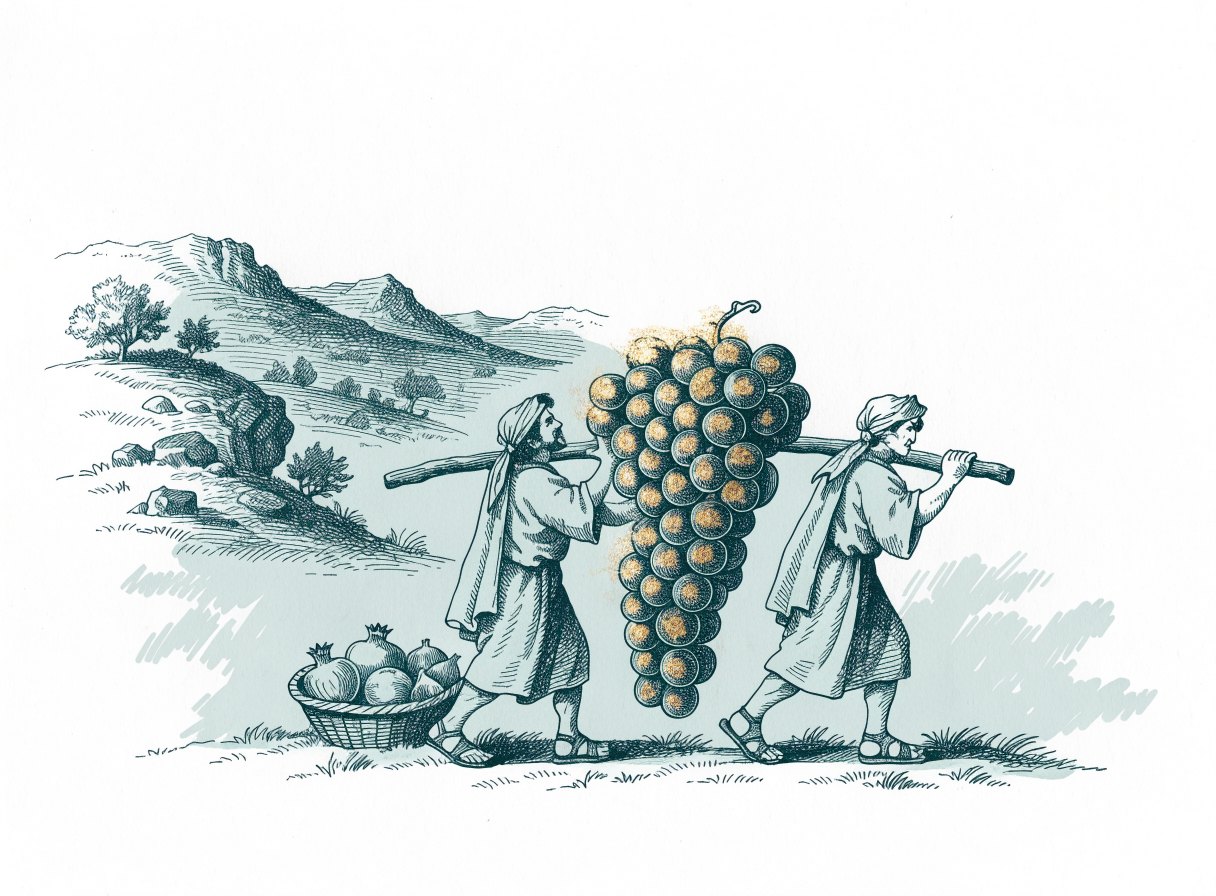
When Israel reached Kadesh, Moses sent twelve men, one from each tribe, to scout the land. They came back after forty days with proof that God had told the truth. In the Valley of Eshcol they had cut “a branch with a single cluster of grapes, and they carried it on a pole between two of them” (Num. 13:23). The land really did flow with milk and honey.
But ten of the twelve spies could not stop talking about the walls and the warriors. “However, the people who dwell in the land are strong, and the cities are fortified and very large” (13:28). Fear spread through the camp like fire. That night the people wept and said, “Would that we had died in the land of Egypt! Or would that we had died in this wilderness!… Let us choose a leader and go back to Egypt” (14:2, 4). The people God had carried out of slavery on eagles’ wings now wanted to go back to the whips.
Only two men stood against the crowd: Joshua and Caleb. “If the LORD delights in us, he will bring us into this land and give it to us, a land that flows with milk and honey. Only do not rebel against the LORD. And do not fear the people of the land” (14:8–9). They saw the same walls as everyone else. The difference was that they also saw God.
God forgave the people when Moses prayed for them (14:20), but forgiveness did not erase the consequences. The generation that refused to go in would not go in. “According to the number of the days in which you spied out the land, forty days, a year for each day, you shall bear your iniquity forty years” (14:34). Only Caleb and Joshua from that generation would enter the land, because Caleb “has a different spirit and has followed me fully” (14:24). Hebrews puts its finger on the root of it: “they were unable to enter because of unbelief” (Heb. 3:19).
Part Two: Forty Years in the Desert
What happened during those forty years? Mostly, the old generation slowly died, and a new one grew up. But this was not a story of God walking away. Years later, Moses looked back and told the new generation what God had been doing the whole time:
Six mornings a week for forty years, bread from heaven lay on the ground (Ex. 16:26, 35). Their sandals never wore out (Deut. 29:5). The cloud led them by day and the fire by night. Moses said God had carried them “as a man carries his son, all the way that you went” (Deut. 1:31). The wilderness was discipline, but it was a Father’s discipline (8:5).
Even Moses failed in the wilderness. When the people complained about water, God told Moses to speak to a rock. Instead, in anger, Moses said, “Hear now, you rebels: shall we bring water for you out of this rock?” and struck the rock twice (Num. 20:10–11). God gave the water anyway, but he told Moses that because he had not trusted God and honored him as holy in front of the people, Moses would not lead Israel into the land (20:12). If the greatest leader in Israel’s history could not get himself into the Promised Land, no one would get in on their own record.
Then came one of the strangest scenes in the Old Testament. The people grumbled again, and “the LORD sent fiery serpents among the people, and they bit the people, so that many people of Israel died” (21:6). When the people confessed their sin, God told Moses to make a bronze serpent and put it on a pole. “And if a serpent bit anyone, he would look at the bronze serpent and live” (21:9). No medicine. No work. Just a look of trust at the thing God had lifted up.
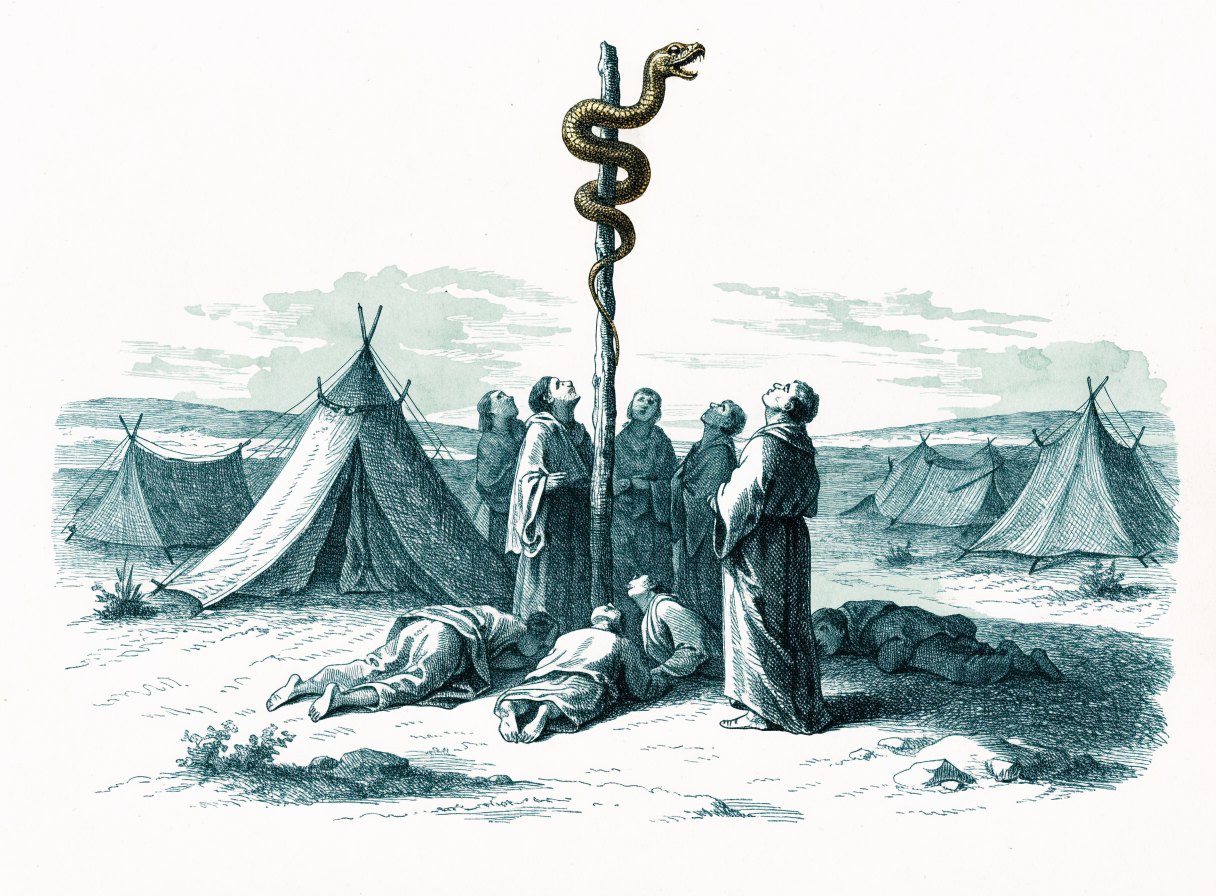
Fourteen centuries later, Jesus told a religious leader named Nicodemus what that scene was about: “And as Moses lifted up the serpent in the wilderness, so must the Son of Man be lifted up, that whoever believes in him may have eternal life” (John 3:14–15). The cure for the bite of sin is to look in faith at the One lifted up on the cross.
Faith is trusting God’s promise and resting on Christ alone for salvation. Israel saw God’s miracles in the wilderness, yet they could not enter the land because of unbelief. Faith is leaning our whole weight on what God has said. It is not a work that earns anything.
The Turn: Look and Live
Israel did not trust God, and God did not let go of Israel. The ten spies saw the grapes and the giants and believed the giants, and still God carried that people through forty years in the desert.
A look of trust is still how anyone is saved. A moment after Jesus told Nicodemus about the bronze serpent come the words, “For God so loved the world, that he gave his only Son, that whoever believes in him should not perish but have eternal life” (John 3:16). You do not have to heal yourself first. Whatever has bitten you, look to Jesus and live. Next week a new generation stands at the Jordan with a new leader, and his name is Joshua.
Living It: Three Practices for This Week
Before Week 24: Read Deuteronomy 6:4–9 and 34, then Joshua 1–6. Week 24 brings a new generation into the land.
For Discussion
- Kadesh was only an eleven-day walk from Sinai. Why do you think fear was more powerful than everything the people had already seen God do?
- Caleb and Joshua saw the same giants as the other ten spies. What made the difference?
- God forgave Israel but still let them face forty years of consequences. How do forgiveness and consequences fit together in your own life?
- How does the bronze serpent help you understand what it means to believe in Jesus (John 3:14–15)?
Sources & For Further Study
- On the date of the exodus and conquest (about 1446 and 1406 BC), following 1 Kings 6:1: Eugene H. Merrill, Kingdom of Priests. Other evangelical scholars hold a later date in the 1200s BC.
- For further reading: Dale Ralph Davis, Joshua: No Falling Words; Iain M. Duguid, Numbers: God’s Presence in the Wilderness (Preaching the Word); Daniel I. Block, Deuteronomy (NIV Application Commentary).
Leading a small group? This week comes as a beautifully formatted, printable PDF, along with a 2-page Small Group Guide: a discussion page for your group and leader notes with a session plan and answer key. Both are free when you join the weekly list.