

“For as by the one man’s disobedience the many were made sinners, so by the one man’s obedience the many will be made righteous.” Romans 5:19
Introduction: Judgment, and a Promise
Last week a serpent asked, “Did God actually say?” and the first man and woman decided they would rather be like God than trust him. Their eyes were opened, and the first thing they saw was their own shame. They sewed fig leaves and hid.
This week God judges. He curses the serpent and the ground. But in the middle of the judgment he makes a promise: the offspring of the woman will crush the serpent’s head. The rest of the Bible is the story of that promise being kept.
Part Three: The Curse and the Promise
Now God speaks judgment, and it is important to see how he does it. He curses the serpent: “cursed are you above all livestock” (3:14). He curses the ground: “cursed is the ground because of you” (3:17). Notice where the word “cursed” lands. God never says it directly to the man or the woman. That does not mean they escaped. The ground is cursed “because of you,” and the Catechism will tell us that all mankind fell “under his wrath and curse” (WSC 19). In the Bible a curse is the opposite of the blessing God spoke over them in Genesis 1:28: his sentence of judgment, cutting off life and good. But the first “cursed” is aimed at the enemy, and that tells us which way the story is going.
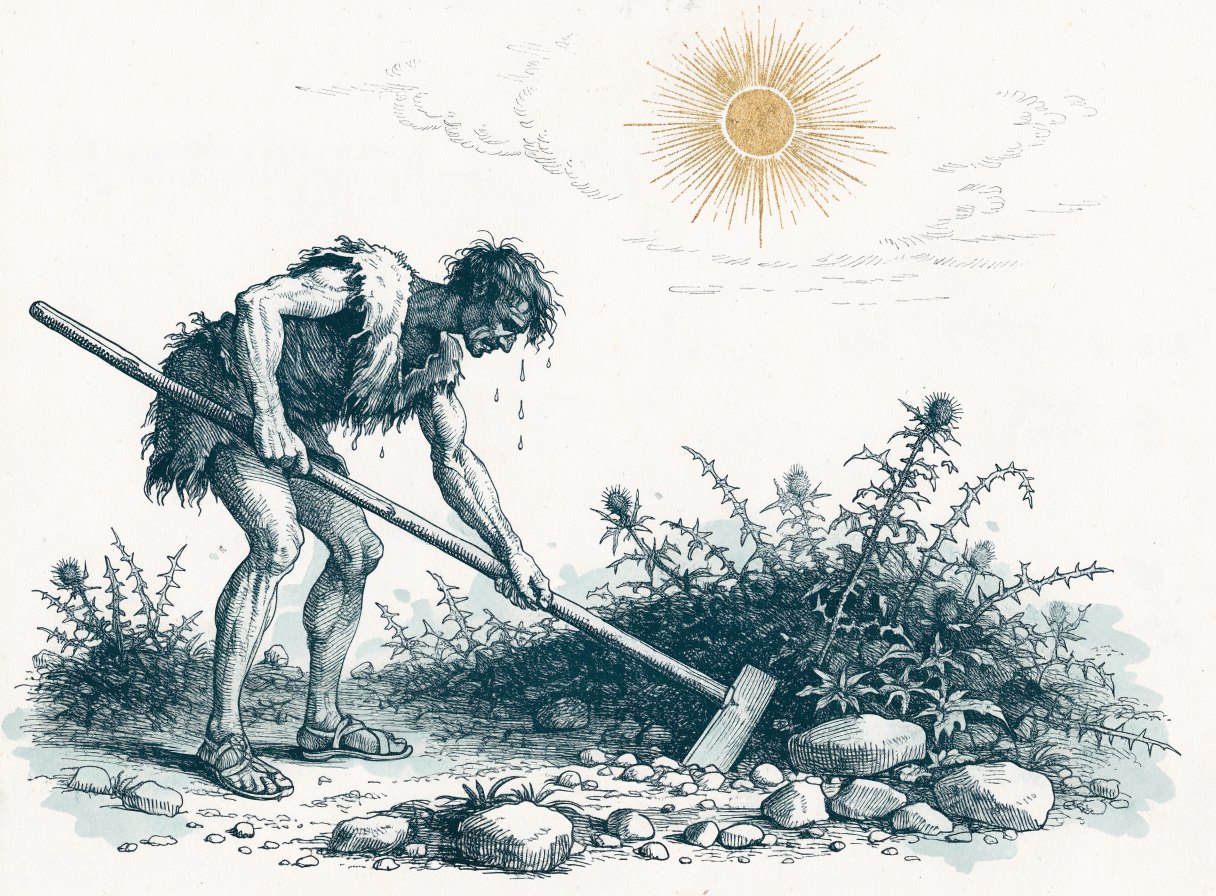
To the woman: pain in bearing children, and a marriage that pulls against itself. “Your desire shall be for your husband, and he shall rule over you” (3:16). The partnership of Genesis 2 will become a contest, her will set against his and his leadership turned harsh. The gift of life will come through pain. The gift of marriage will now come with a fight. To the man: the ground will fight him. Thorns and thistles. Sweat. Work, which was a joy in the garden, will now feel like a battle he can never fully win (3:17–19). And at the end of it all: “for you are dust, and to dust you shall return” (3:19). God had warned, “in the day that you eat of it you shall surely die” (2:17). That day they died. Their bodies would now slowly wear out toward the grave, but in the deepest sense they died at once. The Confession says they “became dead in sin” (WCF 6.2), cut off from the life of God and hiding from him in the trees.
Every grief you have ever felt traces back to this chapter. The labor room. The quarrel at the kitchen table. The job that grinds you down. The diagnosis. The grave. That is not how it was meant to be, and the Bible never asks you to pretend it is fine.
But look again at where God puts the promise. Not after the judgment, when things have calmed down. In the middle of it, in the very sentence he speaks to the serpent: “he shall bruise your head, and you shall bruise his heel” (3:15). Before God says a word to Adam and Eve about pain and thorns and dust, he tells the enemy that he is going to lose. A child of the woman will come. He will be wounded. And he will crush the serpent’s head. The first word of judgment Adam and Eve heard was a promise of rescue, spoken over their heads to their enemy.
The Shorter Catechism gives this promise a name. “God having, out of his mere good pleasure, from all eternity, elected some to everlasting life, did enter into a covenant of grace, to deliver them out of the estate of sin and misery, and to bring them into an estate of salvation by a Redeemer” (WSC 20). Adam broke the covenant of works. Genesis 3:15 is the first word of another covenant, one that rests on what God will do through the woman’s offspring.
Part Four: Garments of Skins
Two quiet verses, and both are full of grace. First, Adam names his wife Eve, a name that sounds like the Hebrew for “life-giver” and resembles the word for “living,” “because she was the mother of all living.” God had just said they would die. Adam names his wife Life-giver. It sounds like he believed the promise. A child would come from her, and through that child, life.
Second, God makes clothes for them. Their fig leaves were their own attempt to cover their shame, and fig leaves do not last. So God himself made them garments of skins. Genesis does not explain it, but you cannot have skins without a death. For the first time in the Bible, something died so that sinners could be covered. God provided what their shame needed and they could not make. Hold on to that picture. It is the first thread of the Lamb.
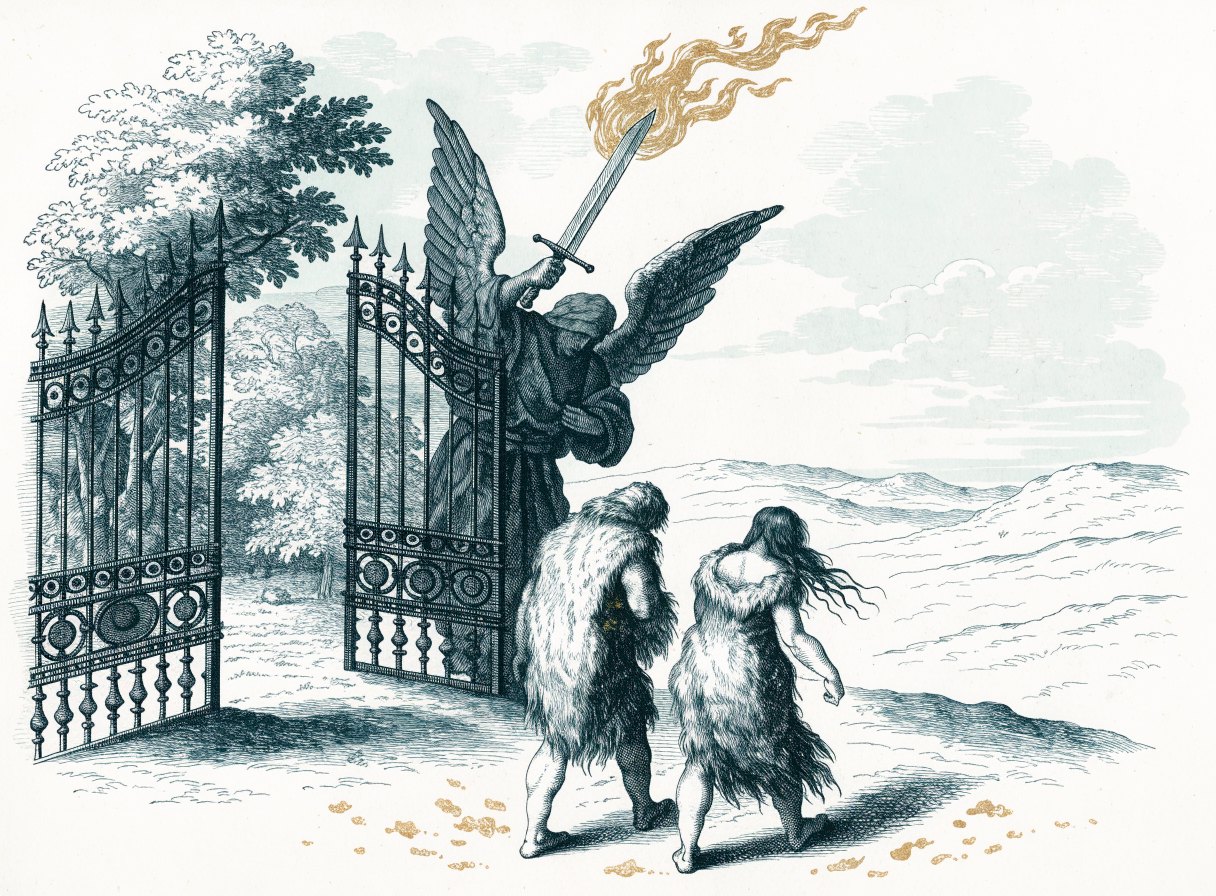
Then God drove them out of the garden, “lest he reach out his hand and take also of the tree of life and eat, and live forever” (3:22–24). This was judgment. The tree of life was the sign of the life God had promised for obedience, and Adam had thrown that life away. But there was mercy folded inside the judgment. To live forever in a fallen, dying state, with no way back to God, would be a nightmare without end. So the way to the tree of life was closed, and cherubim, mighty angelic guardians, stood at the east of the garden with a flaming sword. The road back to God’s presence was shut. Humanity would now live east of Eden, and the whole rest of the Bible is the story of how God would open that road again.
Part Five: In Adam All Die
You might be thinking: that is a sad story about two people a very long time ago. What does it have to do with me? The Bible’s answer is: everything. Remember from Week 6 that Adam stood as the head and representative of the whole human race in the covenant of works (God’s promise of life to Adam, and in him to us, on condition of perfect obedience). When he fell, we fell with him.
Paul breaks off his sentence there and picks it up again a few verses later. The Shorter Catechism explains it: “The covenant being made with Adam, not only for himself, but for his posterity; all mankind, descending from him by ordinary generation, sinned in him, and fell with him, in his first transgression” (WSC 16). The phrase “by ordinary generation” is there for a reason. There is one human being who did not descend from Adam the ordinary way, and you will meet him in the Turn.
This is what Christians call original sin. It means two things. First, we share Adam’s guilt, because he acted as our representative. Second, we inherit Adam’s corrupted nature. From birth our hearts are turned away from God, and that corruption runs through every part of us: mind, will, desires, and body (WCF 6.2). We cannot turn ourselves back (WCF 6.4). David said, “Behold, I was brought forth in iniquity, and in sin did my mother conceive me” (Ps. 51:5). Paul says that before Christ we were “dead in the trespasses and sins” and “by nature children of wrath, like the rest of mankind” (Eph. 2:1, 3). The Catechism defines sin as “any want of conformity unto, or transgression of, the law of God” (WSC 14). That covers what we fail to do and be, as well as what we do.
The Catechism is honest about where that leaves us. “All mankind by their fall lost communion with God, are under his wrath and curse, and so made liable to all the miseries in this life, to death itself, and to the pains of hell forever” (WSC 19). That is hard to read. It should be. God’s wrath is his settled, just opposition to evil, the right response of a holy God to what ruins his world and the people he made. “Liable” means rightly answerable for it. Hell is that just sentence carried out without end, and Jesus himself warned of it plainly (Matt. 10:28). A doctor who will not name the disease cannot treat it. And the Bible names the disease so plainly because it has a cure.
Does it seem unfair that Adam should represent us? Before you decide, look at the very next thing Paul says. The same principle that sank us in Adam is the principle God uses to save us in Christ:
Two more things help. Adam was no poor choice. He was made upright, set in a perfect world, given one clear command, and stood with every advantage any of us could ask for. If he fell there, none of us would have done better in his place. And each of us has signed our own name under his choice. “All have sinned and fall short of the glory of God” (Rom. 3:23), and our own sins show that we agree with what he did.
If one man could not act for many, then one Man could not save many. Representation is how we fell, and it is how we are rescued. In Adam, a whole human race was ruined by one man’s disobedience. In Christ, a new humanity is made righteous by one Man’s obedience. Paul’s “all” on each side means all who belong to that head: everyone in Adam by birth, everyone in Christ by faith. “Justification” means God declaring a guilty sinner righteous in his sight because of what that sinner’s representative has done (WSC 33). “For as in Adam all die, so also in Christ shall all be made alive” (1 Cor. 15:22).
When Adam, the head of the human race, disobeyed God, all humanity fell with him. Since then every person is born guilty and with a heart bent away from God. Sin is more than bad choices. It is a condition we cannot cure ourselves.
The Turn: The Second Adam in a Garden
Last week we heard God call, “Where are you?” This week, watch how he answers his own question in Jesus.
Paul calls Jesus “the last Adam” and “the second man” (1 Cor. 15:45, 47). Now watch how the Gospels tell the story of Jesus, and see Genesis 3 running backward. The first Adam was formed from the ground and given God’s breath. Jesus was “born of woman” (Gal. 4:4), the woman’s offspring of 3:15. He is a true son of Adam (Luke 3:38), born of a human mother, but he was conceived by the Holy Spirit, so he did not come from Adam by ordinary generation and did not fall with him. The first Adam was tempted in a garden full of food and fell. Jesus was tempted in a wilderness after forty days without food, and he stood (Matt. 4:1–11). The first Adam reached for what God had forbidden and said, in effect, “my will be done.” On the night before he died, Jesus went into another garden (John 18:1) and prayed, “Father, if you are willing, remove this cup from me. Nevertheless, not my will, but yours, be done” (Luke 22:42).
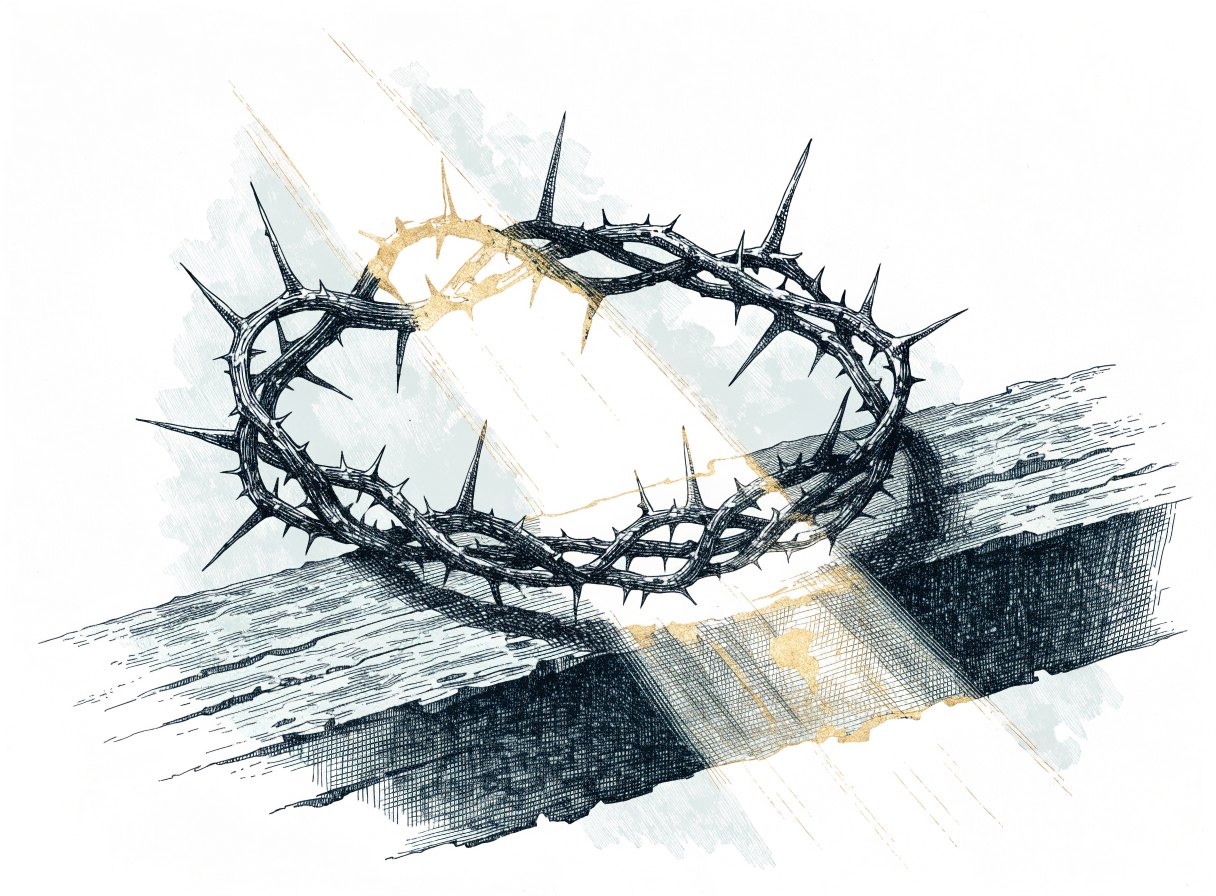
The ground was cursed with thorns because of Adam. The soldiers twisted those thorns into a crown and pressed it on Jesus’ head (Matt. 27:29). Adam was sentenced to die and return to dust. Jesus, who had no sin of his own, went to death in his place. Paul says, “Christ redeemed us from the curse of the law by becoming a curse for us,” and he quotes Moses: “Cursed is everyone who is hanged on a tree” (Gal. 3:13). The heel was struck, and in that very act the serpent’s head took its death blow. “The reason the Son of God appeared was to destroy the works of the devil” (1 John 3:8). He shared our flesh “that through death he might destroy the one who has the power of death, that is, the devil” (Heb. 2:14). The serpent still thrashes, and Christians still feel his bite. But his defeat is sealed, and Paul promises the end of it: “The God of peace will soon crush Satan under your feet” (Rom. 16:20).
And to a dying thief who turned to him on the next cross, Jesus said, “Truly, I say to you, today you will be with me in paradise” (Luke 23:43). “Paradise” is the word the Greek Old Testament used for the garden of Eden (Gen. 2:8). The road east of Eden, guarded by a flaming sword, was opened for a criminal by a dying King. The Bible’s last chapter shows the tree of life again, open to God’s people (Rev. 22:2), and says, “No longer will there be anything accursed” (Rev. 22:3).
Genesis 3 leaves you with a question about your own fig leaves. We all sew them: good works, a decent reputation, comparisons with people worse than us, all stitched together to cover what we really are. Fig leaves do not last. God offers a different covering, one he provided at the cost of a death. “For our sake he made him to be sin who knew no sin, so that in him we might become the righteousness of God” (2 Cor. 5:21). Stop hiding in the trees. When God calls, “Where are you?” answer him honestly. Turn from your sin and trust the Offspring of the woman, who was bruised for you and rose again on the third day (1 Cor. 15:3–4). He will clothe you in his own righteousness.
Living It: Three Practices for This Week
Before Week 9: Read Genesis 4 and 5. Week 9 follows sin into the next generation: Cain and Abel.
For Discussion
- Adam blamed Eve and God; Eve blamed the serpent. Where do you see the blame chain in our world, and in your own life?
- Why does it matter that God placed the promise of 3:15 in the middle of the judgment, before he said a word to Adam and Eve about pain and thorns and dust?
- Read Romans 5:18–19. Why is the idea of a representative both the bad news and the good news?
- Look at the ways Jesus reverses Genesis 3 (the garden, the thorns, the tree, “paradise”). Which one means the most to you, and why?
Sources & For Further Study
- Westminster Shorter Catechism (1647), Q. 13–20. Westminster Confession of Faith (1646), chapter 6, “Of the Fall of Man, of Sin, and of the Punishment Thereof.”
- On זֶרַע in Genesis 3:15: Brown, Driver, and Briggs, Hebrew and English Lexicon; Koehler and Baumgartner, HALOT, s.v. On the Greek translation’s masculine pronoun: R. A. Martin, “The Earliest Messianic Interpretation of Genesis 3:15,” Journal of Biblical Literature 84 (1965): 425–27. On the singular pronoun in the Hebrew: C. John Collins, “A Syntactical Note (Genesis 3:15): Is the Woman’s Seed Singular or Plural?” Tyndale Bulletin 48 (1997): 139–48.
- For further reading: Derek Kidner, Genesis (Tyndale Old Testament Commentaries); Cornelius Plantinga Jr., Not the Way It’s Supposed to Be: A Breviary of Sin; John Murray, The Imputation of Adam’s Sin.
Leading a small group? This week comes as a beautifully formatted, printable PDF, along with a 2-page Small Group Guide: a discussion page for your group and leader notes with a session plan and answer key. Both are free when you join the weekly list.