

“It is finished.” John 19:30
Introduction: Golgotha
Last week Jesus ate the Passover with his disciples and told them the bread was his body and the cup the new covenant in his blood. In Gethsemane he asked the Father to remove the cup of wrath, and then took it anyway. He was arrested, condemned, and handed over in place of Barabbas.
This week we follow him from Pilate’s court to the cross. Then we ask what happened there, and whether it was for you.
The Word: It Is Finished
Part Three: The Cross
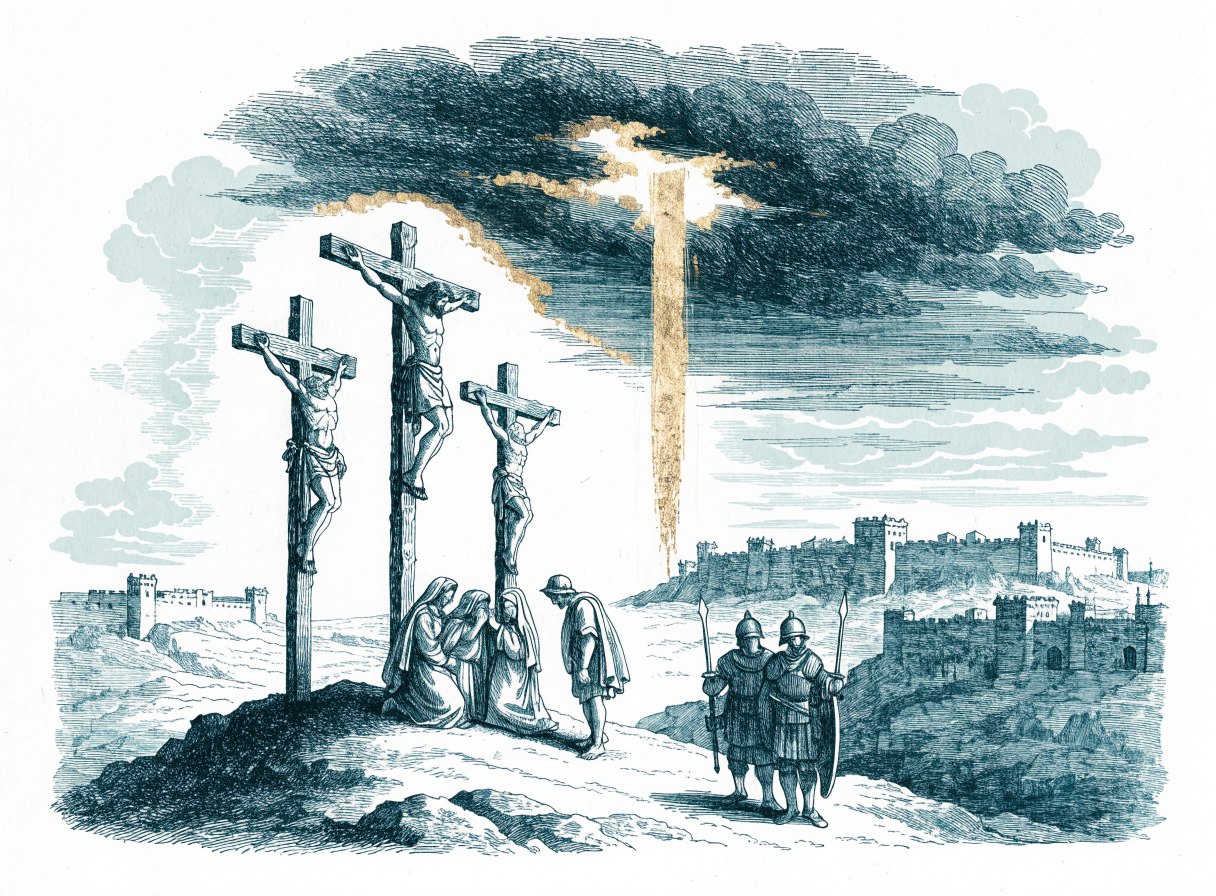
They crucified him at a place called The Skull, Golgotha, just outside Jerusalem’s walls, between two criminals (Luke 23:33; John 19:17, 20; Heb. 13:12). Crucifixion was the most shameful death Rome could give, reserved for slaves and rebels. Luke records Jesus praying for the people killing him: “Father, forgive them, for they know not what they do” (23:34). The crowds mocked: “He saved others; he cannot save himself” (Mark 15:31). They were more right than they knew. He could not save himself and save us too.
One of the criminals beside him mocked him too. The other told him to stop, because “this man has done nothing wrong.” Then he turned to Jesus: “Jesus, remember me when you come into your kingdom.” And Jesus said, “Truly, I say to you, today you will be with me in paradise” (Luke 23:41–43). A dying thief, who admitted he deserved his sentence and had no time to do a single good work, was saved through faith in Jesus alone.
At noon, darkness covered the land for three hours. Then, at about three in the afternoon, “Jesus cried with a loud voice, ‘Eloi, Eloi, lema sabachthani?’ which means, ‘My God, my God, why have you forsaken me?’” (Mark 15:34). He was quoting the first line of Psalm 22, a psalm David wrote a thousand years earlier that describes pierced hands and feet and men casting lots for clothing (Ps. 22:16–18). In that darkness, as our substitute, he bore the Father’s just wrath against our sin. He felt the full weight of being forsaken, cut off from every comfort of his Father’s favor. Yet the Trinity was never torn apart. He was still the beloved Son, and he cried “My God” even there.
Then he cried out, “It is finished” (John 19:30), and, “Father, into your hands I commit my spirit!” (Luke 23:46), and he breathed his last. At that very moment, “the curtain of the temple was torn in two, from top to bottom” (Mark 15:38). The Roman officer who had supervised the execution said, “Truly this man was the Son of God!” (15:39). That evening a rich man named Joseph of Arimathea laid Jesus’ body in his own new tomb and rolled a great stone across the entrance (Matt. 27:57–60).
Part Four: What Happened on the Cross
About seven hundred years before the crucifixion, Isaiah described a Servant of the LORD who would suffer. Read Isaiah 53 next to the Gospels and the details line up with startling precision.
But the most important thing Isaiah tells us is not the details. It is the meaning. “He was pierced for our transgressions.… the LORD has laid on him the iniquity of us all” (Isa. 53:5–6). The New Testament explains the cross with several pictures, each showing a different side of the same diamond.
At the center of them all is substitution: Jesus in our place. “He himself bore our sins in his body on the tree” (1 Pet. 2:24). “For our sake he made him to be sin who knew no sin, so that in him we might become the righteousness of God” (2 Cor. 5:21). This is how God can be both perfectly just and the one who forgives. He does not ignore sin. He punishes it fully, in his Son, so that he can be “just and the justifier of the one who has faith in Jesus” (Rom. 3:26). The Bible’s word for this is propitiation: a sacrifice that turns away God’s wrath by bearing it. And this was love, not grudging payment: “In this is love, not that we have loved God but that he loved us and sent his Son to be the propitiation for our sins” (1 John 4:10).
Who killed Jesus? Peter told a crowd in Jerusalem, “this Jesus, delivered up according to the definite plan and foreknowledge of God, you crucified and killed by the hands of lawless men” (Acts 2:23). God planned it. Human beings were guilty of it. And Jesus went willingly: “No one takes it from me, but I lay it down of my own accord” (John 10:18).
The Turn: For Me
It is possible to know all of this as history and miss the heart of it. The apostle Paul did not miss it. He wrote, “the life I now live in the flesh I live by faith in the Son of God, who loved me and gave himself for me” (Gal. 2:20). Not for a faceless crowd. For me.
“God shows his love for us in that while we were still sinners, Christ died for us” (Rom. 5:8). He did not wait for you to clean up. He did not die for people who had cleaned themselves up. He died for sinners, for the ungodly, for his enemies. And because his work is finished, there is nothing left for you to pay. You cannot add to “It is finished.” You can only receive it.
The thief on the cross had nothing to bring. He could not be baptized, join a church, or do a single good deed. He simply turned to Jesus and said, “Jesus, remember me.” And Jesus said, “today you will be with me in paradise.” If you have never done it, you can do the same thing right now: turn from your sin, and trust the Lamb who died for sinners. No one who comes to him is turned away (John 6:37), and everyone who trusts him can say with Paul that the Son of God “loved me and gave himself for me.” And for everyone who does, this is the verdict: “There is therefore now no condemnation for those who are in Christ Jesus” (Rom. 8:1).
Living It: Three Practices for This Week
Before Week 43: Read Mark 16:1–8, Luke 24, and John 20–21. Week 43 opens the tomb.
For Discussion
- Trace the lamb thread from Genesis 22 to the cross. Which link in that chain means the most to you now?
- The thief on the cross was saved with no time to do good works. What does that teach about how anyone is saved?
- Look at the pictures of the cross: substitution, propitiation, redemption, reconciliation, victory. Which one do you need most right now?
- Paul wrote, “who loved me and gave himself for me.” What would change if you really believed that about yourself?
Sources & For Further Study
- On the meaning of the cross: John Stott, The Cross of Christ; Leon Morris, The Apostolic Preaching of the Cross; Westminster Confession of Faith 8.4–8.5.
- For further reading: John Murray, Redemption Accomplished and Applied; Donald Macleod, Christ Crucified; J. I. Packer and Mark Dever, In My Place Condemned He Stood.
Leading a small group? This week comes as a beautifully formatted, printable PDF, along with a 2-page Small Group Guide: a discussion page for your group and leader notes with a session plan and answer key. Both are free when you join the weekly list.