

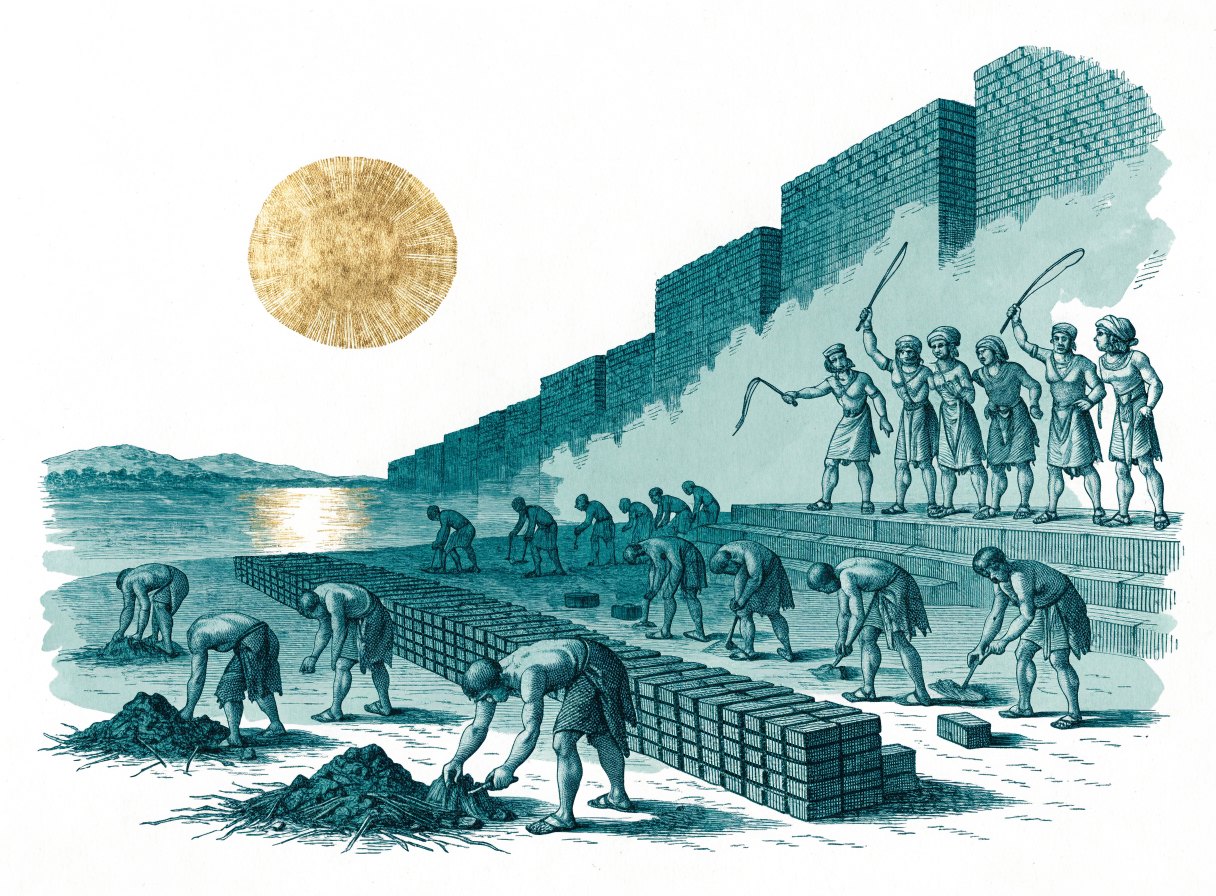
“I have surely seen the affliction of my people who are in Egypt and have heard their cry because of their taskmasters. I know their sufferings” Exodus 3:7
Introduction: A Story Worth Retelling
Every family has a story it tells again and again. How Grandpa came over on the boat. The night the house burned and everyone got out. The story gets told at holidays until the children can recite it, because it explains who the family is.
Israel has a story like that, and the Bible tells it in the book of Exodus (the word means “the way out”). A nation of slaves in Egypt. A night of judgment. A lamb in every house and its blood on every door. A sea that opened and closed. For more than three thousand years God’s people have kept the Passover, and to this day Jewish families retell the story every spring. In a custom that goes back to the early centuries after Christ, the youngest child asks, “Why is this night different from all other nights?” Exodus itself expected that question (12:26). Jesus himself kept the Passover with his disciples on the night before he died. And then he gave the story a new center.
This week opens Unit 3, “Rescue and Covenant.” We have come a long way. In Week 11, God told Abraham that his family would be “sojourners in a land that is not theirs and will be servants there, and they will be afflicted for four hundred years,” and that afterward God would bring them out (Gen. 15:13–14). In Week 14 we watched Jacob’s family of seventy move down to Egypt to survive a famine. The family has grown into a nation, and the prophecy has come true. They are slaves. These two weeks run from Moses’ birth, about 1526 BC, to the night Israel walked out of Egypt in 1446 BC, when Moses was eighty (7:7).
Part One: Slaves in Egypt
Exodus opens with a sentence that changes everything: “Now there arose a new king over Egypt, who did not know Joseph” (Ex. 1:8). Joseph had saved Egypt. Now Joseph’s people were seen as a threat. Pharaoh, the king of Egypt, enslaved them and set taskmasters over them “to afflict them with heavy burdens” (1:11). When that did not shrink their numbers, he ordered the Hebrew midwives to kill every baby boy at birth. But two brave women, Shiphrah and Puah, “feared God and did not do as the king of Egypt commanded them” (1:17). So Pharaoh commanded all his people, “Every son that is born to the Hebrews you shall cast into the Nile” (1:22).
Into that world a baby boy was born to a family from the tribe of Levi, one of Jacob’s twelve sons (2:1). His mother hid him for three months, then placed him in a basket among the reeds of the Nile, and Pharaoh’s own daughter found him and raised him as her son. She named him Moses (2:1–10). Raised in the palace, Moses was “instructed in all the wisdom of the Egyptians” (Acts 7:22). At forty, he tried to defend his people by killing an Egyptian, and had to flee to the desert of Midian, where he spent the next forty years as a shepherd (Ex. 2:11–15; Acts 7:23, 30).
Meanwhile, back in Egypt: “the people of Israel groaned because of their slavery and cried out for help. Their cry for rescue from slavery came up to God. And God heard their groaning, and God remembered his covenant with Abraham, with Isaac, and with Jacob” (2:23–24). God saw his people, and God knew (2:25). Notice the verbs: God heard, God remembered, God saw, God knew. In Week 3 we stood with Moses at the burning bush and heard God’s name, I AM. Before God gave that name, he told Moses why he had come: “I have surely seen the affliction of my people who are in Egypt and have heard their cry because of their taskmasters. I know their sufferings, and I have come down to deliver them” (3:7–8).
And God sent one of the most reluctant rescuers in the Bible. “Who am I that I should go to Pharaoh?” Moses asked (3:11). He made excuse after excuse until he finally begged, “Oh, my Lord, please send someone else” (4:13). God sent him anyway, with his brother Aaron to help him speak. The rescue would rest on God, whatever Moses lacked.
Part Two: “Let My People Go”
Moses and Aaron walked into Pharaoh’s court with God’s message: “Let my people go, that they may hold a feast to me in the wilderness” (5:1). Later, it was put even more plainly: “Let my people go, that they may serve me” (7:16). The word “serve” here is the same Hebrew word Exodus used for their slavery (1:13–14). God was bringing them out of hard service to Pharaoh and into glad service to the God who loved them.
Pharaoh answered with contempt: “Who is the LORD, that I should obey his voice and let Israel go? I do not know the LORD” (5:2). What followed were ten plagues, ten blows of judgment on Egypt. The Nile turned to blood. Frogs, gnats, and flies swarmed the land. The livestock died. Boils broke out. Hail destroyed the crops, and locusts ate what the hail missed. Darkness covered Egypt for three days. And finally, the death of the firstborn.
Why the firstborn? In the ancient world the firstborn son was the heir, the one who carried the family’s name and future. Before the plagues began, God had told Moses what to say to Pharaoh: “Israel is my firstborn son, and I say to you, ‘Let my son go that he may serve me.’ If you refuse to let him go, behold, I will kill your firstborn son” (4:22–23). Pharaoh had been crushing God’s son for generations. The last plague was justice, announced long in advance, and Pharaoh was warned again and again. God also made a distinction: from the fourth plague on, the land where Israel lived was spared (8:22–23; 11:7). On the last night, though, the line between Egypt and Israel would not hold by itself. Israel’s firstborn were sinners too. Only the blood would keep them.
Why ten plagues? Why not one? Because God was answering Pharaoh’s question, “Who is the LORD?” Egypt worshiped many gods: gods of the Nile, of the sun, of the land’s fertility, and Pharaoh himself was honored as divine. God said, “on all the gods of Egypt I will execute judgments: I am the LORD” (12:12). Plague by plague, everything Egypt trusted was shown to be powerless before the one true God. The purpose was stated again and again: “By this you shall know that I am the LORD” (7:17; see 7:5; 8:22; 10:2).
You will also notice something that troubles many readers: Pharaoh’s heart was hardened. Sometimes the text says Pharaoh “hardened his heart” (8:15). Other times it says “the LORD hardened the heart of Pharaoh” (9:12). Both are true. Pharaoh was fully responsible; he refused God again and again. And God, who rules over all things, had said before the first plague, “I will harden his heart” (4:21). He put no evil into Pharaoh. He withheld the mercy that would have softened him, gave him over to the hardness he loved, and used it for his own purposes. Paul quotes God’s words to Pharaoh: “For this very purpose I have raised you up, that I might show my power in you, and that my name might be proclaimed in all the earth” (Rom. 9:17; see Ex. 9:16). It is the same truth we saw with Joseph’s brothers in Week 14. People mean their evil. God rules over it, and he is never its author.
The Turn: The God Who Hears
Israel waited four hundred years in Egypt, and for most of that time heaven seemed silent. It was not. The God who heard their groaning came down, just as he had promised Abraham.
The Son of God came down the same way, and much further. He took on our flesh and blood, “that through death he might destroy the one who has the power of death, that is, the devil, and deliver all those who through fear of death were subject to lifelong slavery” (Heb. 2:14–15). Pharaoh was a cruel master. Sin and death are crueler, and Jesus came to set their slaves free. If you are crying out under a weight you cannot lift, God hears. Next week we see what the rescue cost: a lamb, and blood on the door.
Living It: Three Practices for This Week
Before Week 16: Read Exodus 12 slowly, then 14–15. Week 16 is the night of the Passover and the crossing of the sea.
For Discussion
- Why do you think God waited four hundred years to rescue Israel? What does Exodus 2:23–25 tell you about God while they waited?
- Moses gave excuse after excuse. Which of his excuses sounds most like you? How did God answer him?
- “Let my people go, that they may serve me.” How does that change the way you think about freedom?
- Pharaoh hardened his heart, and God hardened Pharaoh’s heart. How can both be true? Why does it matter that we keep both?
Sources & For Further Study
- On the date of the Exodus: 1 Kings 6:1 and Exodus 12:40–41, as set out in Week 2.
- Westminster Confession of Faith (1646), 5.6 (on God’s hardening of the wicked).
- For further reading: Philip Graham Ryken, Exodus: Saved for God’s Glory (Preaching the Word); Alec Motyer, The Message of Exodus (The Bible Speaks Today).
Leading a small group? This week comes as a beautifully formatted, printable PDF, along with a 2-page Small Group Guide: a discussion page for your group and leader notes with a session plan and answer key. Both are free when you join the weekly list.