

“For the battle is the LORD’s” 1 Samuel 17:47
Introduction: Give Us a King
Judges ended with a cry: “In those days there was no king in Israel. Everyone did what was right in his own eyes” (Judg. 21:25). In 1 and 2 Samuel, Israel finally gets kings. The first one looks perfect and falls apart. The second one is a shepherd boy nobody expected, a man after God’s own heart, who also commits one of the most shameful sins in the Bible.
The real center of these two weeks is a promise. Around 1000 BC, God made a covenant with David that carries his promise to Abraham forward and narrows it to one royal family: one of David’s descendants would sit on a throne that would last forever. From this point on, the Old Testament watches for that King. When the New Testament opens, its very first sentence names him: “The book of the genealogy of Jesus Christ, the son of David” (Matt. 1:1).
On our timeline, Saul begins to reign around 1050 BC, David reigns from about 1010 to 970 BC, and God makes his covenant with David around 1000 BC.
The Word: Anointed
Part One: A King Like the Nations
Samuel was Israel’s last judge and a faithful prophet. But when he grew old and his sons proved corrupt, the elders came with a demand: “Now appoint for us a king to judge us like all the nations” (1 Sam. 8:5). God had planned for Israel to have a king one day (Deut. 17:14–20). The problem was their reason. They wanted to be like everyone else. God told Samuel, “they have not rejected you, but they have rejected me from being king over them” (8:7). Samuel warned them that a king would take their sons and daughters, their best fields, and a tenth of their harvests and flocks. They said, “No! But there shall be a king over us, that we also may be like all the nations” (8:19–20).
So God gave them Saul. He looked the part, “taller than any of the people” (9:2), handsome, and humble at first. But the cracks showed quickly. When Samuel had not arrived by the end of the seven days he had set, Saul grew impatient and offered the sacrifice himself. Samuel walked up just as he finished (13:8–12). Later God commanded him to carry out his judgment on the Amalekites (15:2–3; see Week 24), and Saul kept the best of the livestock, then claimed he had obeyed (15:20–21). Samuel’s answer has echoed for three thousand years:
Saul was a king “like all the nations”: impressive on the outside, driven by fear of the people, and always ready with an excuse. God had already said what he would do: “The LORD has sought out a man after his own heart” (13:14).
Part Two: The Shepherd Boy
God sent Samuel to Bethlehem, to the house of a man named Jesse (the grandson of Ruth and Boaz from Week 26). Jesse paraded his sons in front of the prophet, starting with the oldest and tallest. Samuel thought, surely this is the one. But God said, “Do not look on his appearance or on the height of his stature, because I have rejected him. For the LORD sees not as man sees: man looks on the outward appearance, but the LORD looks on the heart” (16:7).
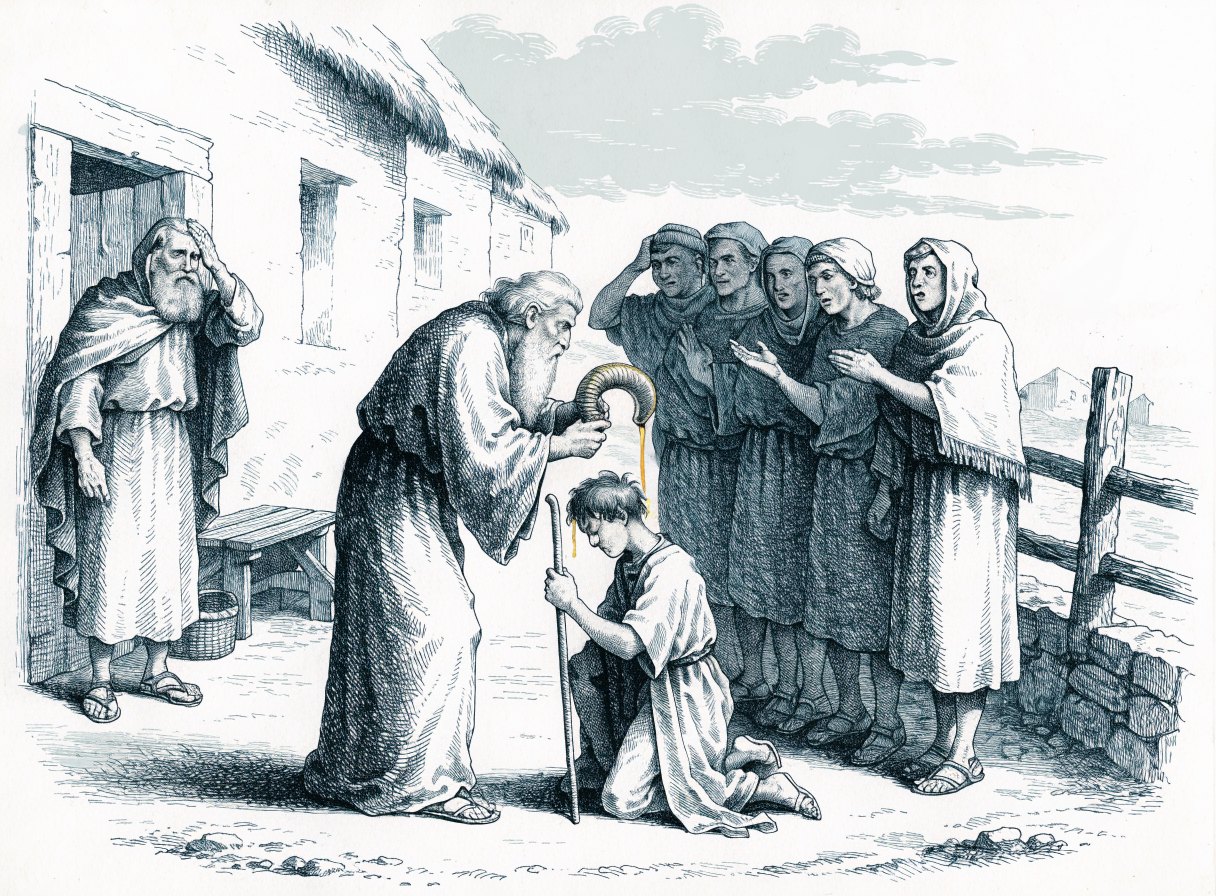
Seven sons passed by. None was chosen. Jesse had not even bothered to call the youngest, who was out keeping the sheep. When David came in, God said, “Arise, anoint him, for this is he” (16:12). Samuel poured the oil, “and the Spirit of the LORD rushed upon David from that day forward” (16:13). God’s king was a young shepherd his own family overlooked.
Then came Goliath. For forty days the giant of the Philistines strode into the valley and mocked Israel’s army, and “Saul and all Israel… were dismayed and greatly afraid” (17:11). David arrived with food for his brothers, heard the giant defy God, and volunteered. He refused Saul’s armor and walked out with a staff, a sling, and five stones.
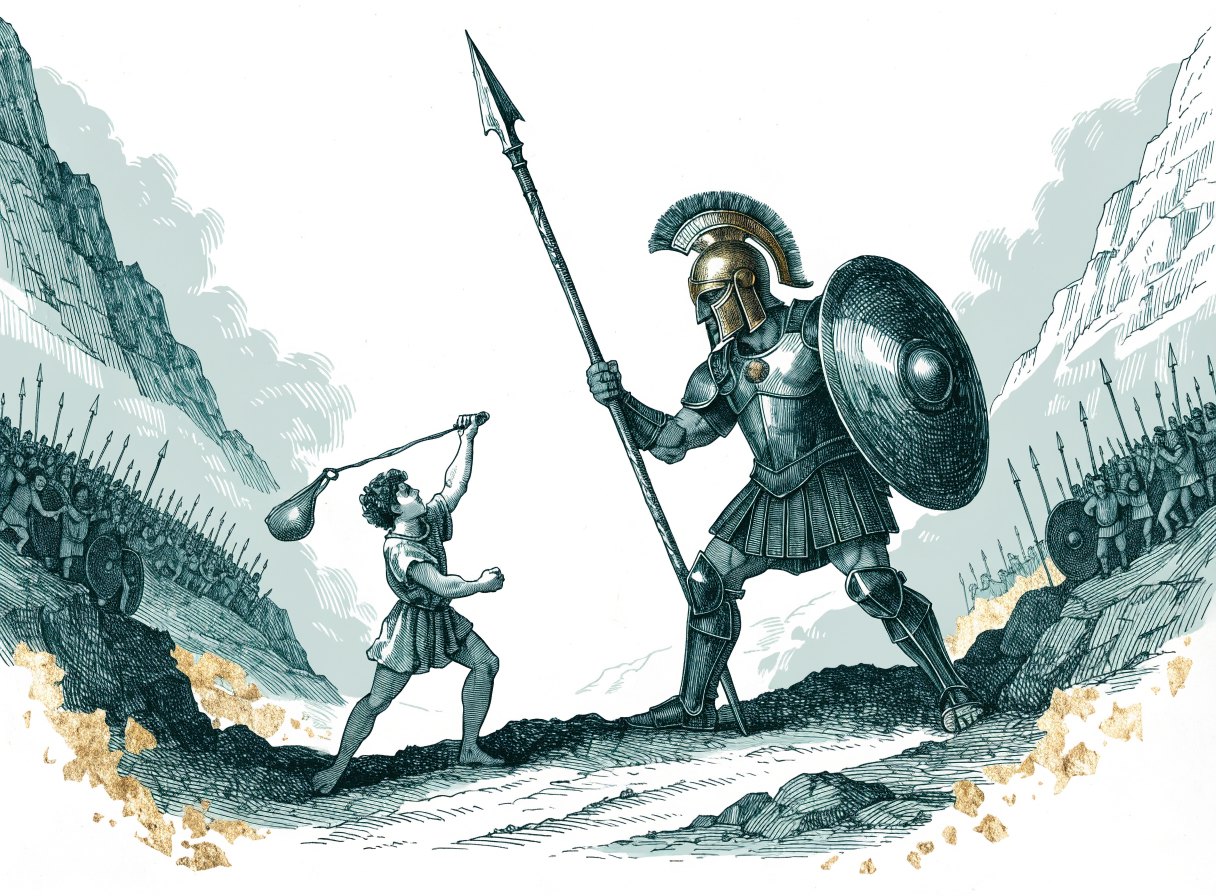
One stone, and the giant fell. We usually read this story as a picture of facing our own giants, and there is courage to learn here. But notice where you actually stand in the story. You are not David. You are one of the terrified soldiers on the hillside. Goliath himself set the terms: one man from each side, and the loser’s people would serve the winner’s (17:8–9). David went out as Israel’s representative. When he won, the Philistines ran, and an army that had cowered for forty days rose up and chased an enemy that was already beaten (17:51–52). That is a picture of what another Son of David would one day do for us.
David then spent years running from a jealous Saul. Twice he had the chance to kill him, and twice he refused. “The LORD forbid that I should do this thing to my lord, the LORD’s anointed” (24:6). He waited for God to give him the throne in God’s time.
The Turn: The King God Chose
Israel wanted a king the nations would respect. God keeps choosing the one people overlook, because he sees what we cannot.
God’s greatest King came the same way. Isaiah said of him, “he had no form or majesty that we should look at him, and no beauty that we should desire him. He was despised and rejected by men” (Isa. 53:2–3). Jesus was born in David’s town to a poor family from David’s line (Luke 2:4, 24), and most people looked right past him. He is still easy to overlook if you are waiting for a king like the nations. Ask God this week for eyes to see the King he chose. Next week God makes David a promise that reaches all the way to Jesus, and then David falls into terrible sin.
Living It: Three Practices for This Week
Before Week 28: Read 2 Samuel 7, 11, and 12, and Psalm 51. Week 28 hears God’s promise to David, and watches the king fall.
For Discussion
- Israel wanted a king “like all the nations.” Why was that request a rejection of God? Where are you tempted to want to be like everyone else?
- Saul looked like a king. David looked like a shepherd. What does 1 Samuel 16:7 say about how God chooses, and how we judge?
- How does it change the Goliath story to see yourself as one of the frightened soldiers rather than as David?
- David twice refused to kill Saul when he had the chance. What does it look like to wait for God’s timing instead of grabbing what he has promised?
Sources & For Further Study
- On מָשִׁיחַ and χριστός: Brown, Driver, and Briggs, Hebrew and English Lexicon; Bauer, Danker, Arndt, and Gingrich (BDAG), s.v.
- For further reading: Dale Ralph Davis, 2 Samuel: Out of Every Adversity; Robert D. Bergen, 1, 2 Samuel (New American Commentary).
Leading a small group? This week comes as a beautifully formatted, printable PDF, along with a 2-page Small Group Guide: a discussion page for your group and leader notes with a session plan and answer key. Both are free when you join the weekly list.