

“for the joy of the LORD is your strength.” Nehemiah 8:10
Introduction: Home, but Not Yet Home
Weeks 33 and 34 left God’s people weeping by the rivers of Babylon with a promise: after seventy years, God would bring them back. These two weeks tell how he kept that promise, and what happened next.
The exiles came home. They rebuilt the temple and the walls of Jerusalem. They gathered to hear God’s law read aloud, wept over it, and then were told to rejoice. But the old problems came back too. The last prophet of the Old Testament, Malachi, scolded them for the same half-hearted worship that had marked the generations before the exile. And then something strange happened. Heaven went quiet. For about four hundred years, no new prophet spoke and no new book of Scripture was written.
These are the last two weeks in the Old Testament part of our story. On our timeline: the first exiles return in 538 BC, the second temple is finished in 516 BC, Nehemiah rebuilds the walls in 445 BC, Malachi prophesies around 430 BC, and then come the silent years, until a baby is born in Bethlehem around 5 BC.
The Word: Return
Part One: Rebuilding the House
In 539 BC, the Persian king Cyrus conquered Babylon. The next year he issued a stunning decree: the Jews could go home and rebuild their temple. Ezra tells us why: “the LORD stirred up the spirit of Cyrus king of Persia” (Ezra 1:1). More than a century earlier, God had even named him through the prophet Isaiah: “who says of Cyrus, ‘He is my shepherd, and he shall fulfill all my purpose’” (Isa. 44:28).
About fifty thousand people made the long journey home (Ezra 2:64–65), led by Zerubbabel, a descendant of David, and Joshua the high priest (Ezra calls him Jeshua). They rebuilt the altar first and began offering sacrifices again. Then they laid the foundation of a new temple. It was a moment of mixed emotions:
Others rejoiced at a new beginning. The old men wept, because they remembered Solomon’s temple, and this one looked like nothing beside it (Hag. 2:3). Then enemies in the land opposed the work, and the building stopped for about sixteen years (4:4–5, 24).
God sent two prophets to get it moving again. Haggai asked a pointed question: “Is it a time for you yourselves to dwell in your paneled houses, while this house lies in ruins?” (Hag. 1:4). To those who thought the new temple was nothing compared to the old one, he gave a promise: “The latter glory of this house shall be greater than the former” (2:9). Zechariah encouraged their leader: “Not by might, nor by power, but by my Spirit, says the LORD of hosts” (Zech. 4:6). In 516 BC, about seventy years after Solomon’s temple burned, the second temple was finished, and the people “celebrated the dedication of this house of God with joy” (Ezra 6:16).
Part Two: Walls and the Word
Decades later, many Jews were still living in the Persian Empire. The book of Esther comes from this period. God is never named in it, yet he quietly saves his people through a Jewish queen who is placed in the palace “for such a time as this” (Esther 4:14).
Around 458 BC a priest and scholar named Ezra led another group home. The Bible describes him in one great sentence: “For Ezra had set his heart to study the Law of the LORD, and to do it and to teach his statutes and rules in Israel” (Ezra 7:10). Study it, do it, teach it, in that order.
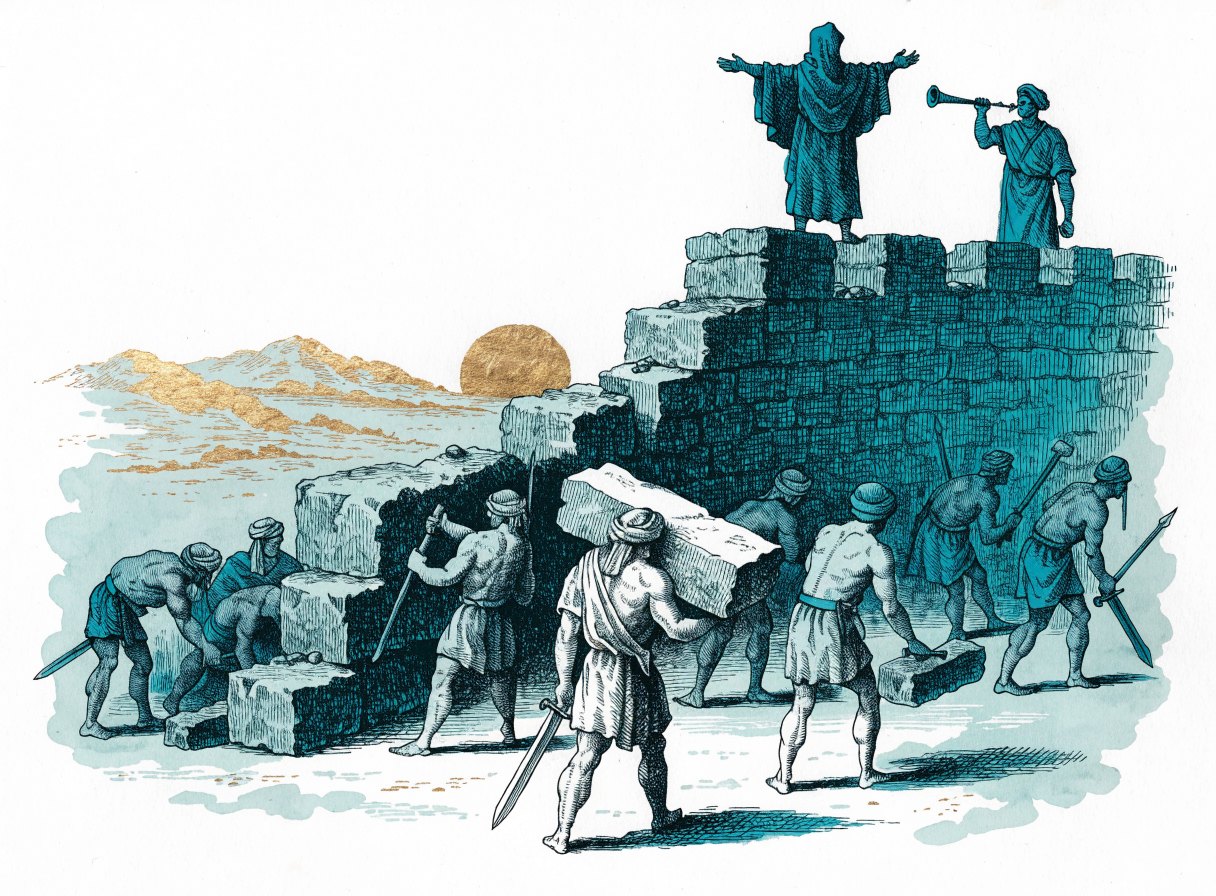
Then in 445 BC a man named Nehemiah, who served as cupbearer to the Persian king, heard that Jerusalem’s walls were still broken down. “As soon as I heard these words I sat down and wept and mourned for days, and I continued fasting and praying” (Neh. 1:4). The king gave him permission to go and rebuild. Enemies mocked and threatened. So Nehemiah organized the workers so that “each labored on the work with one hand and held his weapon with the other” (4:17). They “prayed to our God and set a guard” (4:9). He told the people, “Remember the Lord, who is great and awesome, and fight for your brothers” (4:14). The wall was finished in just fifty-two days, and even their enemies “perceived that this work had been accomplished with the help of our God” (6:15–16).
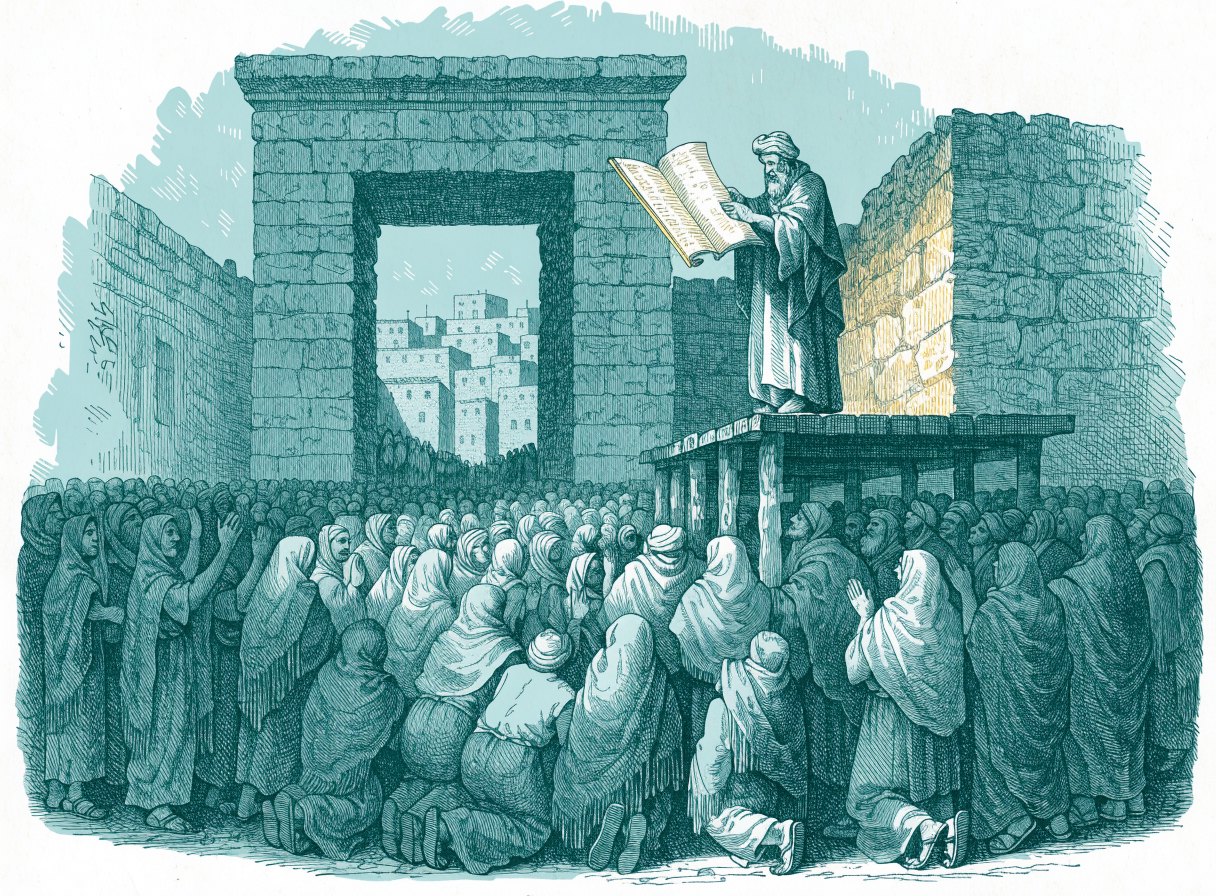
When the wall was done, the people gathered in the square and asked Ezra to bring out the Book of the Law. He stood on a wooden platform and read from early morning until midday, and “the ears of all the people were attentive” (8:3). When he opened the book, everyone stood. The Levites helped, reading “clearly, and they gave the sense, so that the people understood the reading” (8:8). And the people wept as they heard God’s word and realized how far they had fallen. But their leaders told them, “do not be grieved, for the joy of the LORD is your strength” (8:10).
The Turn: Built on Christ
The exiles rebuilt with their hands, but what changed them was the word of God read aloud in the square. Stones and walls could give them a city. Only God could give them a heart.
God is still rebuilding a house, and this time the stones are people. Paul writes to Gentile believers, “you are… members of the household of God, built on the foundation of the apostles and prophets, Christ Jesus himself being the cornerstone” (Eph. 2:19–20). Jesus is the cornerstone the exiles were waiting for. If your life feels like ruins, he is not put off by rubble. Come back to him, and let his word do in you what it did in Jerusalem’s square. Next week the last prophet of the Old Testament speaks, and then heaven goes quiet for four hundred years.
Living It: Three Practices for This Week
Before Week 36: Read Malachi 3–4 and Luke 2:25–32. Week 36 hears the last prophet of the Old Testament, and the four hundred silent years before Jesus.
For Discussion
- At the temple’s foundation, many shouted for joy while the old men who had seen Solomon’s temple wept. Why do you think both reactions made sense?
- Haggai said, “Consider your ways.” What would change if you put God’s priorities ahead of your own projects?
- Nehemiah prayed and also posted guards. How do prayer and practical action work together?
- When Ezra read God’s word, the people wept, and then were told to rejoice. Why do we need both?
Sources & For Further Study
- On the dates of the return (538, 516, 458, 445 BC): Eugene H. Merrill, Kingdom of Priests; Edwin M. Yamauchi, Persia and the Bible.
- For further reading: Derek Kidner, Ezra and Nehemiah (Tyndale Old Testament Commentaries); Iain M. Duguid, Haggai, Zechariah, Malachi (EP Study Commentary).
Leading a small group? This week comes as a beautifully formatted, printable PDF, along with a 2-page Small Group Guide: a discussion page for your group and leader notes with a session plan and answer key. Both are free when you join the weekly list.