

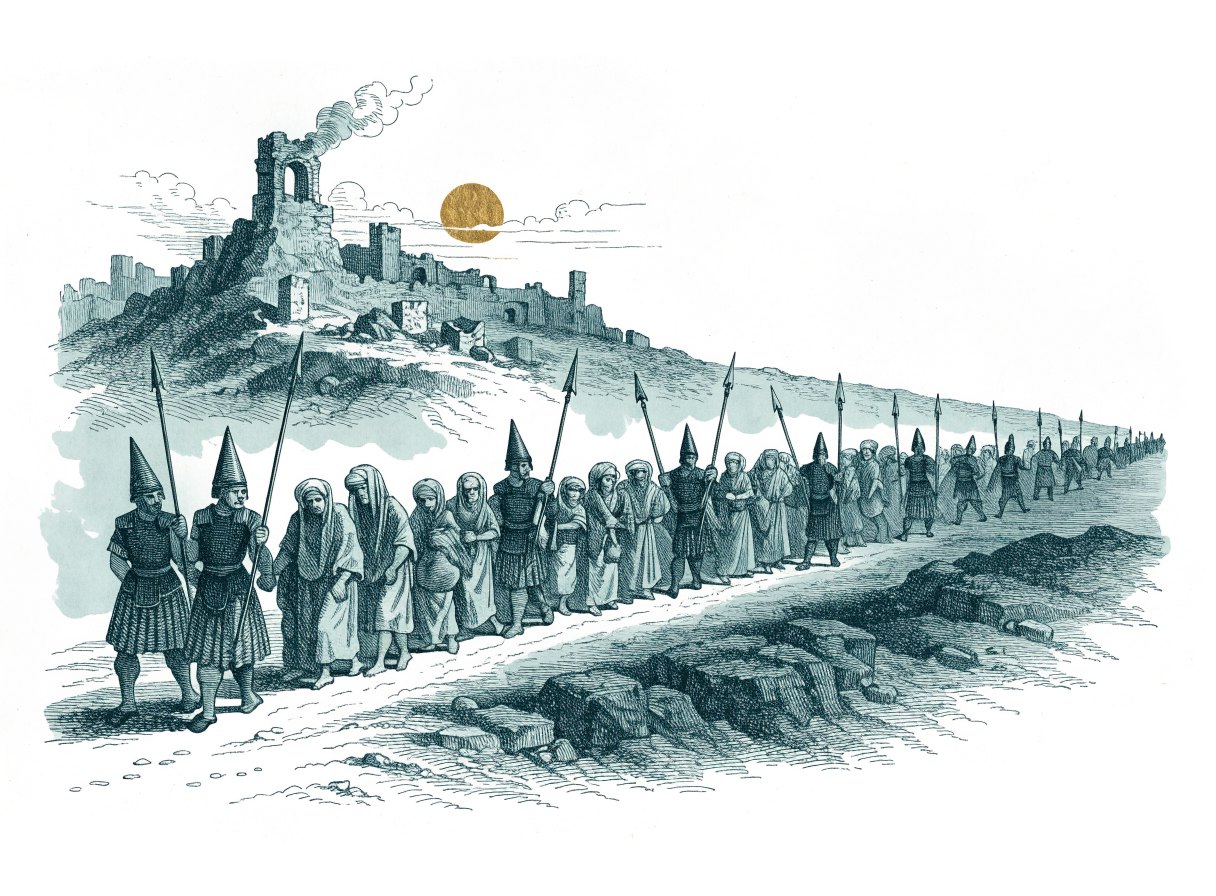
“Finally he sent his son to them, saying, ‘They will respect my son.’” Matthew 21:37
Introduction: After the Fire
Last week the kingdom split in two after Solomon’s death, and the northern kings led Israel into idolatry. Ahab and Jezebel brought Baal worship into the land, and on Mount Carmel Elijah asked the people how long they would limp between two opinions. Fire fell from heaven, and the people cried, “The LORD, he is God.”
This week begins right after that victory, with the same prophet running for his life. Then we watch God send prophet after prophet to his people, and the northern kingdom refuse to listen until it is gone.
Part Three: The Prophet Who Wanted to Die
You would think Elijah would be on top of the world. Instead, when Jezebel swore to kill him, he ran for his life, sat down under a tree in the desert, and prayed to die: “It is enough; now, O LORD, take away my life, for I am no better than my fathers” (19:4).
Look at how God treated his worn-out servant. No lecture. He let him sleep. He sent an angel with food and water, twice. Then he led him to Mount Horeb, also called Sinai, the mountain where God gave Moses the law (Week 17). There a great wind tore the mountains, “but the LORD was not in the wind.” An earthquake, “but the LORD was not in the earthquake.” A fire, “but the LORD was not in the fire. And after the fire the sound of a low whisper” (19:11–12). God came to Elijah gently.
Elijah thought he was the only faithful person left. God told him he was wrong: “I will leave seven thousand in Israel, all the knees that have not bowed to Baal” (19:18). Paul would later point to this verse and say that God always keeps a people for himself: “a remnant, chosen by grace” (Rom. 11:5). If you feel alone in your faith, you are not. And if you are exhausted and discouraged, God is not finished with you. He fed his prophet, gave him rest, spoke to him, and gave him a friend, Elisha, to carry on the work. If you have ever prayed Elijah’s prayer, please tell someone today: a pastor, a friend, or a doctor. In the U.S. you can call or text 988. God cared for Elijah through ordinary means like food, sleep, and a friend, and he still does.
Part Four: Prophets Sent, Prophets Ignored
Elijah was one of many. Over the next century and a half, God sent prophet after prophet. Some of their words are recorded in the books that bear their names.
Amos was a shepherd and fig grower from Judah whom God sent north to say that religion without justice disgusts God: “let justice roll down like waters, and righteousness like an ever-flowing stream” (Amos 5:24). Hosea was told to marry an unfaithful wife and keep loving her, a living picture of God’s love for unfaithful Israel. Through him God cried out, “How can I give you up, O Ephraim? How can I hand you over, O Israel?… My heart recoils within me; my compassion grows warm and tender” (Hos. 11:8). Jonah was sent to Nineveh, a great city of Assyria, Israel’s greatest enemy, and when the city repented, God spared it, to Jonah’s disgust. In the south, Isaiah saw the Lord in the temple and heard the seraphim cry, “Holy, holy, holy” (Isa. 6:3).
The message was always the same: turn back. The writer of Kings sums it up: “Yet the LORD warned Israel and Judah by every prophet and every seer, saying, ‘Turn from your evil ways and keep my commandments…’ But they would not listen, but were stubborn, as their fathers had been, who did not believe in the LORD their God” (2 Kings 17:13–14).
And so the end came. In 722 BC, after a three-year siege, “the king of Assyria captured Samaria, and he carried the Israelites away to Assyria” (17:6). The Assyrians scattered the northern tribes across their empire and brought in foreigners to resettle the land (17:24). They mixed with the Israelites who remained, and their descendants became the Samaritans you meet in the Gospels. The northern kingdom of Israel was gone. Only Judah remained, and Judah had been watching. Week 33 will show whether it learned anything.
Repentance is turning from sin to God. It is more than feeling sorry, and it is itself a gift of God’s grace (Acts 11:18), not a payment for his mercy. It means seeing your sin as God sees it, grieving over it, trusting his mercy in Christ, and turning to a new way of life. The prophets called Israel to it again and again, and Jesus calls us to it today.
The Turn: Finally He Sent His Son
Jesus once told a story about a man who planted a vineyard and leased it to tenants. At harvest he sent servants to collect his share, and the tenants beat one, killed another, and stoned a third. He sent more servants, and they did the same. “Finally he sent his son to them, saying, ‘They will respect my son’” (Matt. 21:37). But they killed him too. The religious leaders knew he was talking about them (Matt. 21:45). The servants were the prophets. And the son was Jesus himself.
“Long ago, at many times and in many ways, God spoke to our fathers by the prophets, but in these last days he has spoken to us by his Son” (Heb. 1:1–2). The prophets said, “Thus says the LORD.” Jesus said, “Truly, I say to you.” He did not only bring God’s word; he is the Word (John 1:1). He is the final Prophet, who reveals to us by his Word and Spirit the will of God for our salvation (Westminster Shorter Catechism 24). And Elijah himself appeared with Moses on the mountain of transfiguration, talking with Jesus (Matt. 17:3), the Law and the Prophets standing beside the One they had pointed to.
The last book of the Old Testament promised, “Behold, I will send you Elijah the prophet before the great and awesome day of the LORD comes” (Mal. 4:5). Jesus said that promise came true in John the Baptist (Matt. 11:14). John was not Elijah come back to life (John 1:21). He came “in the spirit and power of Elijah” to prepare the way (Luke 1:17). And when Jesus came, he was even greater than Elijah. Elijah called down fire on a sacrifice. Once, when his disciples wanted to call down fire on a village that rejected him, Jesus “turned and rebuked them” (Luke 9:54–55). He had not come to bring the fire down on sinners. He had come to take it himself. On the cross, the judgment that fell on Carmel’s altar fell on him.
Elijah’s question still stands, and it is for you: “How long will you go limping between two different opinions? If the LORD is God, follow him” (1 Kings 18:21). God has spoken by his Son, and his Son took the fire for sinners. The Lord is “patient toward you, not wishing that any should perish, but that all should reach repentance” (2 Pet. 3:9). Do not stop your ears the way the northern kingdom did. Turn from your idols, trust Jesus today, and say with the people on the mountain, “The LORD, he is God.”
Living It: Three Practices for This Week
Before Week 33: Read 2 Kings 22–23 and 25, and Psalm 137. Week 33 follows Judah to its darkest day, when the temple falls.
For Discussion
- Right after his greatest victory, Elijah wanted to die. What does God’s gentle care for him teach you about seasons of deep discouragement?
- God sent prophet after prophet, and Israel would not listen. Why is it so hard to hear warnings?
- Jesus told the story of the vineyard owner who finally sent his son. What does that story say about God’s patience and about who Jesus is?
- Hebrews says God once spoke by the prophets but now has spoken by his Son. What changes if Jesus is God’s final word to you?
Sources & For Further Study
- For further reading: O. Palmer Robertson, The Christ of the Prophets; Westminster Shorter Catechism 24 (Christ’s office as a prophet).
Leading a small group? This week comes as a beautifully formatted, printable PDF, along with a 2-page Small Group Guide: a discussion page for your group and leader notes with a session plan and answer key. Both are free when you join the weekly list.