

“The grace of the Lord Jesus Christ and the love of God and the fellowship of the Holy Spirit be with you all.” 2 Corinthians 13:14
Introduction: The Deepest Truth About God
Last week we asked who the God who is there is. We learned that he made everything and needs nothing, that he speaks and shows himself, and that he is spirit: infinite, eternal, unchangeable, and holy beyond anything Isaiah could bear.
This week we take up a question that puzzles many new believers. If there is only one God, who are the Father, the Son, and the Holy Spirit? We will stand at the Jordan River, where all three appear at once, and then ask why it matters that God has never been alone.
Part Four: One God in Three Persons
Now we come to the deepest thing the Bible says about God, and the thing that most surprises people who did not grow up in church. The Bible insists, from start to finish, that there is only one God. Faithful Jews still recite it every morning and evening (see Deut. 6:7): “Hear, O Israel: The LORD our God, the LORD is one” (Deut. 6:4). And yet, as the story unfolds, we meet the Father, we meet the Son, and we meet the Holy Spirit, and each one is fully God.
The hints are there on the first page. “In the beginning, God created the heavens and the earth.… And the Spirit of God was hovering over the face of the waters. And God said, ‘Let there be light’” (Gen. 1:1–3). God, his Spirit, and his spoken Word, all at work in creation. A few verses later God says, “Let us make man in our image” (1:26). Those early readers could not have explained it fully. The New Testament opens it up. John deliberately echoes Genesis: “In the beginning was the Word, and the Word was with God, and the Word was God.… All things were made through him” (John 1:1, 3). The Word was with God, so he is distinct from the Father. The Word was God, so he is not a lesser being. And John tells us who the Word is: “And the Word became flesh and dwelt among us” (1:14). He is Jesus.
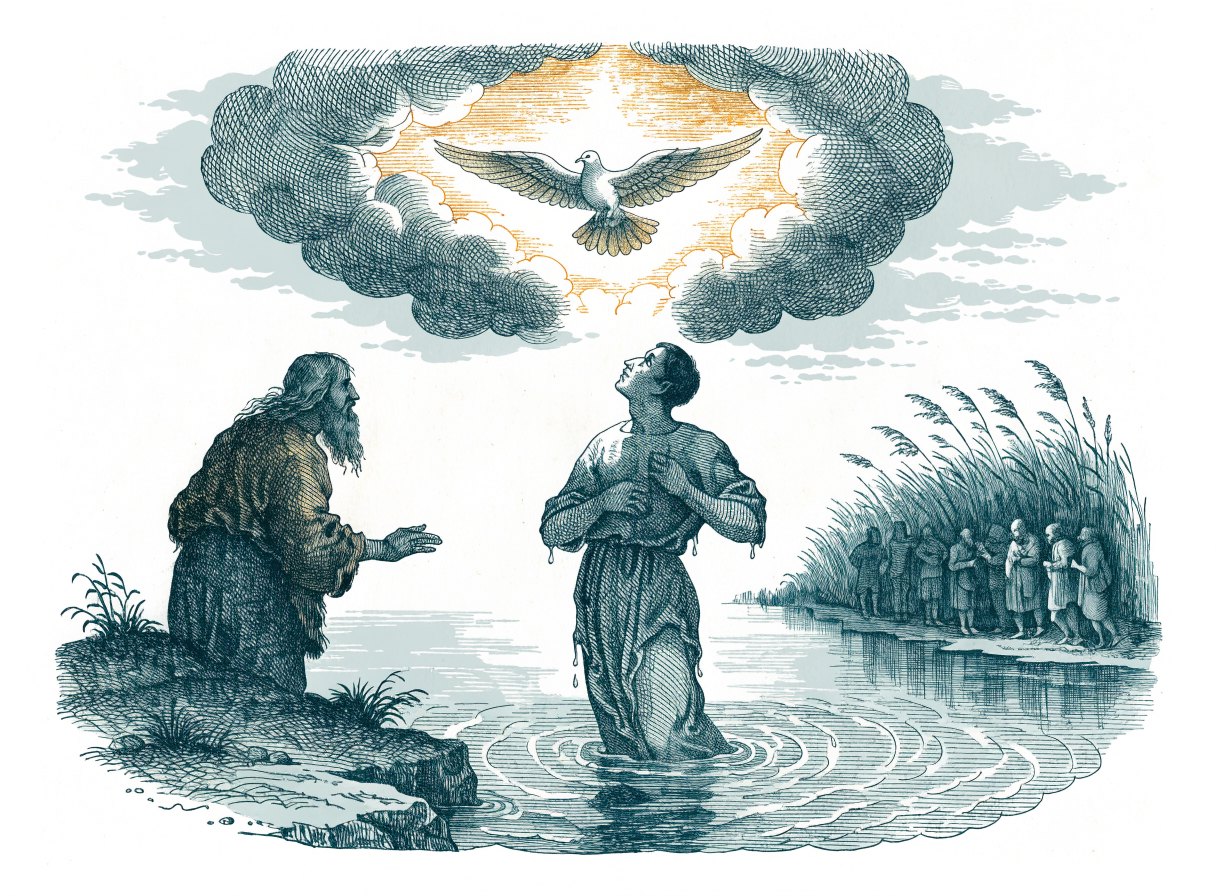
At the Jordan River, around AD 27–29, all three appear at once. The Son stands in the water. The Spirit descends like a dove. The Father speaks from heaven. And when Jesus sent his followers out at the end of Matthew’s Gospel, he told them to baptize “in the name of the Father and of the Son and of the Holy Spirit” (Matt. 28:19). Mark that word: name, singular. One name, three persons.
A word about that word person. In the Trinity, a “person” does not mean a separate being, the way three people in a room are three beings. It means the Father, the Son, and the Spirit are truly distinct from one another in how they relate: the Father is the Father of the Son, the Son is the Son of the Father, and the Spirit comes from the Father and the Son (WCF 2.3). They share one being. When the Catechism below says “substance” or “Godhead,” it means that one divine being. One What, three Whos.
The church gathered all of this into the word Trinity (“tri-unity”). The word is not in the Bible, but everything it describes is. The Shorter Catechism puts it simply: “There are three persons in the Godhead; the Father, the Son, and the Holy Ghost; and these three are one God, the same in substance, equal in power and glory” (WSC 6). “Holy Ghost” is the older English for the Holy Spirit.
Christians have drawn this diagram for about eight hundred years. It is called the Shield of the Trinity, and it keeps us from the two most common mistakes. Some people think God is one person who wears three masks, appearing sometimes as the Father, sometimes as the Son, sometimes as the Spirit. That cannot be right, because at the Jordan all three are present at the same moment, and elsewhere the Son prays to the Father (John 17:1) and promises to send the Spirit from the Father (John 15:26). Others think of the Father, Son, and Spirit as three gods, or three thirds of one god. That cannot be right either, because God is one, and each person is fully God. The shield holds both truths: each person is God, and no person is another.
Will you fully understand this? No. Neither do I, and neither did Augustine or Calvin. Most comparisons you will hear (water, ice, and steam; an egg with shell, white, and yolk) end up teaching one of the two mistakes. It is better to say what the Bible says and then bow. A God you could fully figure out would be a God about your size. The Trinity is exactly what you would expect if the God who is there is far greater than us and has truly told us about himself.
Also read: John 14:16–17, 26; 2 Corinthians 13:14; Ephesians 1:3–14; Matthew 28:18–20
There is one God, and he exists eternally as three persons: the Father, the Son, and the Holy Spirit. They are not three gods, and they are not one God wearing three masks. Each person is fully God, equal in power and glory, and each is distinct from the others.
“Very God of very God, begotten, not made, being of one substance with the Father.” (Nicene Creed, on the Son)
Part Five: The God Who Needs Nothing and Loves Freely
The Trinity matters for your life, not only for your doctrine. The Bible says “God is love” (1 John 4:8). If God were a single, solitary person, we might wonder whether his love had to wait for a world to give it somewhere to go. God has never been alone, and his love has never been waiting. On the night before he died, Jesus prayed to his Father about the glory “that you have given me because you loved me before the foundation of the world” (John 17:24). Before there were stars, the Father loved the Son and the Son loved the Father, in the Holy Spirit, who is himself fully God. The Father did not need the Son the way a lonely man needs a friend. Father, Son, and Spirit are the one God, and this love is simply what God is, full and complete forever.
So go back to last week. God does not need you. He was perfectly happy and full of love before you existed. That means he did not create the world to fill a hole in himself. He created it out of fullness, to share what he already had. God could have made nothing at all and lost nothing. He made the world because he freely willed to. The elders in Revelation sing, “Worthy are you, our Lord and God, to receive glory and honor and power, for you created all things, and by your will they existed and were created” (Rev. 4:11). He made all things by his own free will, and he was glad to.
And that changes how you can come to him. You do not have to earn your way in by being useful. You cannot make him love you by giving him something he lacks. The only way to come to a God like this is with empty hands, the way Isaiah came, the way every one of us must come. Paul ends a long, hard chapter about God’s plan by simply breaking into worship: “For from him and through him and to him are all things. To him be glory forever. Amen” (Rom. 11:36).
The Turn: The God Who Has Made Himself Known
Moses hid his face at the bush. Isaiah cried “Woe is me” in the temple. Even the seraphim cover their faces. And John, after all of that, writes one of the most daring sentences in the Bible:
That sounds like it contradicts Isaiah, who said, “my eyes have seen the King.” John answers it himself. Writing about Isaiah’s vision, he says, “Isaiah said these things because he saw his glory and spoke of him” (John 12:41), and the “him” is Jesus. What Isaiah saw in the temple was the glory of the Son, the one who makes the Father known.
The word for “made him known” is the root of our word “exegesis,” to lead out, to explain. Jesus is God explaining himself. If you want to know what the God who is there is like, you do not have to climb to heaven or decode the stars. Look at Jesus. Look at him touching lepers, welcoming children, weeping at a friend’s grave, forgiving a sinful woman who wept at his feet (Luke 7:47–48). When Philip, one of the Twelve, asked Jesus to show them the Father, Jesus answered, “Whoever has seen me has seen the Father” (John 14:9).
And look at what Jesus came to do. Isaiah needed a coal from the altar to take away his guilt. Every one of us stands where Isaiah stood, with unclean lips and an unclean heart, before a God who is holy, holy, holy. Jesus came to be the sacrifice on that altar. The holy God met his own standards himself, in his Son, so that he could be both just and merciful at once. That is what you will watch unfold, week by week, all the way to the cross.
Through the prophet Jeremiah, God told his people what was worth boasting about. Not wisdom, not strength, not money, “but let him who boasts boast in this, that he understands and knows me, that I am the LORD who practices steadfast love, justice, and righteousness in the earth” (Jer. 9:24). And Jesus told us what eternal life is: “that they know you, the only true God, and Jesus Christ whom you have sent” (John 17:3).
So this is the invitation of the whole Bible, and of this week. The God who is there can be known. He has spoken. He has come. He calls you to turn from your sin and trust his Son, and he promises that whoever comes to him will be received. If you already know him, then let this week make you smaller and him larger in your eyes, and let that be a relief. If you do not yet know him, you do not need to understand everything first. You need to come as Isaiah came, honest about your sin, and trust Jesus, the sacrifice God provided, to take your guilt away. He has promised, “whoever comes to me I will never cast out” (John 6:37).
Living It: Three Practices for This Week
Before Week 5: Read Genesis 1:1–2:3. Week 5 begins at creation: God made everything out of nothing, by a word.
For Discussion
- Read Acts 17:24–25. Why might it be good news, and not cold news, that God does not need anything from us?
- Using the Shield of the Trinity, explain in your own words why God is not one person in three masks, and not three gods.
- Jesus said, “Whoever has seen me has seen the Father” (John 14:9). What is one thing about Jesus in the Gospels that shows you what God is like?
Sources & For Further Study
- Westminster Shorter Catechism (1647), Q. 4 and Q. 6. Westminster Confession of Faith (1646), 1.1; 2.1; 2.3.
- On the Shield of the Trinity (Scutum Fidei): a diagram of this kind appears in manuscripts of Peter of Poitiers (c. 1210), and in shield form in English manuscripts of the 1200s.
- For further reading: J. I. Packer, Knowing God; A. W. Tozer, The Knowledge of the Holy; R. C. Sproul, The Holiness of God; Michael Reeves, Delighting in the Trinity.
Leading a small group? This week comes as a beautifully formatted, printable PDF, along with a 2-page Small Group Guide: a discussion page for your group and leader notes with a session plan and answer key. Both are free when you join the weekly list.