

“what is man that you are mindful of him, and the son of man that you care for him?” Psalm 8:4
Introduction: What Are We For?
Last week began with an old man’s garage and a tool no one could name: only the maker can tell you what a thing is for. We learned that “image” was the word for a king’s statue set up in his land, and we watched God speak the world into being and call it very good. This week the camera moves in close. On the sixth day God does something he has not done before. He makes a creature in his own image.
Then Genesis 2 tells the story again from the ground up: a man formed from dust and the breath of God, a garden to work and keep, a woman made from his side, and a God who comes near to them. These chapters answer the question every person asks sooner or later: what am I for?
Part Three: In Our Image
Every plant and animal in Genesis 1 is made “according to its kind.” Only one creature is made after God’s likeness: “in our image, after our likeness.” And God pauses before he does it. For every other creature he says, “Let there be,” or “Let the earth bring forth.” Here he says, “Let us make.” The whole chapter slows down for this.
What does it mean to be made in God’s image? The Shorter Catechism answers: “God created man male and female, after his own image, in knowledge, righteousness, and holiness, with dominion over the creatures” (WSC 10). Unpack that, and read it beside Genesis 1:27, and you find three things.
We were made to reflect God’s character. The first man and woman knew God truly, did what was right, and were holy, set apart for him. The New Testament confirms this when it describes salvation as the image being restored: the new self “is being renewed in knowledge after the image of its creator” (Col. 3:10), “created after the likeness of God in true righteousness and holiness” (Eph. 4:24). That is why the New Testament speaks of renewal. Sin did not erase the image, but it ruined the knowledge, righteousness, and holiness that made it shine. Every person still bears God’s image. Only in Christ is it being made new.
We were made to rule God’s world on his behalf. “Let them have dominion” is the very next phrase after “in our image.” Think back to the king’s statue. Adam and Eve were God’s representatives, appointed to care for his world the way a good king cares for his realm. Dominion is a gardener’s rule, as Genesis 2 will show.
We were made male and female, to bear the image together. “Male and female he created them.” The image is not the man alone or the woman alone. Both bear it fully and equally, and they were made for each other. The righteousness the Catechism names was never a private thing. Jesus summed up God’s law as love for God and love for neighbor (Matt. 22:37–39), and from the first day God’s image was meant to live out that love side by side.
This one truth changes how you look at every person. The unborn child knit together in the womb (Ps. 139:13–14). The person with a disability who will never hold a job. The elderly man who no longer remembers your name. The person of another nation and color, since God “made from one man every nation of mankind” (Acts 17:26). Your enemy. Even after sin entered the world, God still grounded the value of human life in his image: “Whoever sheds the blood of man, by man shall his blood be shed, for God made man in his own image” (Gen. 9:6). James warns against cursing “people who are made in the likeness of God” (James 3:9). C. S. Lewis once said there are no ordinary people. He was right. Every one of them is a living statue of the King.
God made everything out of nothing by his word, and it was very good. He made human beings, male and female, in his own image, to know him, reflect his character, and care for his world. Every human life carries that dignity.
“God created man male and female, after his own image, in knowledge, righteousness, and holiness, with dominion over the creatures.” (Westminster Shorter Catechism 10)
Part Four: The Garden
Genesis 2 tells the creation of man again, this time up close. Chapter 1 is the wide shot: the whole universe, and humanity at the top of it. Chapter 2 is the close-up: one man, one garden, one woman, one command.
You may notice two things as you read. First, the name changes. Genesis 1 calls him “God.” Genesis 2 calls him “the LORD God,” using the personal name we met at the burning bush in Week 3. The God who made the stars is the God who comes close and makes promises. Second, some readers say Genesis 1 and 2 are two different creation stories that do not agree. They are one story told twice: first the whole week from far away, then the sixth day up close. Chapter 2 is not trying to give the order of all creation. It slows down to show how God made the man and the woman and set them in their home.
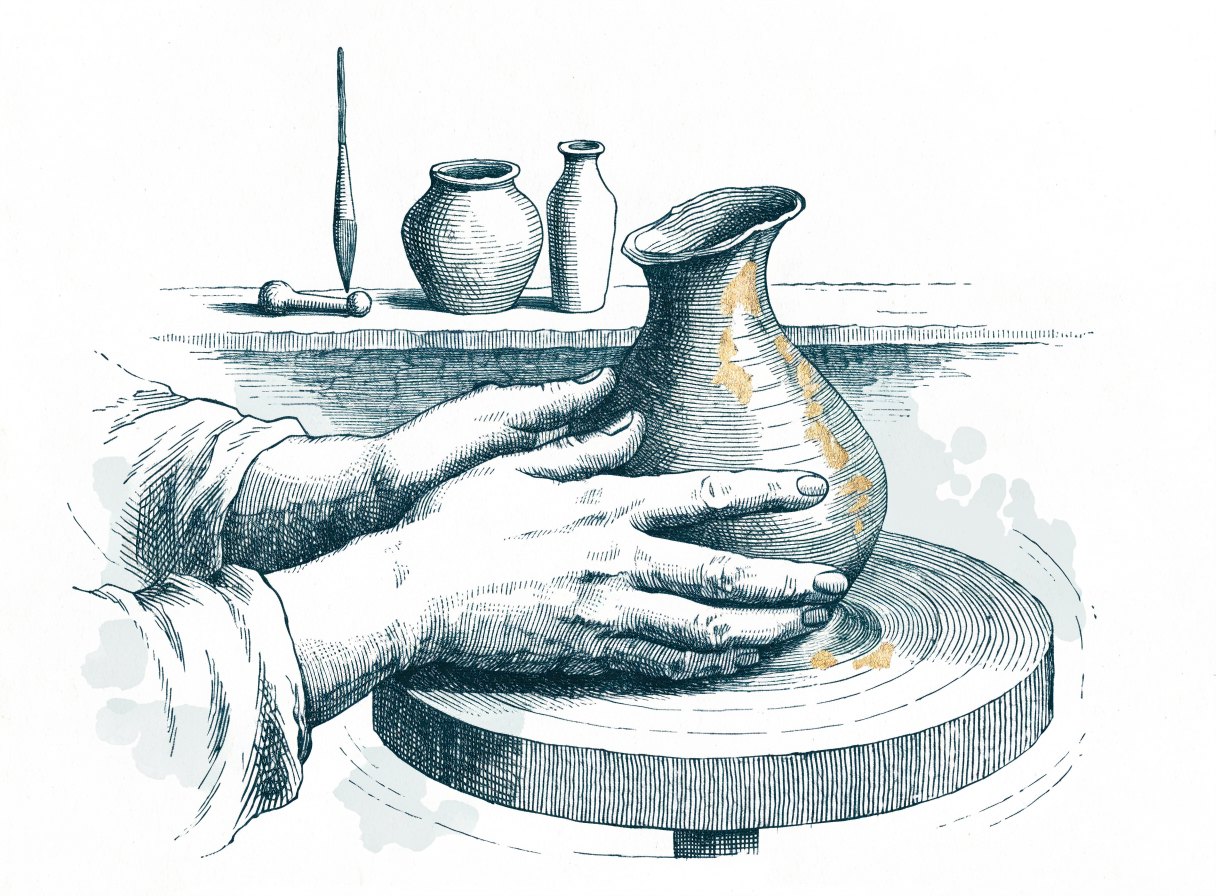
Two things come together in you. Dust: you are made of the same stuff as the ground, humble and fragile. And breath: the life in you came from the mouth of God. The word for “formed” is the word for what a potter does with clay (it is used that way in Jeremiah 18). Notice how close God comes. In Genesis 1 he speaks from a distance. In Genesis 2 the text pictures him stooping like a potter over the clay, shaping a man and breathing into him. Then he plants a garden for him to live in.
He gave him work. “The LORD God took the man and put him in the garden of Eden to work it and keep it” (Gen. 2:15). Work came before the fall, so work itself was never the curse. God worked six days, and the creature made in his image was given work to do: dominion with a spade in its hand. In Hebrew, “work” and “keep” are the same two verbs later used together for the Levites’ service at the tabernacle (the Levites were the tribe God set apart to serve at his house), where English Bibles translate them “minister” and “keep guard” (Num. 3:7–8). Adam was a gardener, and he was something like a priest, tending the place where God met with man.
He gave him a command. “You may surely eat of every tree of the garden, but of the tree of the knowledge of good and evil you shall not eat, for in the day that you eat of it you shall surely die” (Gen. 2:16–17). Look at the proportions: every tree, and one exception. The command was the shape of a relationship. Would Adam trust God’s word about what is good, or decide good and evil for himself? Reformed Christians call this arrangement the covenant of works (the Shorter Catechism calls it the “covenant of life”). The Westminster Confession explains: “The first covenant made with man was a covenant of works, wherein life was promised to Adam; and in him to his posterity, upon condition of perfect and personal obedience” (WCF 7.2). (“Posterity” means his descendants.) Adam stood as the head and representative of the whole human race, so what he did counted for all of us (Rom. 5:18–19; 1 Cor. 15:22; WSC 16). Next week we will see what that meant.
He gave him a wife. For the first time in the Bible, God says something is not good: “It is not good that the man should be alone” (Gen. 2:18). So he brings the animals to Adam to name, and none of them is a match. Then God puts him to sleep, takes a rib, and builds the woman, and brings her to him. Adam’s response is the first human speech recorded in the Bible, and it comes out as a poem: “This at last is bone of my bones and flesh of my flesh” (2:23). Then comes a sentence Jesus himself quoted as the words of the Creator: “Therefore a man shall leave his father and his mother and hold fast to his wife, and they shall become one flesh” (2:24; see Matt. 19:4–6). Then the chapter ends with a quiet line that will matter very much next week: “And the man and his wife were both naked and were not ashamed” (2:25). Nothing to hide. Nothing between them and God.
He gave him rest. Genesis 2 actually opens with the seventh day: God “rested on the seventh day from all his work that he had done. So God blessed the seventh day and made it holy” (2:2–3). Adam was made on the sixth day, so his first whole day in the world was a day of rest. God rested because he was finished, and satisfied, and he invited his image to share his rest. Jesus said, “The Sabbath was made for man” (Mark 2:27). From the first week of the world, rest was a gift.
Part Five: What Is Man?
Centuries later, David looked up at the same stars we read about last week and asked the question these two weeks have been circling:
Both halves are true. Next to the universe, man is tiny. And God crowned him with glory and honor and put the world under his feet.
But look around. Does it look like the world is under our feet? We cannot keep our gardens weeded, let alone rule creation well. We bury the people we love. Our bodies break down. The book of Hebrews quotes Psalm 8 and then says honestly what we all can see: “At present, we do not yet see everything in subjection to him” (Heb. 2:8). Something has gone terribly wrong with God’s image. That is next week’s story.
But Hebrews does not stop there. The very next words are these: “But we see him who for a little while was made lower than the angels, namely Jesus, crowned with glory and honor because of the suffering of death, so that by the grace of God he might taste death for everyone” (Heb. 2:9). (Hebrews quotes the ancient Greek translation of the psalm, which renders “heavenly beings” as “angels.”) We do not yet see the world under man’s feet. We do see one Man crowned.
The Turn: The True Image
If you have been following closely, a question may be forming. If we were made in the image of God, why is that image so hard to see in us, and in me? Why do I so often reflect selfishness instead of God’s holiness, fear instead of his peace, and want to be served instead of to serve? Next week we will learn exactly how the image was defaced. But the Turn of this week is to see where the image is found whole.
“Firstborn” here means first in rank, the heir over creation, not the first thing made. The very next verse says all things were created through him (Col. 1:16).
Jesus is the image of God that never failed. Adam was made in God’s image. The Son is God’s image. From all eternity he is “the radiance of the glory of God and the exact imprint of his nature” (Heb. 1:3). He became a man, the last Adam (1 Cor. 15:45), and as a man he wore the image perfectly. Where Adam would fail as our head, Jesus obeyed for his people (Rom. 5:19). He worked, and kept the garden of his Father’s will without a single failure. He ruled the wind and the waves. He loved God with all his heart and his neighbor as himself.
And the good news is that he did not come only to show us the image. He came to restore it in us. Those who belong to him, Paul says, “are being transformed into the same image from one degree of glory to another” (2 Cor. 3:18). God’s plan is that they be “conformed to the image of his Son” (Rom. 8:29). The statue that was defaced is being carved again, by the same hands that formed Adam from the dust.
The Shorter Catechism opens with this very question: “What is the chief end of man?” Its answer: “Man’s chief end is to glorify God, and to enjoy him for ever” (WSC 1).
So come back to the garage question. What are you for? You were made by God and in his image, to know him, reflect him, and care for his world. You have not lived up to that, and neither have I. But the true Image came, lived the life you were made for, and died to take away the sin that ruined you. If you turn from your sin and trust him, he will begin to make you, day by day, what you were always meant to be. And on the last day, John says, “we shall be like him, because we shall see him as he is” (1 John 3:2).
Living It: Three Practices for This Week
Before Week 7: Read Genesis 3:1–13. Week 7 is the darkest page in the story: the serpent, the fruit, and a man and woman hiding from God.
For Discussion
- Kings set up images of themselves to mark their rule. What does it mean for you to be God’s “living image” in your home, work, and neighborhood?
- Read Genesis 9:6 and James 3:9. How should the image of God shape the way we treat the unborn, the disabled, the elderly, people of other races, and our enemies?
- Work, marriage, and rest were all given before sin entered the world. How does that change the way you think about each one?
- Hebrews 2:8–9 says we do not yet see everything under man’s feet, “but we see… Jesus.” How is Jesus the answer to Psalm 8?
Sources & For Further Study
- Westminster Shorter Catechism (1647), Q. 1, 9, 10, 12, 16. Westminster Confession of Faith (1646), 4.1–2; 7.2; 21.7–8.
- D. J. A. Clines, “The Image of God in Man,” Tyndale Bulletin 19 (1968). C. S. Lewis, The Weight of Glory (1941).
- On צֶלֶם and דְּמוּת: Brown, Driver, and Briggs, Hebrew and English Lexicon; Koehler and Baumgartner, HALOT, s.v. For the royal statue: A. Abou-Assaf, P. Bordreuil, and A. R. Millard, La statue de Tell Fekherye et son inscription bilingue assyro-araméenne (1982).
- On the Eden and tabernacle language (Gen. 2:15; Num. 3:7–8): Gordon J. Wenham, “Sanctuary Symbolism in the Garden of Eden Story” (1986); G. K. Beale, The Temple and the Church’s Mission.
- For further reading: Anthony A. Hoekema, Created in God’s Image; Derek Kidner, Genesis (Tyndale Old Testament Commentaries).
Leading a small group? This week comes as a beautifully formatted, printable PDF, along with a 2-page Small Group Guide: a discussion page for your group and leader notes with a session plan and answer key. Both are free when you join the weekly list.