

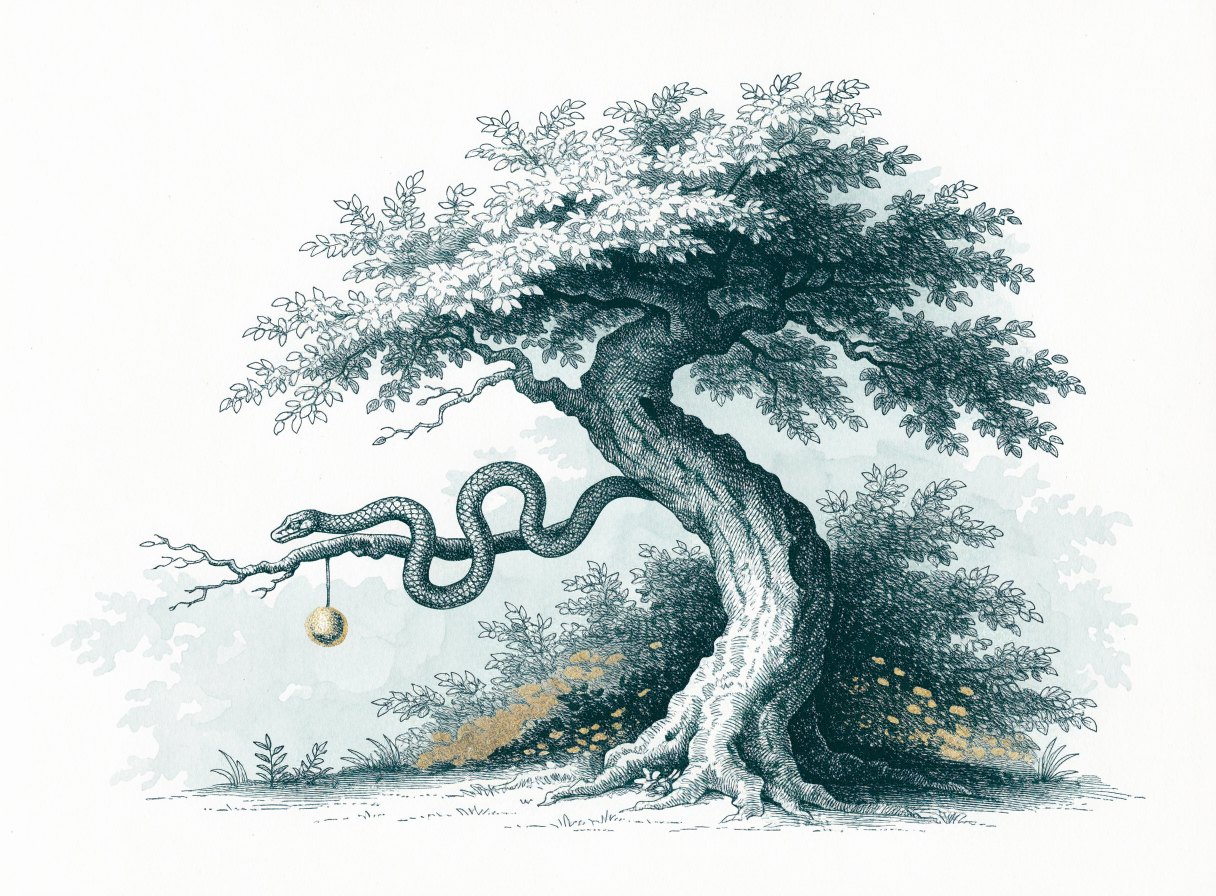
“I will put enmity between you and the woman, and between your offspring and her offspring; he shall bruise your head, and you shall bruise his heel.” Genesis 3:15
Introduction: Why Does the World Feel So Wrong?
Last week we stood in a garden where everything was very good. A river ran through it, the trees were heavy with fruit, a man and a woman worked and rested with nothing to hide, and God came near. Now look up from the page at the world you actually live in. Hospitals. Funerals. Divorce papers. The news. The way you snapped at someone you love this morning. The thing you swore you would never do again and did.
Everyone knows the world is not the way it should be. We feel it in our bones. The question is why. Some say suffering is just nature, the way things have always been. Some say the problem is society, or poverty, or ignorance, and better systems will fix us. Some say there is no “wrong” at all, only what we happen to dislike. The Bible gives a different answer, and it is harder and more hopeful than any of them. The world is not the way it was made. Something happened. A good world was broken from the inside, by the very creatures God made to care for it.
Genesis 3 is one of the most important chapters ever written. If you understand it, you will understand the rest of the Bible, because the rest of the Bible is God’s answer to it. You will understand the news. And you will understand yourself, which is the hardest part. But do not miss what is hidden in the middle of the chapter. In the same breath that God pronounces judgment, he makes a promise. The darkest page in the story holds its first ray of light.
The Word: Offspring
Part One: “Did God Actually Say?”
Who is this serpent? Genesis does not say, but the last book of the Bible does: “that ancient serpent, who is called the devil and Satan, the deceiver of the whole world” (Rev. 12:9).
Was it a snake, or something else? Genesis calls it one of the “beast[s] of the field that the LORD God had made” (3:1), and the curse in 3:14 falls on an animal. For most of church history, from Augustine to Calvin, and in Reformed teachers since, such as Geerhardus Vos and Herman Bavinck, Christians have read it this way: Satan, a fallen angel, spoke through a real creature. Calvin called the serpent “the mouth of the devil.” Notice what that means. Satan did not come into the garden as a monster. He came hidden inside something Eve knew, something God had made and called good. He still works that way. Paul warns that “even Satan disguises himself as an angel of light” (2 Cor. 11:14). Evil rarely comes looking evil. The tempter in Eden did not frighten Eve. He fascinated her.
And notice that he never once says, “Disobey God.” He is too clever for that. Watch how he works, because he still works the same way.
First, he questions God’s word. “Did God actually say…?” He opens with a question, not an argument. He gets the woman thinking about God’s command instead of simply trusting it. And he twists it: “You shall not eat of any tree.” God had said the opposite. Every tree but one was a gift. The serpent turns a generous Father into a stingy one.
Second, he denies God’s warning. “You will not surely die.” This is the first lie in the Bible, and it is still the most popular one. There are no real consequences. God does not mean what he says. You can do this and be fine.
Third, he slanders God’s heart. “For God knows that when you eat of it your eyes will be opened, and you will be like God.” In other words: God is holding out on you. He is keeping something good from you because he does not want you to be his equal. The serpent was aiming past the fruit at the woman’s trust in God’s goodness.
Look at the woman’s answer, too. She adds to God’s word (“neither shall you touch it”) and softens his warning (“lest you die” instead of “you shall surely die”). She is already beginning to see God as harsher than he is and his warning as weaker than it is. That is how temptation still works. Before the hand reaches, the heart doubts whether God is good and whether he means what he says.
Part Two: Their Eyes Were Opened
It happens in one sentence. She saw, she desired, she took, she ate, she gave. And Adam was “with her” (3:6). Nothing suggests he was anywhere else while the serpent talked. He had heard God’s command directly (Gen. 2:16–17), before the woman was even made, and he said nothing and then ate. The Shorter Catechism names their sin simply: “The sin whereby our first parents fell from the estate wherein they were created was their eating the forbidden fruit” (WSC 15). It may look small, but it was the creature deciding to be the judge of good and evil instead of trusting the Creator’s word. Every sin since has the same root.
The serpent had promised, “your eyes will be opened.” And they were. But what they saw was not glory. They saw their own nakedness, and for the first time they were ashamed. Last week’s chapter, Genesis 2, ended with “the man and his wife were both naked and were not ashamed” (2:25). Now they rush to cover themselves. Shame entered the world in a moment, and it has never left. Every one of us knows the instinct: to hide, to cover, to make sure no one sees what we really are.
Before, the sound of God coming near was the best sound in the garden. Now it is terrifying. They hide among the very trees God gave them. And then comes one of the most tender sentences in the Bible. God, who knew exactly where they were, came looking: “Where are you?” The question was a summons out of hiding. Before God asked what they had done, he asked where they were.
Then the blame begins. Adam: “The woman whom you gave to be with me, she gave me fruit of the tree, and I ate” (3:12). He blames his wife, and in the same breath he blames God for giving her to him. Eve: “The serpent deceived me, and I ate” (3:13). Neither one says, “I did it. I am sorry.” A few minutes into the fall, the man who spoke the first love poem in Genesis 2 is pointing at his wife. That is what sin does to love.
The Turn: Where Are You?
Adam and Eve did what people have done ever since. They sinned, felt the shame of it, and tried to cover it themselves with fig leaves. Then they hid among the trees. Then God came looking: “But the LORD God called to the man and said to him, ‘Where are you?’” (Gen. 3:9).
It was not a question for information. God knew. It was the call of a Father to a child who had run. Thousands of years later, Jesus explained why he had come: “For the Son of Man came to seek and to save the lost” (Luke 19:10). The God who walked into the garden looking for Adam came into the world looking for you. Your fig leaves will not cover you, and hiding has never worked. Come out and answer him honestly. He is calling you so that he can cover you himself.
Living It: Three Practices for This Week
Before Week 8: Read Genesis 3:14–24 and Romans 5:12–21. Week 8 hears God’s judgment, and the first promise of a Rescuer.
For Discussion
- What explanations for “why the world feels wrong” have you heard? How does Genesis 3 answer the question differently?
- The serpent questioned God’s word, denied his warning, and slandered his heart. Which of those three do you find most tempting? Why?
- Why do you think God’s first words after the fall were a question, “Where are you?” What does that tell you about him?
Sources & For Further Study
- Westminster Shorter Catechism (1647), Q. 13–20. Westminster Confession of Faith (1646), chapter 6, “Of the Fall of Man, of Sin, and of the Punishment Thereof.”
- On the serpent: John Calvin, Commentary on Genesis, on 3:1; Augustine, City of God 14.11; Geerhardus Vos, Biblical Theology; Herman Bavinck, Reformed Dogmatics 3:33–36; Reformation Study Bible, note on Genesis 3:1.
- For further reading: Derek Kidner, Genesis (Tyndale Old Testament Commentaries); Cornelius Plantinga Jr., Not the Way It’s Supposed to Be: A Breviary of Sin; John Murray, The Imputation of Adam’s Sin.
Leading a small group? This week comes as a beautifully formatted, printable PDF, along with a 2-page Small Group Guide: a discussion page for your group and leader notes with a session plan and answer key. Both are free when you join the weekly list.