

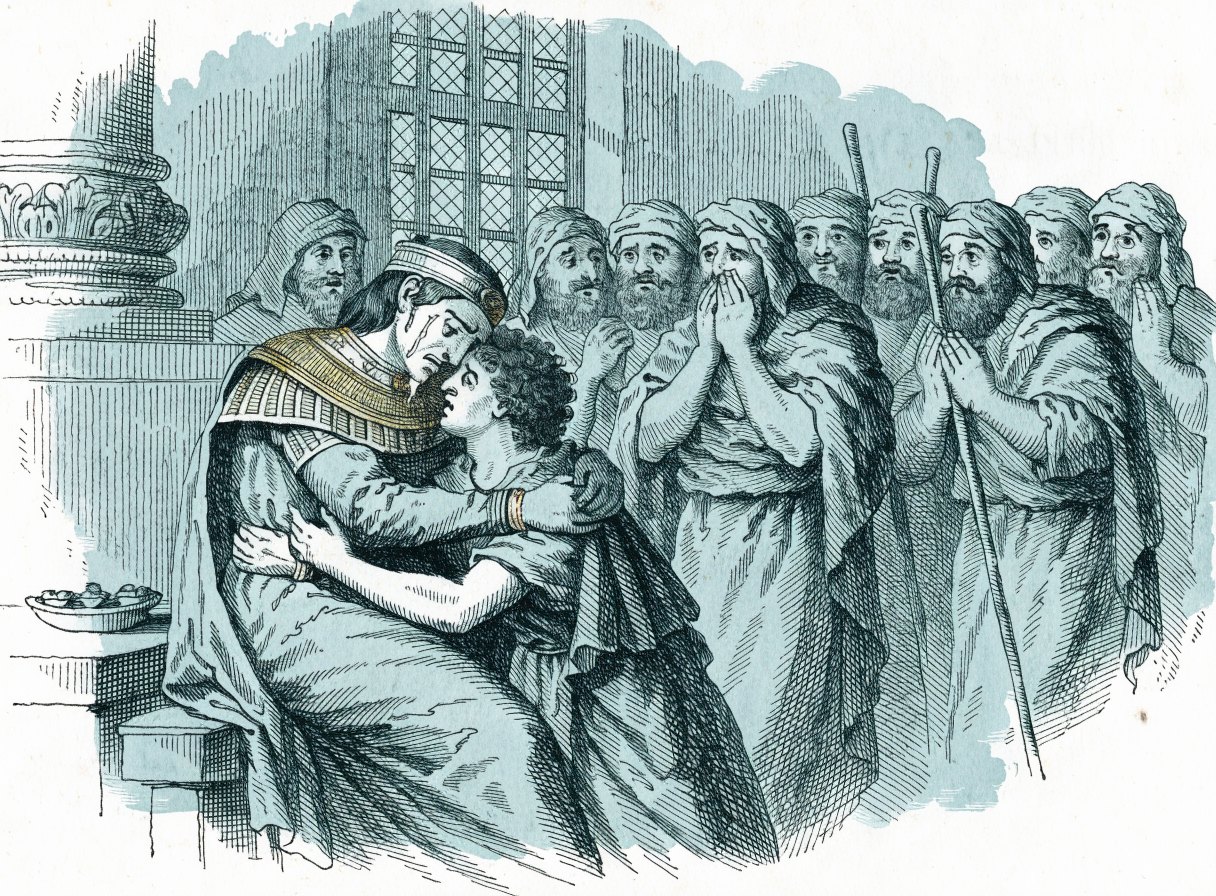
“for God sent me before you to preserve life.” Genesis 45:5
Introduction: From the Grasper to the Dreamer
Last week we followed the promise through Isaac and his twins. God chose Jacob the grasper before he was born, met him at Bethel when he was running away and bargaining, and at the river Jabbok made him say his own name, then sent him away limping, renamed Israel. Jacob had twelve sons, and their families became the twelve tribes of Israel.
This week the camera turns to one of those sons. Joseph is his father’s favorite and his brothers’ enemy. They sell him, and for thirteen years he is a slave and then a prisoner. Then God lifts him up to rule Egypt and save the very brothers who sold him. One word in Hebrew holds the whole story together.
The Word: Meant
Part Three: Joseph
Of all his sons, Jacob loved Joseph most, the first son of his beloved Rachel. He gave him a special robe, and his brothers “hated him and could not speak peacefully to him” (37:4). Joseph did not help matters. At seventeen he told his brothers about his dreams, in which they all bowed down to him. The favoritism Jacob had suffered from his own father, he now passed on to his sons.
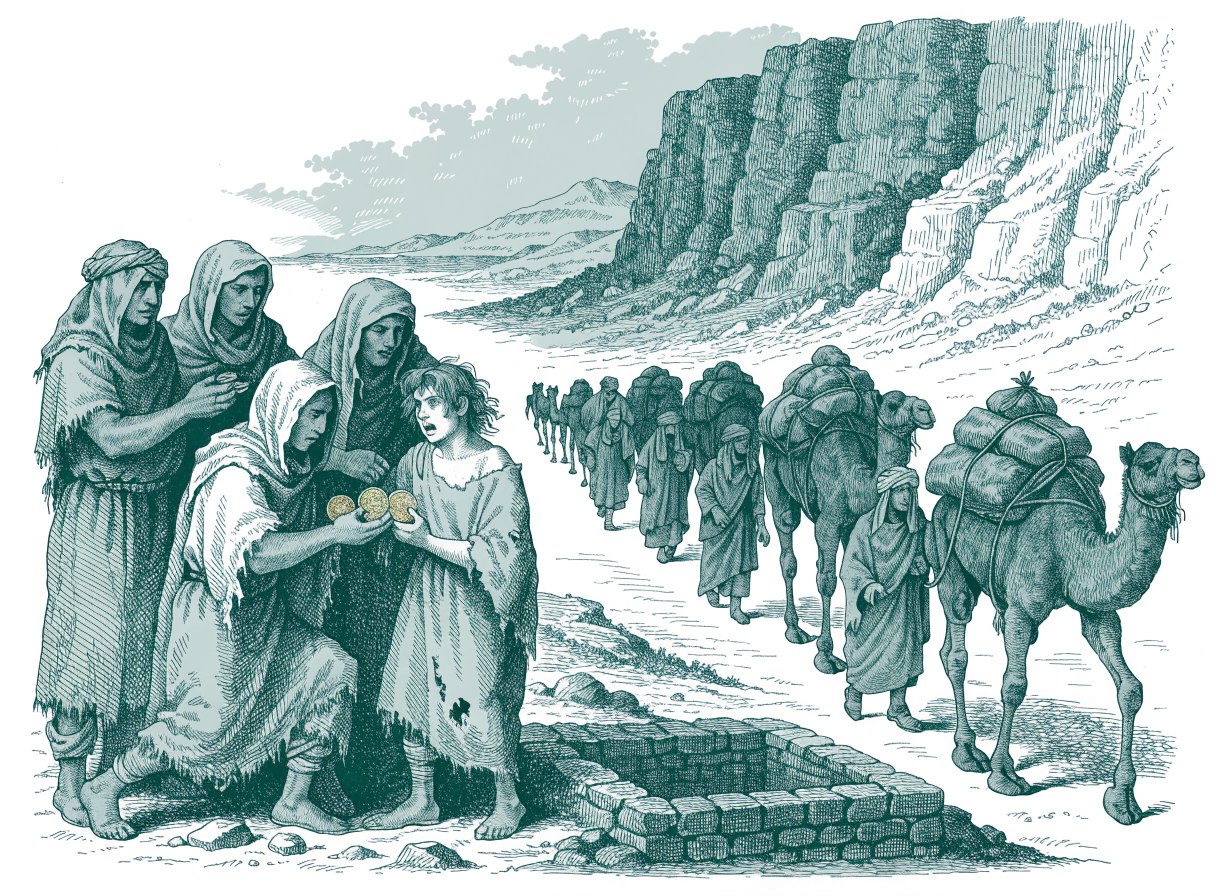
When Jacob sent Joseph to check on his brothers in the fields, they saw him coming and plotted to kill him. They threw him into an empty cistern. Then Judah had another idea: “What profit is it if we kill our brother and conceal his blood? Come, let us sell him” (37:26–27). So they sold him to passing traders for twenty shekels of silver. (Genesis calls them both Ishmaelites and Midianites, names that overlapped for desert caravan peoples; compare Judg. 8:24.) They dipped his robe in goat’s blood and let their father believe a wild animal had torn him apart. Notice the irony. Years before, Jacob had deceived his own father with goatskins. Now his sons deceive him with goat’s blood.
Right after Joseph is sold, Genesis stops to tell an ugly story about Judah (Gen. 38). He left his brothers, married a Canaanite woman, and had three sons. The first two were wicked, and the LORD put them to death. Judah promised his third son to Tamar, the oldest son’s widow, and then quietly broke the promise. So Tamar sat by the road dressed as a prostitute, and Judah slept with her, leaving his seal, cord, and staff as a pledge of payment. Three months later he heard his daughter-in-law was pregnant and ordered her burned. She sent him the pledge: “By the man to whom these belong, I am pregnant” (38:25). And Judah confessed: “She is more righteous than I” (38:26). Tamar bore twins, and one of them, Perez, became the ancestor of King David. Matthew writes her into the first lines of Jesus’ family tree: “Judah the father of Perez and Zerah by Tamar” (Matt. 1:3). That confession on the road is where the Judah of chapter 44 begins.
Joseph was taken to Egypt and sold as a slave to an officer named Potiphar. And here a sentence appears that runs like a refrain through the next chapters: “The LORD was with Joseph” (39:2). He rose to run Potiphar’s whole household. Then Potiphar’s wife tried to seduce him, and when he refused, she accused him of attacking her, and he was thrown into prison. “But the LORD was with Joseph and showed him steadfast love” (39:21). Joseph did right and suffered for it. For at least two more years he sat in prison, forgotten by the people he had helped (40:23; 41:1).
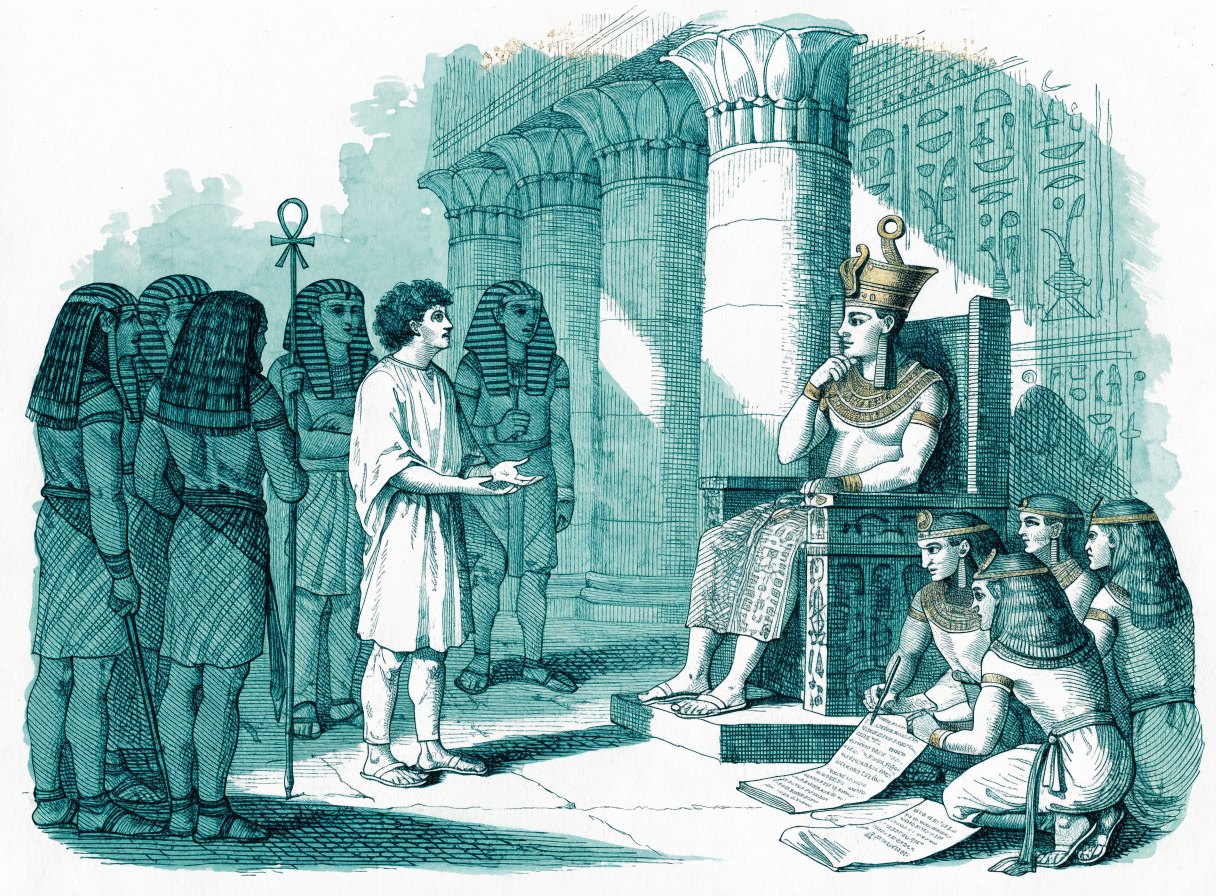
Then Pharaoh had two dreams that no one could interpret, and someone remembered the Hebrew prisoner. Joseph told Pharaoh that God was warning of seven years of plenty followed by seven years of famine. Pharaoh was so impressed that he put Joseph in charge of all Egypt: “See, I have set you over all the land of Egypt” (41:41). Joseph was thirty years old (41:46). Thirteen years after the pit, the slave was second only to Pharaoh (41:40).
When the famine came, it struck Canaan too, and Jacob sent ten of his sons to Egypt to buy grain. They bowed before the governor without knowing who he was. Joseph’s dreams had come true. He tested them. He held one brother in prison and demanded they bring back Benjamin, the youngest, Rachel’s other son and now their father’s favorite. Then Joseph arranged for Benjamin to be accused of theft and said Benjamin would have to stay as his slave.
The turning point of the whole story belongs to Judah. Judah, the brother who had once suggested selling Joseph for silver, stepped forward and begged: “Please let your servant remain instead of the boy as a servant to my lord, and let the boy go back with his brothers. For how can I go back to my father if the boy is not with me?” (44:33–34). The man who once sold a brother into slavery now offered himself as a slave in his brother’s place. God had changed Judah.
Joseph could not hold back any longer. He sent everyone else out and wept so loudly the Egyptians heard it. “I am Joseph!” His brothers were terrified. But Joseph said, “Come near to me, please… I am your brother, Joseph, whom you sold into Egypt. And now do not be distressed or angry with yourselves because you sold me here, for God sent me before you to preserve life” (45:3–5). He brought the whole family down to Egypt. The household of Jacob, numbered at seventy with Joseph and his sons (46:27), was saved from the famine. (Stephen says seventy-five in Acts 7:14, following the Greek Old Testament, which counts more of Joseph’s descendants.) Jacob saw the son he thought was dead. He would live his last seventeen years in Egypt and die there.
Near the end, Joseph brought his two sons, Manasseh and Ephraim, to his dying father. Jacob claimed them as his own: “Ephraim and Manasseh shall be mine, as Reuben and Simeon are” (48:5). That is why the Bible later counts two tribes from Joseph, and why the count still comes to twelve when Levi, the priestly tribe, receives no land of its own. Joseph placed the boys so Jacob’s right hand, the hand of the greater blessing, would rest on Manasseh, the firstborn. Jacob crossed his hands and laid his right hand on Ephraim. Joseph tried to move it, and the old man refused: “I know, my son, I know… his younger brother shall be greater than he” (48:19). The grasper who once stole a blessing now gives one away, and like God at the twins’ birth, he sets the younger ahead of the older. Hebrews remembers this moment as an act of faith (Heb. 11:21).
Before he died, Jacob blessed his sons, and he gave Judah a promise that reaches all the way to the end of the Bible: “The scepter shall not depart from Judah, nor the ruler’s staff from between his feet… and to him shall be the obedience of the peoples” (49:10). (A scepter is the staff a king holds as the sign of his rule.) A king would come from Judah. Israel’s great king David would come from Judah’s line, and so would Jesus (Matt. 1:2–16).
Part Four: You Meant It for Evil, God Meant It for Good
After Jacob died, the brothers panicked. Surely now Joseph would pay them back. They sent a message begging forgiveness and came and fell down before him: “Behold, we are your servants.” And Joseph wept, and said the sentence this whole story has been building toward: “Do not fear, for am I in the place of God? As for you, you meant evil against me, but God meant it for good, to bring it about that many people should be kept alive, as they are today” (50:19–20).
Joseph held two things together that we usually pull apart. First, the brothers were guilty. He did not say, “It was all God’s plan, so it’s fine.” They meant evil, and they did evil. Second, God was in control of every step. The pit, the slave caravan, the false accusation, the forgotten years in prison were all woven into God’s plan to save thousands of lives, including the very family that had sold him.
The Westminster Confession says it with great care. God’s providence reaches “even to the first fall, and all other sins of angels and men,” not by merely allowing them, but by “bounding” and “ordering, and governing of them… to his own holy ends,” and yet “the sinfulness thereof proceedeth only from the creature, and not from God, who, being most holy and righteous, neither is nor can be the author or approver of sin” (WCF 5.4).
This is one of the most practical truths in the Bible. Paul puts it in a single sentence: “And we know that for those who love God all things work together for good, for those who are called according to his purpose” (Rom. 8:28). That does not mean every bad thing is secretly good. Joseph’s brothers did evil. It means that God, who governs all things, will not let the evil done to his people have the last word. He will weave even that into good. And Paul tells us what that good is in the very next verse: to be “conformed to the image of his Son” (Rom. 8:29).
And notice what made Joseph able to forgive. “Am I in the place of God?” Joseph did not need to be the judge, because God already was. He did not need revenge to make the story come out right, because God had already written the ending. Forgiveness starts there, with trusting that God is God and you are not, and it never asks you to pretend the wound did not happen. For a Christian it goes one layer deeper: we forgive because we have been forgiven a debt we could never pay (Matt. 18:21–35; Eph. 4:32). In Seventy Times Seven I called Lamech’s song, from Week 9, the score-keeping heart fully grown. Joseph held the ledger and had the power to collect, and he tore it up: “I will provide for you and your little ones” (50:21).
God not only made the world; he holds it together and governs everything in it, from kings and nations to sparrows and hairs on our heads. He works even through human sin and suffering for his good purposes, without ever doing evil himself.
The Turn: The Brother Who Saves
Read Joseph’s story again and you will hear echoes of another story. The New Testament never says outright that Joseph was a picture of Jesus, but when Stephen retells Israel’s history, Joseph is the first in a line of deliverers whom God’s people rejected, a line Stephen says ends with “the Righteous One” (Acts 7:9–10, 35, 52): “the patriarchs, jealous of Joseph, sold him into Egypt; but God was with him and rescued him.” Hold the parallels loosely, but they are there.
Joseph was the beloved son of his father, rejected by his own brothers, sold for pieces of silver, falsely accused, and locked in the king’s prison (39:20). He went down into the pit and was raised up to be second only to the king, and men cried out before him, “Bow the knee!” (41:43). And from that place of power he did not take revenge. He forgave the very brothers who betrayed him, and he became the means by which they were saved.
Jesus came “to his own, and his own people did not receive him” (John 1:11). He was betrayed for thirty pieces of silver, falsely accused, and crucified between criminals. And Peter, preaching in Jerusalem, said the most Joseph-like sentence in the New Testament: “this Jesus, delivered up according to the definite plan and foreknowledge of God, you crucified and killed by the hands of lawless men” (Acts 2:23). You meant it for evil. God meant it for good. The worst thing human beings ever did, killing the Son of God, was the very thing God used to save us. And then God raised him up and seated him at his right hand.
The brothers came to Joseph afraid, offering to be his slaves. He said, “Do not fear… I will provide for you.” That is exactly how the risen Jesus receives sinners who come to him. You do not have to bargain like Jacob at Bethel. You do not have to grasp. You can come the way Jacob finally came at the river: limping, honest about your name, holding on. Turn from your sin and trust the Brother who is “not ashamed to call them brothers” (Heb. 2:11), who “suffered once for sins, the righteous for the unrighteous, that he might bring us to God” (1 Pet. 3:18), and who was raised again. He will not pay you back, because he took the payment himself. He has already provided everything you need.
Living It: Three Practices for This Week
Before Week 15: Read Exodus 1–3. Week 15 opens Unit 3: four hundred years later, Abraham’s family are slaves in Egypt, and God hears their cry.
For Discussion
- Judah went from selling a brother to offering himself in his brother’s place. What changed him? Where have you seen God change someone like that?
- “You meant evil against me, but God meant it for good.” How does that sentence hold both human guilt and God’s control together?
- Joseph asked, “Am I in the place of God?” How does trusting God’s judgment free us to forgive?
- Which parallel between Joseph and Jesus stands out most to you, and why?
Sources & For Further Study
- Westminster Shorter Catechism (1647), Q. 11 (providence). Westminster Confession of Faith (1646), 3.5 (election) and 5.4 (providence and sin).
- On חָשַׁב in Genesis 50:20: Brown, Driver, and Briggs, Hebrew and English Lexicon; Koehler and Baumgartner, HALOT, s.v.
- On Hosea 12:3–4 and the wrestler at Jabbok: John Calvin, Commentary on Hosea, on 12:3–4. David S. Jones, Seventy Times Seven: On the God Who Forgives Past All Counting, chapters 8 and 18.
- For further reading: Derek Kidner, Genesis (Tyndale Old Testament Commentaries); John Calvin, Commentary on Genesis, on chapters 28, 32, and 45–50; Timothy Keller, Walking with God through Pain and Suffering; Jerry Bridges, Trusting God.
Leading a small group? This week comes as a beautifully formatted, printable PDF, along with a 2-page Small Group Guide: a discussion page for your group and leader notes with a session plan and answer key. Both are free when you join the weekly list.