

“So then, there remains a Sabbath rest for the people of God.” Hebrews 4:9
Introduction: From the Plains of Moab
Last week a generation of Israel stood at the border of the Promised Land and refused to go in. For forty years God fed them with manna and led them through the desert while that generation died, and even Moses lost his place in the land. When serpents bit the people, God told them to look at a bronze serpent on a pole and live.
This week a new generation gets ready to cross over. Before they do, they need one last word from Moses and a new leader, and his name tells you where the whole story is going.
The Word: Joshua
Part Three: Moses’ Last Sermons
Forty years after the exodus, Israel camped on the plains of Moab, just east of the Jordan River, across from the city of Jericho. The old generation was gone. Before he died, Moses preached a series of farewell sermons to their children. Those sermons are the book of Deuteronomy, a Greek name meaning “second law.” It fits, because Moses was retelling God’s law to a new generation.
At the heart of Deuteronomy is a confession that observant Jews still recite every morning and evening, called the Shema after its first word, “Hear”:
When someone asked Jesus which commandment was the greatest, he quoted this passage (Matt. 22:37–38). Moses wanted God’s words at the kitchen table, on the road, and in the last words spoken before sleep.
Moses also made sure the new generation understood why God had chosen them. “It was not because you were more in number than any other people that the LORD set his love on you and chose you, for you were the fewest of all peoples, but it is because the LORD loves you and is keeping the oath that he swore to your fathers” (Deut. 7:7–8). And they were not about to receive the land because they were better than the Canaanites: “the LORD your God is not giving you this good land to possess because of your righteousness, for you are a stubborn people” (9:6). It was grace from start to finish.
Moses knew their hearts would keep failing. So near the end he gave them a promise: “And the LORD your God will circumcise your heart and the heart of your offspring, so that you will love the LORD your God with all your heart and with all your soul, that you may live” (30:6). The law could command love. Only God could create it. God was already giving new hearts to people like Caleb and Rahab. But the promise points ahead to the new covenant, when Christ would pour out his Spirit in fullness (Jer. 31:33; Ezek. 36:26).
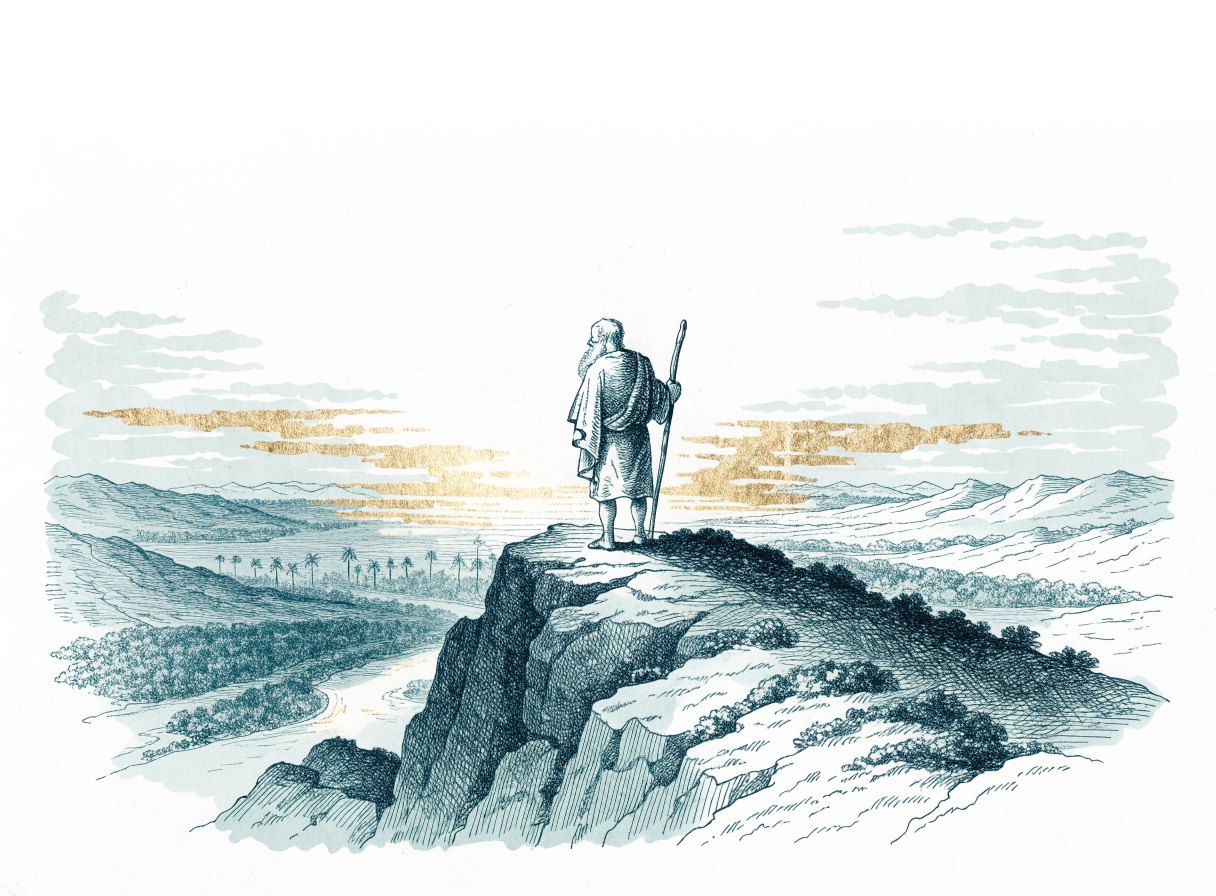
Then Moses climbed Mount Nebo. From the top “the LORD showed him all the land,” as far as the western sea, down to “the Valley of Jericho the city of palm trees” (34:1, 3). God said, “I have let you see it with your eyes, but you shall not go over there” (34:4). And Moses died on the mountain, and God himself buried him (34:5–6). Like Abraham and his sons before him, the greatest prophet in Israel saw the promise from a distance and died in faith (see Heb. 11:13). Centuries later he would stand on another mountain, in the land at last, talking with Jesus (Matt. 17:3).
Part Four: Into the Land
After Moses died, God spoke to Joshua: “Just as I was with Moses, so I will be with you. I will not leave you or forsake you. Be strong and courageous” (Josh. 1:5–6). Joshua’s courage would rest on God’s presence and God’s word, which he was to meditate on “day and night” (1:8).
Rahab. The first person in Canaan we meet is a prostitute in Jericho named Rahab. She hid two Israelite spies and told them why: “I know that the LORD has given you the land.… for the LORD your God, he is God in the heavens above and on the earth beneath” (2:9, 11). She had heard what God did at the Red Sea forty years earlier, and she believed. She tied a scarlet cord in her window as a sign, and when the city fell, she and her family were saved (6:25). Hebrews lists her among the heroes of faith (Heb. 11:31). And Matthew lists her in the family tree of Jesus (Matt. 1:5). A Canaanite woman with a ruined reputation became an ancestor of the Messiah. Grace was never limited to one bloodline.
The Jordan. When the priests carrying the ark stepped into the river, “the waters coming down from above stood and rose up in a heap very far away,” and “all Israel was passing over on dry ground” (3:16–17). A generation that had been children at the Red Sea, or not yet born, now walked through a river of their own. Joshua had twelve stones taken from the riverbed and stacked as a memorial, so that “when your children ask in time to come, ‘What do those stones mean to you?’” the parents could tell them what God had done (4:6–7).
Jericho. Before the battle, Joshua met a man with a drawn sword and asked, “Are you for us, or for our adversaries?” The answer: “No; but I am the commander of the army of the LORD” (5:13–14). Joshua fell on his face and took off his sandals, because the ground was holy (5:14–15). Many Christians have seen in this commander the Son of God himself, come to lead the battle. Jericho fell without a battering ram or a single assault on its walls. The people marched around it for seven days, the priests blew rams’ horns, the people shouted, “and the wall fell down flat” (6:20). “By faith the walls of Jericho fell down” (Heb. 11:30).
Years of fighting followed. When the land had been divided among the tribes, the book sums up God’s faithfulness in one of the great sentences of the Bible: “Not one word of all the good promises that the LORD had made to the house of Israel had failed; all came to pass” (21:45). The promise God made to Abraham in Genesis 12, that his offspring would receive this land, had come true. God had kept every word. Whether Israel would finish the job is the question Week 25 will answer. Before he died, the old Joshua gathered the people and put the choice to them: “choose this day whom you will serve.… But as for me and my house, we will serve the LORD” (24:15).
The Hard Question: What About the Canaanites?
Any honest reader of Joshua stops at verses like this: “they devoted all in the city to destruction, both men and women, young and old” (6:21). How could a loving God command that? This is hard, and it should feel hard. Christians have thought carefully about it for centuries. Here is what the Bible itself says.
It was judgment, after long patience. Centuries earlier, God told Abraham his descendants would live as strangers in a foreign land for four hundred years before he brought them back, “for the iniquity of the Amorites is not yet complete” (Gen. 15:13, 16). God waited centuries. The Canaanite religions included burning children as offerings: “they even burn their sons and their daughters in the fire to their gods” (Deut. 12:31). God said the land itself “vomited out its inhabitants” (Lev. 18:25). This was not about race, and it was not a reward for Israel’s goodness (Deut. 9:5–6). When Israel later did the same things, God drove them out of the land too, just as he had warned (Lev. 18:28; 2 Kings 17:7–18).
God is the Judge, and he takes no delight in death. To “devote to destruction” meant handing a city over wholly to God, as his judgment. That included children, and I will not pretend that is easy to read. But the Bible says every life belongs to the God who gave it, and that “the wages of sin is death” for every one of us (Rom. 6:23). God does not hand out death lightly: “I have no pleasure in the death of the wicked” (Ezek. 33:11). We are not told everything. We are told enough to trust that “all his ways are justice” (Deut. 32:4).
Mercy was open. Rahab heard the same news as everyone else in Jericho and turned to God. She and her family were spared. Even the Gibeonites, who tricked their way into a treaty, were spared, and God held Israel to its oath (Josh. 9). God says elsewhere that when a nation under judgment “turns from its evil, I will relent” (Jer. 18:8).
It was a one-time command, not a pattern for us. God gave this command to Israel, by his direct word, for the conquest of one land in one period of history. He never gives it to the church. Jesus said, “My kingdom is not of this world. If my kingdom were of this world, my servants would have been fighting” (John 18:36). Christians spread the kingdom with the gospel, never the sword. Anyone who uses Joshua to justify violence today has misread the whole Bible.
It is a preview of the final judgment. One day God “will judge the world in righteousness by a man whom he has appointed” (Acts 17:31). The conquest is a small, sobering picture of that day. And the only safe place then is the same as it was for Rahab: under the sign of God’s mercy. For us that sign is the cross, where Jesus took the judgment we deserve.
The Turn: The Better Joshua
About fourteen hundred years later, another Joshua came to the Jordan. Jesus was baptized in the same river Israel had crossed, and then “Jesus, full of the Holy Spirit, returned from the Jordan and was led by the Spirit in the wilderness for forty days, being tempted by the devil” (Luke 4:1–2). Forty days, for Israel’s forty years. A different desert, the same tests.
Israel was hungry in the wilderness and grumbled. Jesus was hungry, and when the devil told him to turn stones into bread, he answered from Deuteronomy: “Man shall not live by bread alone, but by every word that comes from the mouth of God” (Matt. 4:4; Deut. 8:3). Israel put God to the test at Massah. Jesus refused: “You shall not put the Lord your God to the test” (Matt. 4:7; Deut. 6:16). Israel turned to a golden calf. Jesus answered, “You shall worship the Lord your God and him only shall you serve” (Matt. 4:10; Deut. 6:13). Every answer Jesus gave came from Moses’ last sermons. Where Israel failed, Jesus obeyed, and he did it for us.
Look back over these two weeks and you will find Jesus everywhere. He is the true bread from heaven (John 6:32–35). He is the rock that gave water in the desert (1 Cor. 10:4). He is the One lifted up like the bronze serpent, so that everyone who looks to him in faith will live (John 3:14–15). He is the better Joshua, who leads us past every border into God’s own rest. “Come to me, all who labor and are heavy laden, and I will give you rest” (Matt. 11:28).
The saddest words in these two weeks are “they were unable to enter because of unbelief.” The ten spies saw the fruit with their own eyes and still would not trust God. Hebrews turns their story into an invitation for you: “Today, if you hear his voice, do not harden your hearts” (Heb. 3:15). Do not stand at the border. Turn from your sin, trust the Savior who passed every test in your place, and follow him in.
Living It: Three Practices for This Week
Before Week 25: Read Judges 2:6–23. Week 25 opens Unit 4: Israel in the land, falling into a cycle of sin and rescue.
For Discussion
- Deuteronomy says God chose Israel because he loved them, not because they were better. Why does that matter for how you see yourself?
- Rahab was a Canaanite and a prostitute, and she became an ancestor of Jesus. What does her story say to someone who thinks they are too far gone?
- Jesus answered every temptation with Scripture. Which verse do you need ready for your own wilderness right now?
- Which part of the Canaanite question is hardest for you? How does Rahab’s story change the way you see it?
Sources & For Further Study
- On the conquest and the Canaanites: Christopher J. H. Wright, The God I Don’t Understand; Meredith G. Kline, The Structure of Biblical Authority (on the “intrusion” of final judgment).
- For further reading: Dale Ralph Davis, Joshua: No Falling Words; Iain M. Duguid, Numbers: God’s Presence in the Wilderness (Preaching the Word); Daniel I. Block, Deuteronomy (NIV Application Commentary).
Leading a small group? This week comes as a beautifully formatted, printable PDF, along with a 2-page Small Group Guide: a discussion page for your group and leader notes with a session plan and answer key. Both are free when you join the weekly list.