

“And I will give you a new heart, and a new spirit I will put within you.” Ezekiel 36:26
Introduction: Songs in a Foreign Land
Last week we watched Judah fall. God sent prophet after prophet, and the people mocked them. Babylon came in waves, and in 586 BC Jerusalem burned, the temple with it. By the rivers of Babylon the exiles hung up their lyres and asked, “How shall we sing the LORD’s song in a foreign land?”
This week God answers that question. He shows his people how to live faithfully in exile, and in the ashes he gives some of the brightest promises in the Bible.
The Word: New Covenant
Part Three: Faithful in a Foreign Land
How do you live for God when everything familiar is gone? God answered through a letter Jeremiah sent to the exiles. Do not sit and wait to go home. “Build houses and live in them; plant gardens and eat their produce. Take wives and have sons and daughters.… But seek the welfare of the city where I have sent you into exile, and pray to the LORD on its behalf, for in its welfare you will find your welfare” (Jer. 29:5–7). And there was hope: “When seventy years are completed for Babylon, I will visit you… and bring you back to this place” (29:10). The very next verse is the famous one: “For I know the plans I have for you.” It was spoken to exiles who were told to settle in for seventy years. Most of them would die in Babylon. God’s good plans were bigger than one lifetime.
Daniel and his three friends show what that looks like. They served the king faithfully, learned the language, and rose to high office. But they drew lines they would not cross. Daniel “resolved that he would not defile himself with the king’s food” (Dan. 1:8). When Nebuchadnezzar set up a golden statue and ordered everyone to bow, Shadrach, Meshach, and Abednego refused: “our God whom we serve is able to deliver us from the burning fiery furnace, and he will deliver us out of your hand, O king. But if not, be it known to you, O king, that we will not serve your gods” (3:17–18). They were thrown into the fire, and the king saw “four men unbound, walking in the midst of the fire, and they are not hurt” (3:25). God had not left them alone in the fire.
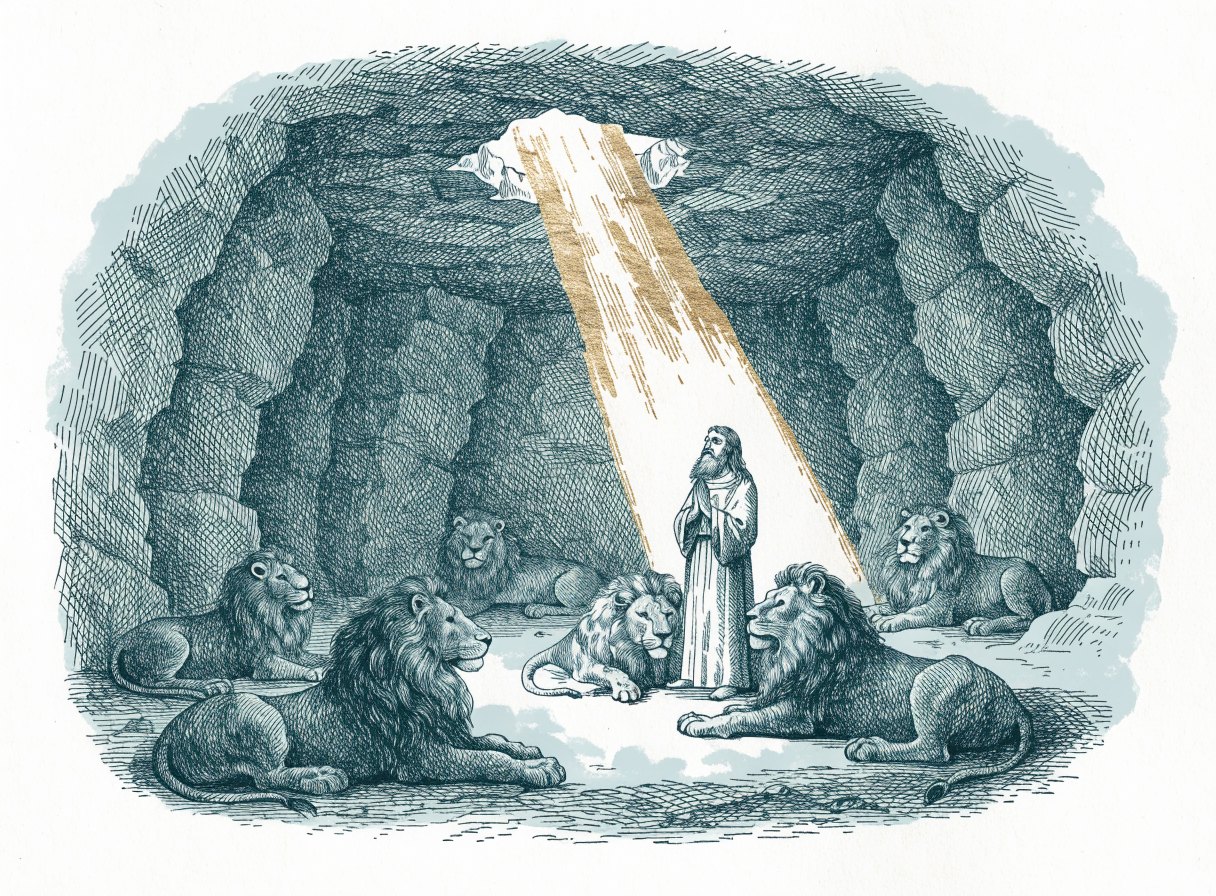
Decades later, when Daniel was an old man, Babylon had fallen to the Medes and Persians, and King Darius ruled, a law made prayer to any god or man but the king a crime for thirty days. Daniel went home to his upper room, where the windows were open toward Jerusalem, and “got down on his knees three times a day and prayed and gave thanks before his God, as he had done previously” (6:10). He was thrown to the lions, and in the morning he said, “My God sent his angel and shut the lions’ mouths” (6:22).
And God made a promise to the scattered exiles that changes everything: “Though I removed them far off among the nations… yet I have been a sanctuary to them for a while in the countries where they have gone” (Ezek. 11:16). The temple was gone. God was not. He himself became their sanctuary in Babylon.
God rules over all things, including nations, kings, and history. Babylon burned the temple because God sent it as his judgment, and Babylon fell when God said so. Nothing happens outside his plan. Yet God never does evil, and people are still responsible for what they choose. His plan is good.
Part Four: Promises in the Ashes
In the darkest chapter of their history, God gave his people some of his brightest promises. The writer of Lamentations, sitting in the ruins, said: “But this I call to mind, and therefore I have hope: The steadfast love of the LORD never ceases; his mercies never come to an end; they are new every morning; great is your faithfulness” (Lam. 3:21–23).
Through Jeremiah, God promised a new covenant. The old one was written on stone, and Israel broke it. The new one would be written on hearts, and it would rest on forgiveness: “For I will forgive their iniquity, and I will remember their sin no more” (Jer. 31:34). Through Ezekiel, God promised a new heart and his own Spirit: “I will remove the heart of stone from your flesh and give you a heart of flesh. And I will put my Spirit within you” (Ezek. 36:26–27). He showed Ezekiel a valley full of dry bones and asked, “Son of man, can these bones live?” Then he breathed into them, and they stood up, a vast army (37:1–10). God told Ezekiel, “these bones are the whole house of Israel” (37:11). God can bring a dead people back to life.
Through Daniel, God showed a vision of a heavenly King: “with the clouds of heaven there came one like a son of man.… And to him was given dominion and glory and a kingdom.… his dominion is an everlasting dominion, which shall not pass away, and his kingdom one that shall not be destroyed” (Dan. 7:13–14). Babylon’s kingdom would fall. This one never would.
And the exile would end. Jeremiah had said seventy years (Jer. 25:11). Counted from the first captives in 605 BC, that brings you to about 539, when Babylon fell. Counted from the temple’s fall in 586, it brings you to 516, when a new temple was finished. Daniel, reading Jeremiah’s scroll, knew the time was nearly up (Dan. 9:2). That is where Week 35 picks up the story.
The Turn: The Exile Who Brings Us Home
Six hundred years after the temple fell, Jesus rode toward Jerusalem, and when he saw the city, “he wept over it.” He foresaw that it would fall again (Luke 19:41–44), and it did, to Rome, in AD 70. He wept as Jeremiah wept, because he loved the city that was rejecting him.
Then Jesus went through an exile of his own, the deepest one there has ever been. Adam and Eve were driven out of the garden. Israel was driven out of the land. Jesus was led outside the city walls, and on the cross he cried, “My God, my God, why have you forsaken me?” (Matt. 27:46). There, as our substitute, he bore the Father’s just wrath against the sin that sent us into exile. He was still the beloved Son, and he went into that darkness for us, so that we could be brought home.
The night before, he had already told his disciples what his death meant: “This cup that is poured out for you is the new covenant in my blood” (Luke 22:20). Everything Jeremiah and Ezekiel promised comes through him: sins forgiven and remembered no more, God’s law written on the heart, the Holy Spirit living within. And at his trial he told the high priest that he is the Son of Man from Daniel’s vision: “you will see the Son of Man seated at the right hand of Power, and coming with the clouds of heaven” (Mark 14:62).
The New Testament calls Christians “sojourners and exiles” (1 Pet. 2:11). This world is not yet our home. So we do what Jeremiah told the exiles: we build, plant, marry, work, and seek the good of the cities where God has put us, while we wait for the true home Jesus has secured. If your life feels like exile right now, hear Lamentations again: his mercies are new every morning. And if you are far from God, the One who went into exile for sinners is calling you home. Turn to him and trust him today.
Living It: Three Practices for This Week
Before Week 35: Read Ezra 1 and 3, and Nehemiah 8. Week 35 follows the exiles home to rebuild.
For Discussion
- God told the exiles to seek the welfare of Babylon. What would it look like for you to seek the good of your city?
- Shadrach, Meshach, and Abednego said, “But if not.” What does it mean to trust God even if he does not rescue you the way you want? How does the cross show that God is good even when he says no?
- The new covenant promises forgiveness, a new heart, and the Spirit. Which of these do you most need to believe today?
- Jesus went into the deepest exile on the cross. How does that change the way you see your own seasons of feeling far from God?
Sources & For Further Study
- On the new covenant: O. Palmer Robertson, The Christ of the Covenants; Westminster Confession of Faith 7.6.
- For further reading: Philip Graham Ryken, Jeremiah and Lamentations (Preaching the Word); Iain M. Duguid, Ezekiel (NIV Application Commentary); Dale Ralph Davis, The Message of Daniel.
Leading a small group? This week comes as a beautifully formatted, printable PDF, along with a 2-page Small Group Guide: a discussion page for your group and leader notes with a session plan and answer key. Both are free when you join the weekly list.