

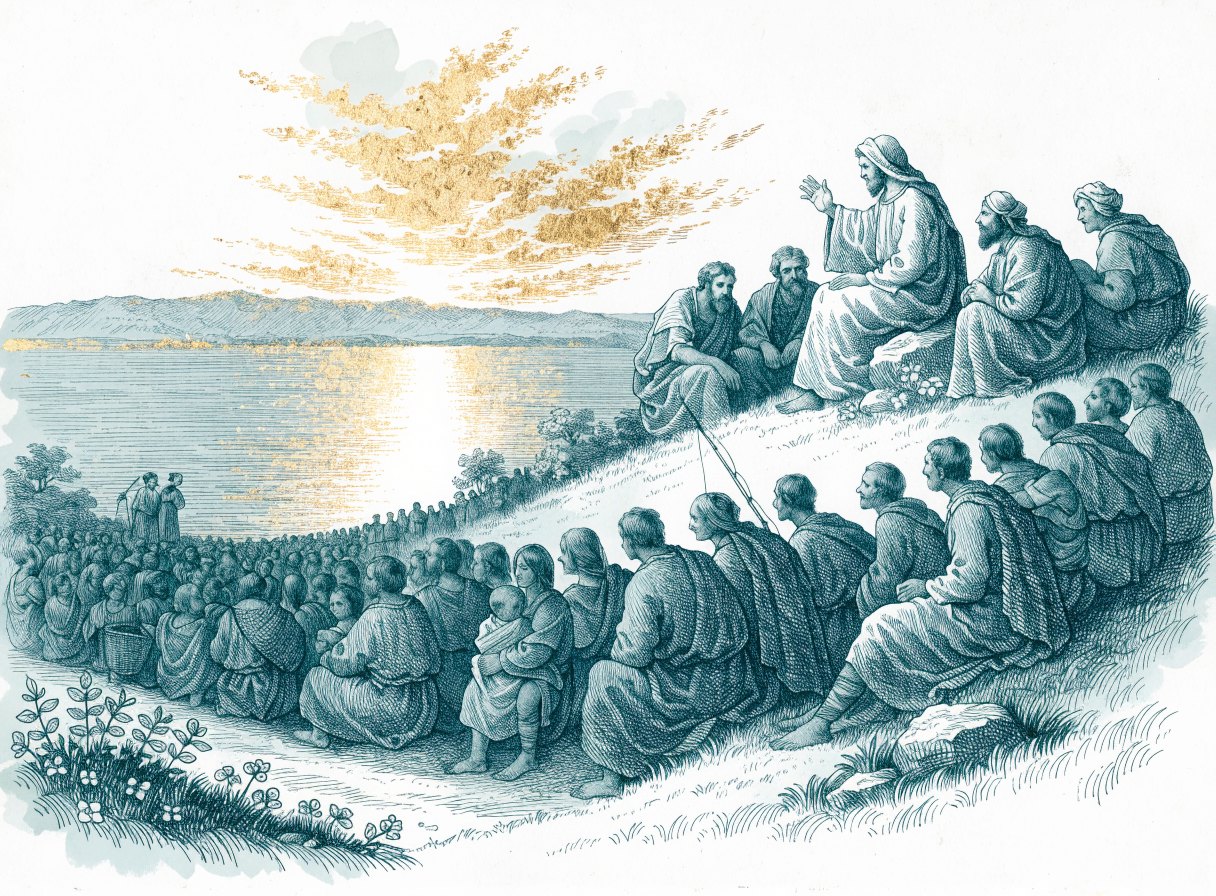
“Your kingdom come, your will be done, on earth as it is in heaven.” Matthew 6:10
Introduction: The Sermon as a Mirror
Last week the King arrived. Jesus announced that the kingdom of God was at hand, called fishermen, touched a leper, and ate with sinners. Then on a hillside he began his most famous sermon by blessing the poor in spirit, the mourners, and the meek.
This week the Sermon on the Mount goes deeper, and it becomes a mirror none of us can stand in front of for long. Then Jesus shows that his kingdom starts small and grows, already here and not yet complete.
Part Three: A Righteousness You Cannot Reach
The Sermon on the Mount is beautiful. It is also terrifying, if you read it honestly. Jesus said he came not to abolish the law but to fulfill it, and then he said, “unless your righteousness exceeds that of the scribes and Pharisees, you will never enter the kingdom of heaven” (5:17, 20). The Pharisees were the most careful law-keepers in Israel.
Then he went deeper than any rule-keeper ever had. You have heard, “You shall not murder.” But Jesus said that “everyone who is angry with his brother will be liable to judgment” (5:21–22). You have heard, “You shall not commit adultery.” But “everyone who looks at a woman with lustful intent has already committed adultery with her in his heart” (5:27–28). And he summed it up: “You therefore must be perfect, as your heavenly Father is perfect” (5:48).
Who can do that? No one. That is the first thing the Sermon wants us to see. Like the law at Sinai (Week 18), the Sermon works first as a mirror. It shows that we cannot enter God’s kingdom on our own record. The only righteousness that exceeds the Pharisees’ is a righteousness God gives. Paul longed to “be found in him, not having a righteousness of my own that comes from the law, but that which comes through faith in Christ” (Phil. 3:9). Jesus lived the Sermon on the Mount perfectly, every word, and he would die to pay for every line his people have broken. Both his perfect record and his payment are credited to everyone who trusts him. And God does more than credit us: he gives a new heart that begins to love what the Sermon commands. That is how the poor in spirit inherit the kingdom.
And then, for those who belong to him, the Sermon becomes a guide. It is no ladder into the kingdom. It is a portrait of life inside it. Jesus ended with a story about two builders: one built his house on the rock and one on sand. When the storm came, only one stood. “Everyone then who hears these words of mine and does them will be like a wise man who built his house on the rock” (7:24). The crowds were astonished, “for he was teaching them as one who had authority” (7:29).
Part Four: Already and Not Yet
Jesus’ disciples, like many in Israel, expected the Messiah to drive out the Romans and set up a political kingdom immediately. Jesus surprised them. His kingdom would start small and hidden, and grow. “The kingdom of heaven is like a grain of mustard seed that a man took and sowed in his field. It is the smallest of all seeds, but when it has grown it is larger than all the garden plants and becomes a tree…” (Matt. 13:31–32). It works like a little leaven, or yeast, that slowly spreads through a whole batch of dough (13:33).
So the kingdom is already here. It came with Jesus, and anyone who trusts him is “transferred… to the kingdom of his beloved Son” right now (Col. 1:13). But it is not yet here in full. Sickness, injustice, and death still walk the earth. That is why Christians still pray, “Your kingdom come.” One day it will come completely, when Jesus returns, and the cry will go up, “The kingdom of the world has become the kingdom of our Lord and of his Christ, and he shall reign forever and ever” (Rev. 11:15).
How do you get in? Jesus told a religious leader named Nicodemus, “unless one is born again he cannot see the kingdom of God” (John 3:3). It takes a new birth by the Spirit, a work only God can do. And the newborn heart answers the way Jesus called everyone to answer: “repent and believe in the gospel” (Mark 1:15). Turn from going your own way, and trust the King.
No one can enter God’s kingdom by trying harder. We must be born again. The Holy Spirit gives new life to spiritually dead hearts, opens our eyes to see Christ, and makes us willing to trust him. Faith itself is his gift.
The Turn: Treasure Worth Everything
Jesus told two very short stories about what it is like to find the kingdom. “The kingdom of heaven is like treasure hidden in a field, which a man found and covered up. Then in his joy he goes and sells all that he has and buys that field.” And it is “like a merchant in search of fine pearls, who, on finding one pearl of great value, went and sold all that he had and bought it” (Matt. 13:44–46).
Notice the words “in his joy.” Following Jesus costs everything. The fishermen left their nets. But no one in those stories feels like he is making a sacrifice. He has found something worth more than everything else he owns put together. The kingdom of God is the treasure.
Those parables measure what the kingdom is worth. They never set its price. The King paid that himself, at the cross. You cannot buy your way in with good works; the Sermon on the Mount shows that. But you can receive it as a gift, like a child. The poor in spirit are blessed, because theirs is the kingdom. Come with empty hands. Repent and believe the good news. And then live the rest of your life as a citizen of the kingdom that cannot be shaken (Heb. 12:28), praying every day, “Your kingdom come, your will be done.”
Living It: Three Practices for This Week
Before Week 41: Read Mark 14 and Luke 22:7–20. Week 41 follows Jesus to the upper room and the garden.
For Discussion
- Jesus said anger and lust break God’s law in the heart. How does the Sermon on the Mount work as a mirror for you?
- Jesus told Nicodemus, “unless one is born again he cannot see the kingdom of God” (John 3:3). Why does entering the kingdom take a new birth? Why isn’t a better effort enough?
- The kingdom is “already” and “not yet.” Where do you see it already? Where are you still longing for it?
- In Jesus’ parables, a man sells everything “in his joy.” What would it look like for you to treat the kingdom as treasure rather than burden?
Sources & For Further Study
- On the Sermon on the Mount: D. Martyn Lloyd-Jones, Studies in the Sermon on the Mount; Sinclair B. Ferguson, The Sermon on the Mount.
- For further reading: Westminster Larger Catechism 191 (on “Thy kingdom come”); Timothy Keller, King’s Cross.
Leading a small group? This week comes as a beautifully formatted, printable PDF, along with a 2-page Small Group Guide: a discussion page for your group and leader notes with a session plan and answer key. Both are free when you join the weekly list.