

“Create in me a clean heart, O God, and renew a right spirit within me.” Psalm 51:10
Introduction: A Promise, and a Fall
Last week Israel demanded a king like all the nations, and God gave them Saul, who looked the part and would not obey. Then God sent Samuel to Bethlehem to anoint a shepherd boy, and David brought down Goliath in the name of the LORD.
This week David is on the throne in Jerusalem, and he wants to build God a house. God answers with a promise that runs through the rest of the Bible. Then the man after God’s own heart falls, and we see what real repentance looks like.
Part Three: A House Forever
After Saul died, David became king, first over Judah at Hebron, then over all Israel. He was thirty years old, and he reigned forty years (2 Sam. 5:4). He captured the old fortress city of Jerusalem and made it his capital, “the city of David” (5:7). Then, at peace in his new palace, David had an idea. “See now, I dwell in a house of cedar, but the ark of God dwells in a tent” (7:2). (The ark was the gold-covered chest that stood for God’s throne among his people.) He wanted to build God a house, a temple.
That night God answered through the prophet Nathan, and he turned David’s idea upside down. David would not build God a house. God would build David a house, a dynasty:
Read those promises slowly. An offspring from David’s own body. A kingdom God himself would establish. A son who would build God’s house. Solomon would build the first one, but his temple would one day fall, and the promise would need a greater Son. A Father-son relationship between God and this King. And a throne that would outlast every dynasty on earth: forever. When this son sinned, God would discipline him, “but my steadfast love will not depart from him, as I took it from Saul” (7:15). This was grace. David had done nothing to earn it. It was the same covenant of grace God made with Abraham, now running through one family toward one King. King David went in and sat before the LORD and said, “Who am I, O Lord GOD, and what is my house, that you have brought me thus far?” (7:18).
In Israel, prophets spoke God’s word, priests offered sacrifices, and kings ruled. Jesus fills all three offices. As prophet he reveals God to us, as priest he offered himself and prays for us, and as king he rules and defends us. He is the forever King promised to David.
Part Four: The King Falls
If the story stopped there, David would be the hero. It does not stop there. One spring, when kings went to war, David stayed home. From his roof he saw a woman bathing. Her name was Bathsheba, and her husband, Uriah, was one of David’s own soldiers, away at the front. “So David sent messengers and took her” (11:4). The king used his power to take what was not his. When she became pregnant, David tried to cover it up, and when that failed, he arranged for Uriah to be killed in battle. Then he married Bathsheba. The chapter ends with one quiet, terrible line: “But the thing that David had done displeased the LORD” (11:27).
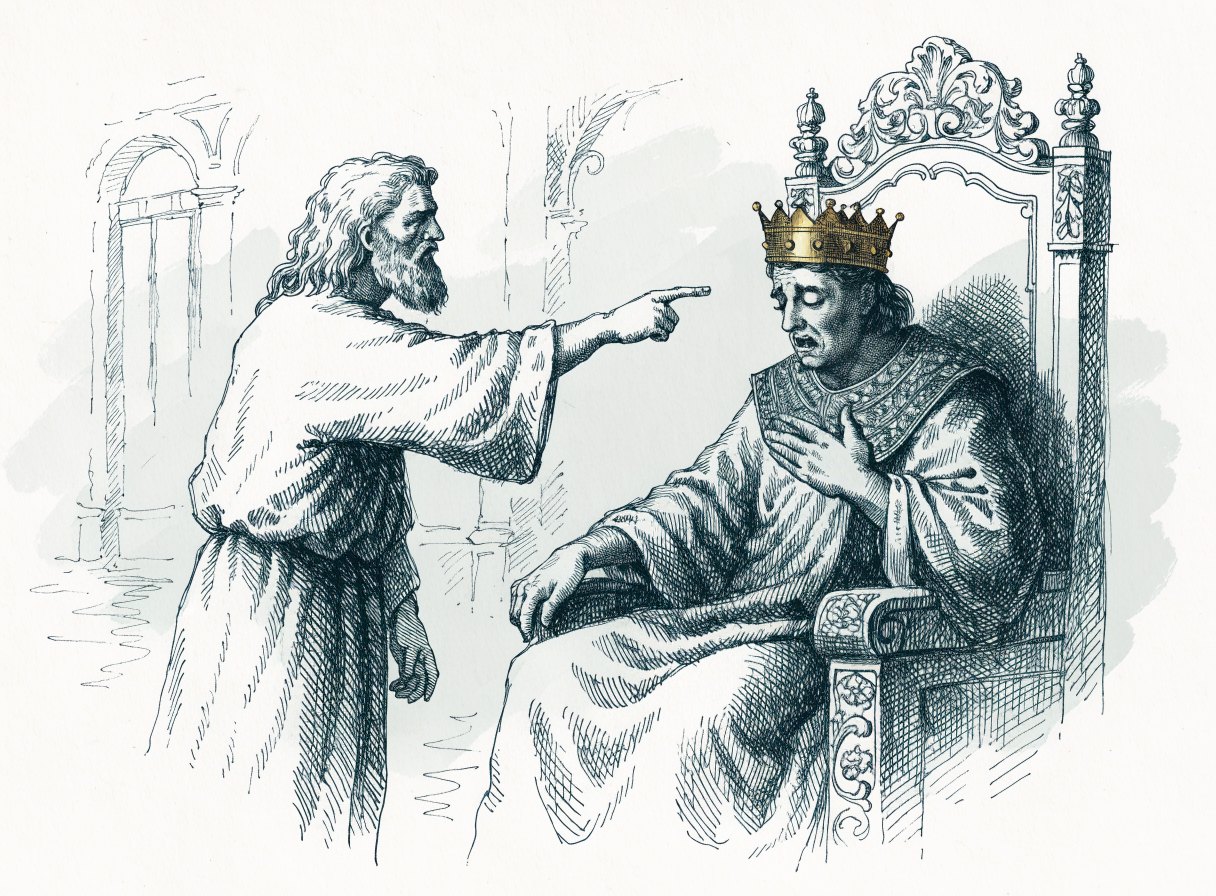
God sent Nathan again, this time with a story. A rich man with huge flocks had a guest to feed, so he stole a poor man’s only lamb, a pet the poor man’s children loved. David was furious: “the man who has done this deserves to die” (12:5). And Nathan said four words: “You are the man!” (12:7).
Here is the difference between David and Saul. Saul said “I have sinned” too, but only after insisting he had obeyed and blaming the people, and then he asked Samuel to honor him before the elders (1 Sam. 15:20–30). David made no excuse at all: “I have sinned against the LORD” (12:13). And Nathan answered at once, “The LORD also has put away your sin; you shall not die.” Forgiveness was real and immediate. So were the consequences. The child died, and “the sword shall never depart from your house” (12:10). David’s family was torn apart by violence for the rest of his life. Those consequences were not God taking his forgiveness back. They were a Father’s discipline (Heb. 12:6), the same kind God had promised even for David’s royal son (2 Sam. 7:14).
After Nathan confronted him, David wrote Psalm 51, the prayer of every sinner who has ever come home to God: “Have mercy on me, O God, according to your steadfast love; according to your abundant mercy blot out my transgressions.… Create in me a clean heart, O God, and renew a right spirit within me” (Ps. 51:1, 10).
The Turn: The Son of David
David died around 970 BC. His tomb was still there a thousand years later, when Peter preached in Jerusalem: David “both died and was buried, and his tomb is with us to this day” (Acts 2:29). So how could God’s promise of a forever throne come true? Peter answered: “Being therefore a prophet, and knowing that God had sworn with an oath to him that he would set one of his descendants on his throne, he foresaw and spoke about the resurrection of the Christ.… This Jesus God raised up” (Acts 2:30–32).
Jesus is the Son of David. He was born in Bethlehem, “the city of David” (Luke 2:4). Before his birth the angel told Mary, “the Lord God will give to him the throne of his father David, and he will reign over the house of Jacob forever, and of his kingdom there will be no end” (Luke 1:32–33). He was anointed with the Spirit of God, who descended on him at his baptism (Acts 10:38), with the Father’s voice saying, “This is my beloved Son” (Matt. 3:16–17). Hebrews applies God’s promise to David directly to Jesus: “I will be to him a father, and he shall be to me a son” (Heb. 1:5).
Jesus is the better David. David fought Goliath as Israel’s champion. Jesus fought our real enemies (sin, death, and the devil) and won the victory for people who could never have won it themselves (Heb. 2:14–15). David was a man after God’s heart who still fell into adultery and murder. Jesus was “tempted as we are, yet without sin” (Heb. 4:15). David needed Nathan to say, “You are the man,” and then needed forgiveness. Jesus, the sinless King, took the guilt of sinners like David, and like us, on himself at the cross.
And because he rose, his throne really is forever. “Of the increase of his government and of peace there will be no end, on the throne of David and over his kingdom” (Isa. 9:7). The question this week leaves you with is the one Israel faced: Who will be your king? You can choose a king like the nations: success, approval, comfort, yourself. Or you can bow to the Son of David, who laid down his life for sinners and turns away no one who comes to him (John 6:37). If you have sinned like David, pray like David. Confess it to God, and trust the King who forgives: “The LORD also has put away your sin.”
Living It: Three Practices for This Week
Before Week 29: Read 1 Kings 3 and 6. Week 29 follows Solomon, the son who asked for wisdom and built God’s house.
For Discussion
- In 2 Samuel 7, David wanted to do something for God, and God promised to do something for David. Why does that order matter?
- Compare how Saul and David each responded when confronted with sin. What separates real repentance from making excuses?
- David was forgiven immediately but still faced consequences. Why is it good news that God’s discipline is a Father’s discipline (Heb. 12:6)?
- Jesus is called “the son of David” in the first verse of the New Testament. What does it mean to you that he is a King whose throne lasts forever?
Sources & For Further Study
- On the covenant with David: O. Palmer Robertson, The Christ of the Covenants; Westminster Confession of Faith 7.5–7.6. On David as representative champion: Dale Ralph Davis, 1 Samuel: Looking on the Heart.
- For further reading: Dale Ralph Davis, 2 Samuel: Out of Every Adversity; Robert D. Bergen, 1, 2 Samuel (New American Commentary).
Leading a small group? This week comes as a beautifully formatted, printable PDF, along with a 2-page Small Group Guide: a discussion page for your group and leader notes with a session plan and answer key. Both are free when you join the weekly list.