


“These things I have spoken to you, that my joy may be in you, and that your joy may be full.” John 15:11
“Strive for peace with everyone, and for the holiness without which no one will see the Lord.” Hebrews 12:14
Introduction: The Pursuit of Happiness
In 1776 a group of men signed their names under a sentence that said every person is endowed by their Creator with certain rights, and that among them are “Life, Liberty and the pursuit of Happiness.” Notice what was promised. Not happiness. The pursuit of it. Nearly two hundred and fifty years later, we are still running. We chase it through promotions and paychecks, through relationships and vacations, through screens and substances and the next purchase. A whole industry now sells it by the chapter and the course. And most of us, if we are honest, are still not sure we have caught it.
The Bible does not scold us for wanting to be happy. That surprises some Christians. Many of us grew up hearing a line that sounds very spiritual: “God doesn’t want you happy. He wants you holy.” There is a true warning inside that sentence. God will not trade your holiness for your comfort. But as a whole statement it is only half right, and the half it gets wrong has done real harm. It teaches people that holiness is the price you pay and happiness is the thing you give up. It makes God sound like the enemy of our joy.
The Puritan Thomas Watson saw it more clearly. “Blessedness is the desire of all men,” he wrote (The Beatitudes, ch. 2). The desire is not the problem. God made us to want it. The problem is where we look. “Millions of men mistake both the nature of blessedness and the way thither” (ibid.). So this study takes the world’s search seriously, sets its favorite answers beside what God has said, and follows the Scriptures to a conclusion the older Reformed writers stated without embarrassment. In 1662 Thomas Brooks gave a whole book this title: Holiness, the Only Way to Happiness. He was not being clever. He was summarizing the Bible.
Three convictions run underneath every section. First, God is the good. He is not merely the giver of good things; he is the thing itself (Ps. 16:11; 73:25). Second, sin always lies about happiness. It promises joy and pays in ashes (Jer. 2:13; Heb. 11:25). Third, holiness is not the price of joy; it is the shape of it. To become like God is to share his happiness (Heb. 12:10; 1 Pet. 1:8, 15–16). The Westminster Shorter Catechism puts all three in one sentence: “Man’s chief end is to glorify God, and to enjoy him forever” (Q. 1). Glorify and enjoy. Not one or the other.
The Word: O the Happiness of That Man
The very first word of the Psalter is a word about happiness. Our English Bibles say “Blessed,” and that is a fine translation, but it can make the word sound stiff and churchy, like something said over you with a raised hand. The Hebrew word is warmer than that.
Look at what Psalm 1 says the happy man does and does not do. He does not take his counsel from the wicked, linger in the path of sinners, or settle into the scoffer’s chair. Walk, stand, sit: sin slows you down until you are not going anywhere. Instead, “his delight is in the law of the LORD.” Not his duty. His delight. The holy life in Psalm 1 is not a man gritting his teeth through a list of rules. It is a man who has found where the water is and put his roots down beside it.
So the Bible’s own vocabulary will not let us separate holiness from happiness. The word for the holy man is the word for the happy man.
The Broken Cisterns: What the World Says vs. the Word
In ancient Israel a cistern was a pit dug out of rock and plastered to hold rainwater. It was hard work, and it held flat, still water at best. A spring was the opposite: fresh water bubbling up on its own, free. Jeremiah’s picture is almost comic. God’s people walked away from a spring to go dig their own tanks, and the tanks were cracked. That is the world’s pursuit of happiness in one sentence. It is not that people want too much. It is that they settle for leaky substitutes, and they work very hard to do it. “They who go to the creature for blessedness,” Watson wrote, “go to the wrong box” (The Beatitudes, ch. 2).
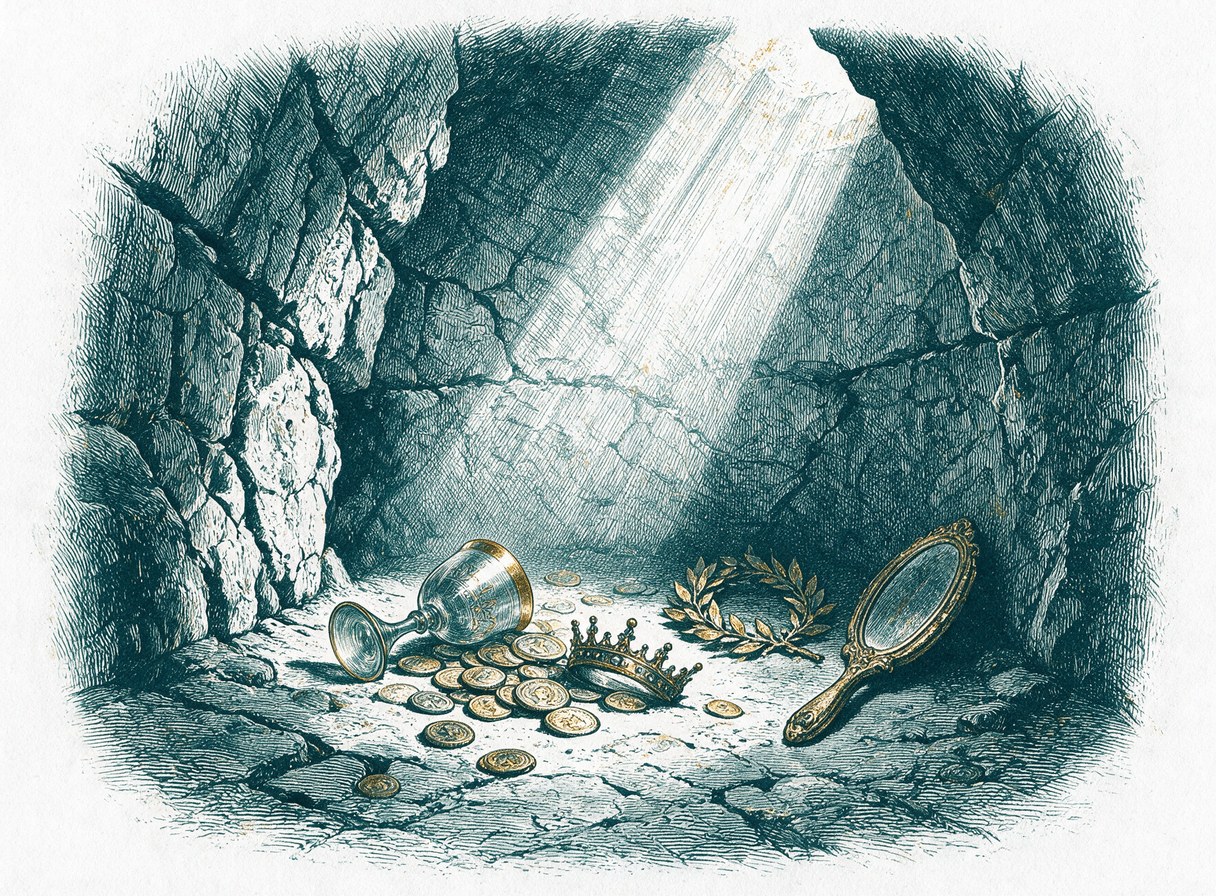
Here are six of the cisterns our culture digs most often, each set beside what God has said.
1Money
Money is not evil. It is a gift, and the Bible is full of honest work and generous giving. But money is a terrible god, because it can never say “enough.” Jesus told a story about a farmer whose barns overflowed and who said to his soul, “Relax, eat, drink, be merry.” God called him a fool that same night (Luke 12:19–20). The wealth was real. The happiness it promised was not.
Paul sets the alternative plainly: “But godliness with contentment is great gain” (1 Tim. 6:6). Godliness is holiness lived out. Contentment is happiness that no longer needs the next thing. Put them together and you are rich. Charles Spurgeon said it from the pulpit in 1877: “A man will never be dazzled with gold, who has his heart satiated with God!”
Also read: Ecclesiastes 5:10; Matthew 6:19–21, 24; Philippians 4:11–13; 1 Timothy 6:6–10, 17–19; Hebrews 13:5
2Pleasure
Solomon ran this experiment further than any of us ever will. “Whatever my eyes desired I did not keep from them. I kept my heart from no pleasure” (Eccl. 2:10). He had the wine, the music, the gardens, the houses, the women. And his verdict at the end was this:
The problem with sinful pleasure is not that it is too pleasurable. It is that it does not last and it does not satisfy. Moses understood this. He grew up in Pharaoh’s palace with every pleasure Egypt could offer, and he walked away from it, “choosing rather to be mistreated with the people of God than to enjoy the fleeting pleasures of sin” (Heb. 11:25). Fleeting is the key word. Notice that Hebrews does not say Moses gave up pleasure. It says he traded a fleeting pleasure for a greater one: “for he was looking to the reward” (11:26). Compare Psalm 16:11. At God’s right hand there are pleasures, and they are “forevermore.”
Also read: Proverbs 14:12–13; Isaiah 55:1–2; Hebrews 11:24–26; James 4:1–4; 1 John 2:15–17
3Approval
We are made for glory, so it is no surprise we hunger for it. But the approval of people is the leakiest cistern of all. It has to be refilled every day, and the crowd that cheers on Sunday can shout “Crucify him” on Friday. Jesus put his finger on why the religious leaders of his day could not believe in him: they were addicted to each other’s praise.
The holy life frees you from the tyranny of the audience. When your heart is set on hearing “Well done, good and faithful servant” (Matt. 25:21), the opinion of the room loses its grip. That is not a loss of joy. It is a release into it.
Also read: Proverbs 29:25; Galatians 1:10; Matthew 6:1–6; 1 Corinthians 4:3–5; 1 Thessalonians 2:4
4Comfort
If happiness means nothing hard ever happens, then no one has ever been happy, including Jesus. J.C. Ryle was careful here: “True happiness is not perfect freedom from sorrow and discomfort” (Happiness, 1878). The Christian is not promised an easy life. He is promised a good Father who uses even the hard things to make him holy, and therefore to make him glad.
Notice the order. Painful now, fruitful later. Holiness is the fruit, and peace comes with it. Paul could describe the Christian life as “sorrowful, yet always rejoicing” (2 Cor. 6:10). Both words are true at the same time. The world cannot hold them together. The gospel can.
Also read: Romans 5:3–5; 8:28–29; 2 Corinthians 4:16–18; James 1:2–4; 1 Peter 1:6–9
5Freedom
We think of holiness as a cage and sin as the open field. Jesus says it is the other way around. Sin is the cage. It promises freedom and delivers addiction, shame, and broken relationships. Anyone who has tried to stop a sin in his own strength knows how free he really was.
Real freedom is not the absence of a master. It is having the right one. “Take my yoke upon you, and learn from me, for I am gentle and lowly in heart, and you will find rest for your souls. For my yoke is easy, and my burden is light” (Matt. 11:29–30). The psalmist found the commandments to be a wide-open road: “Lead me in the path of your commandments, for I delight in it” (Ps. 119:35).
Also read: Romans 6:16–23; Galatians 5:1, 13; Psalm 119:32, 45; 2 Peter 2:19
6The Self
This is the cistern underneath all the others. Money, pleasure, approval, comfort, and freedom are usually just different ways of serving the self. And the self is a bottomless pit. It cannot be filled, because it was never meant to be the source. It was meant to be a vessel.
Henry Scougal, a young Scottish minister, wrote in 1677 that “the worth and excellency of a soul is to be measured by the object of its love” (The Life of God in the Soul of Man). A soul that loves only itself shrinks to its own size. A soul that loves God grows toward his. Jesus does not ask you to stop wanting life. He tells you where to find it.
Also read: Jeremiah 17:9; Proverbs 3:5–7; 28:26; Galatians 2:20; Philippians 3:7–11
Holiness, the Only Way to Happiness
Once we see the cisterns for what they are, the Bible’s positive answer comes into focus. Happiness is not found beside God, as if he were one more good thing among others. It is found in God. And holiness is simply the way a sinner is brought near enough to enjoy him.
Asaph wrote those words after nearly losing his faith over the happiness of the wicked. They had money, health, and no troubles, and he envied them (Ps. 73:3–12). Then he went into the sanctuary of God, and he saw their end, and he saw his own portion. The prosperous sinner has everything except God. The struggling saint has nothing except God, which turns out to be everything.
God is the fountain
Jonathan Edwards preached a sermon in 1733 called “The Christian Pilgrim.” In it he said that “God is the highest good of the reasonable creature; and the enjoyment of him is the only happiness with which our souls can be satisfied.” Then he gave one of the most beautiful pictures in all of Puritan and Reformed writing. All the good things of this life, he said, family and friends and earthly comforts, “are but shadows. But the enjoyment of God is the substance. These are but scattered beams, but God is the sun. These are but streams, but God is the fountain. These are but drops, but God is the ocean” (Works, Banner of Truth, 2:244).

That changes how we enjoy everything else. A Christian can love his wife, laugh with his friends, and enjoy a good meal more freely than anyone, because none of those things has to be God for him. They are streams. He knows where the fountain is.
Holiness is the road
But a sinner cannot walk into the presence of a holy God and enjoy him. “Strive for peace with everyone, and for the holiness without which no one will see the Lord” (Heb. 12:14). Jesus said the same thing in the Beatitudes: “Blessed are the pure in heart, for they shall see God” (Matt. 5:8). That verse was one of the texts on the title page of Brooks’s book, and his whole argument is packed into it. The happiness is seeing God. The way there is a pure heart. Brooks put it bluntly: “So that there is now no way under heaven to be happy, but by being holy.” And again, turning it around to show God’s intent: “where he is resolved to make happy, there he is resolved to make holy” (The Crown and Glory of Christianity, 1662, Epistle Dedicatory).
Jesus himself tied obedience and joy together in the upper room, on the night before he died:
Read it slowly. Keeping his commandments is how we abide in his love. And the reason he tells us this is joy, his joy in us, and our joy made full. Holiness is not a detour from joy. It is the road that runs straight into it.
The Reformed confessions say the same thing in their own careful way. The Heidelberg Catechism describes true conversion as two things: “the dying of the old self and the birth of the new” (Q. 88). And what is the new self? “Complete joy in God through Christ and a strong desire to live according to the will of God in all good works” (Q. 90). Notice that joy in God and the desire for holiness are not two separate blessings. They are one new heart. The Westminster Confession adds that the believer’s assurance enlarges his heart “in peace and joy in the Holy Ghost, in love and thankfulness to God, and in strength and cheerfulness in the duties of obedience” (WCF 18.3). Cheerful obedience. That is what holiness looks like from the inside.
J.C. Ryle, the Anglican bishop whose book Holiness is still read today, summed it up in six words: “The holiest men are always the happiest!” (Happiness, 1878).
The Expulsive Power: How the Change Happens
So far this may sound like a simple instruction: stop drinking from cisterns and go to the fountain. But anyone who has tried knows it is not that simple. The cistern is right there, and it is familiar, and it still tastes like water. How does a heart actually let go?
In the early 1800s a Scottish preacher named Thomas Chalmers answered that question in a sermon on 1 John 2:15 (“Do not love the world or the things in the world”). You cannot simply rip a love out of the human heart, he said, and leave an empty space. The heart will not stay empty. It must love something. Telling people how bad the world is will not do it. What will? “The only way to dispossess it of an old affection, is by the expulsive power of a new one” (“The Expulsive Power of a New Affection”).
That is how holiness grows. Not mainly by willpower, though effort is real (Phil. 2:12–13). It grows when something better takes the place of the thing we loved. Jesus told a two-sentence parable about exactly this:
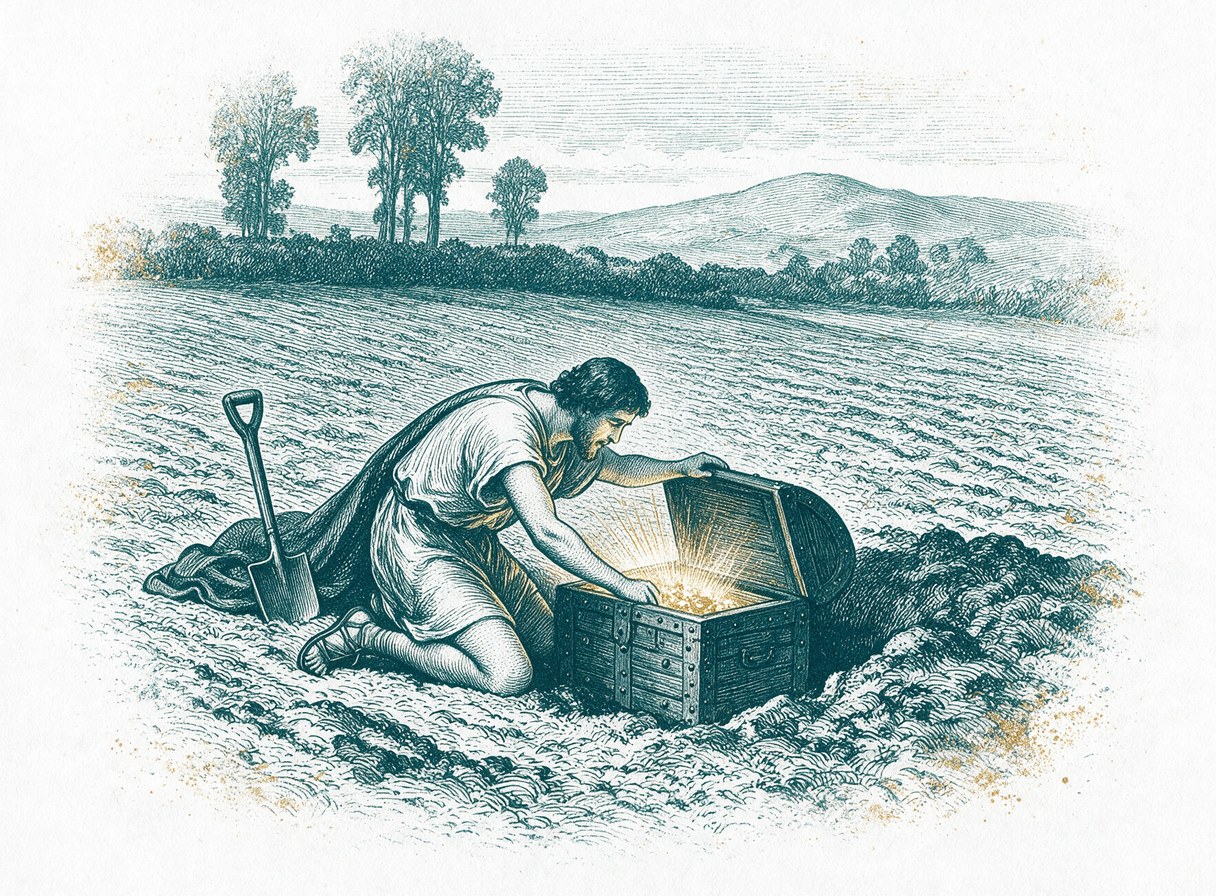
Three words carry the whole parable: “in his joy.” The man sells everything, which sounds like the ultimate sacrifice. But Jesus says he does it gladly, because he has seen what is in that field. That is the secret of the holy life. It is not mainly a life of saying no. It is a life of having seen something so good that the no takes care of itself.
John Piper has spent his ministry pressing this point, and he puts it in one sentence: “God is most glorified in us when we are most satisfied in him” (Desiring God). It follows that every temptation is a contest between two promises of happiness. Sin says, “You will be happier with me.” God says, “In my presence there is fullness of joy.” We fight sin by believing the better promise. John Owen, the greatest of the Puritan theologians, saw the same battle and named it from the other side: “where there is a predominant satisfaction in these things, there is no spiritual joy” (Works 17:588). The question is never whether you will be satisfied by something. The question is which satisfaction will rule your heart.
Spurgeon saw this as one of the great safeguards of the Christian life: “God’s people will not go astray from him, when their hearts are thoroughly happy with him” (“Happiness the Privilege and Duty of Christians,” June 10, 1877). Happy saints are hard to tempt. That is why joy in God is not optional. It is a weapon.
R.C. Sproul once described his own years of chasing the next goal: “I kept changing my goals and my plans and thinking that each plateau would bring me final peace and happiness.” Each plateau came. The peace did not. His conclusion was Augustine’s, and it is ours: “we cannot be satisfied until we drink of the water that is Christ” (“Satisfied in Christ,” Ligonier Ministries).
The Turn: The Joy Set Before Him

Everything in this study could still leave you staring at yourself. Am I holy enough to be happy? Have I found enough joy to fight my sin? If that is where it ends, it is just one more cistern, a more religious one. So we have to finish where Scripture always finishes: with Christ.
First, look at what Jesus pursued. He is the only perfectly holy man who has ever lived, and Hebrews tells us what drove him to the cross:
For the joy. The most costly act of obedience in the history of the world was done by a man who was looking at joy: the joy of his Father’s glory, the joy of his bride redeemed, the joy of the right hand of God where, Psalm 16 says, there are pleasures forevermore. If anyone ever proved that holiness and happiness are one road, it was Jesus.
Second, look at where happiness begins. David wrote Psalm 32 after his worst failure, the adultery and murder that nearly wrecked his life. And he opens it with the same word that opens Psalm 1:
ʾAshrê again. O the happiness of the forgiven man. Paul quotes these verses in Romans 4:7–8 to show that this happiness comes by grace, through faith, not by works. That matters enormously. Holiness is the road to happiness, but no sinner can start down that road on his own. We start at the cross, forgiven. Before David could sing about delight in God’s law, he had to confess what he had done: “I acknowledged my sin to you… and you forgave the iniquity of my sin” (Ps. 32:5). The first happiness of the Christian life is a God who no longer counts your sins against you. Every other joy grows from that root.
Third, look at who makes you holy. The Shorter Catechism defines sanctification as “the work of God’s free grace, whereby we are renewed in the whole man after the image of God, and are enabled more and more to die unto sin, and live unto righteousness” (Q. 35). Free grace. God’s work. The Spirit who produces holiness in us is the same Spirit whose fruit is “love, joy, peace” (Gal. 5:22). He does not hand you a list and wish you luck. He changes what you love. “And we all, with unveiled face, beholding the glory of the Lord, are being transformed into the same image from one degree of glory to another” (2 Cor. 3:18). We become like what we behold. Behold him, and you will become holy. Become holy, and you will see him more. See him more, and you will be glad.
The world pursues happiness and never catches it, because it is running away from the only One who has it to give. The Christian stops running from God and runs to him, and finds that the road home was the road to joy all along. As Thomas Watson put it, “the same day you become godly, you become blessed” (The Beatitudes, ch. 3).
Living It: Five Practices
For Discussion
- Have you ever heard “God wants you holy, not happy”? What is true about that saying, and what does Psalm 1 or Matthew 5 add to it?
- Which of the six cisterns (money, pleasure, approval, comfort, freedom, the self) pulls hardest at you? How has it failed to hold water?
- Thomas Watson said those who “bless themselves in their sins” will never be blessed. Think of a specific sin. What happiness did it promise you, and what did it actually deliver?
- Thomas Chalmers says an old love is driven out only by a new one. What would a “better promise” look like in a temptation you are facing right now?
- Psalm 32 begins, “O the happiness of the one whose transgression is forgiven.” Why does Christian happiness have to begin with forgiveness instead of with our own holiness?
- Jesus endured the cross “for the joy that was set before him” (Heb. 12:2). How does his example change the way you think about obedience that costs you something?
Sources & For Further Study
- Text: Psalm 1:1–3; 16:11; 32:1–5; 51:12; 73:3–26; 90:14; 119:11, 35; 139:23–24; Nehemiah 8:10; Ecclesiastes 2:10–11; Isaiah 55:1–2; Jeremiah 2:13; 17:9; Matthew 5:3–8; 11:28–30; 13:44; 16:25; 25:21; Luke 12:15–21; John 5:44; 8:34–36; 15:10–11; Romans 4:7–8; 2 Corinthians 3:18; 6:10; Galatians 5:22; Philippians 2:12–13; 4:4; 1 Timothy 1:11; 6:6; Hebrews 11:24–26; 12:1–2, 10–14; 1 Peter 1:8, 15–16; 1 John 1:9; 2:15. English quotations follow the ESV.
- Hebrew and Greek: HALOT and BDB on אַשְׁרֵי (ʾashrê) and בָּרוּךְ (bārûk); BDAG on μακάριος (makarios), εὐλογητός (eulogētos), χαρά (chara), and ἁγιασμός (hagiasmos). Strong’s: ʾashrê H835; makarios G3107; chara G5479; hagios G40; hagiasmos G38. Young’s Literal Translation, Psalm 1:1.
- Confessions: Westminster Shorter Catechism Q. 1 (man’s chief end) and Q. 35 (sanctification); Westminster Larger Catechism Q. 1; Westminster Confession of Faith 13 (sanctification) and 18.3 (assurance and cheerful obedience); Heidelberg Catechism Q&A 88–90; John Calvin, Geneva Catechism (1545), Q. 1–4.
- The Puritans: Thomas Brooks, The Crown and Glory of Christianity, or, Holiness the Only Way to Happiness (1662); Thomas Watson, The Beatitudes (1660), chs. 2–3, and A Body of Divinity, on Q. 1; Richard Baxter, The Saints’ Everlasting Rest (1650), ch. 1; John Owen, Works 17:588; Henry Scougal, The Life of God in the Soul of Man (1677).
- Later Reformed voices: Jonathan Edwards, “The Christian Pilgrim” (1733), Works (Banner of Truth) 2:244, and the Resolutions; Thomas Chalmers, “The Expulsive Power of a New Affection”; C.H. Spurgeon, “Happiness the Privilege and Duty of Christians” (June 10, 1877); J.C. Ryle, Happiness (1878) and Holiness; D. Martyn Lloyd-Jones, Studies in the Sermon on the Mount; R.C. Sproul, “Satisfied in Christ” (Ligonier Ministries).
- Practical: John Piper, Desiring God: Meditations of a Christian Hedonist and Battling Unbelief; J.I. Packer, Rediscovering Holiness; Jerry Bridges, The Pursuit of Holiness; Randy Alcorn, Happiness; David S. Jones, Seventy Times Seven, on the God whose forgiveness is where every Christian joy begins.
Want this whole study as a beautifully formatted, printable PDF, ready for your small group? It’s free when you join the weekly list.